The SpaceX CEO “knew exactly what he was doing” when his satellite technology was used by the Ukrainian military to strike civilian targets, the senior Russian official says
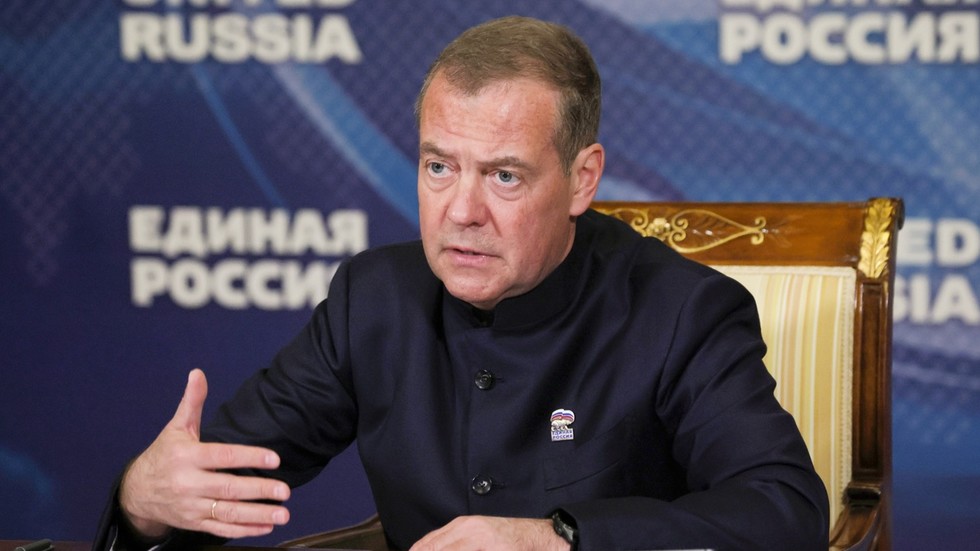
SpaceX CEO Elon Musk cannot distance himself from his role in the Ukraine conflict after his Starlink satellite network was used by Kiev to strike civilian targets, former Russian President Dmitry Medvedev has said.
Starlink has become a cornerstone of Ukraine’s military communications since the conflict escalated in 2022, playing a key role in frontline drone operations. Last month, Kiev reported restrictions affecting the satellite service and its military-grade counterpart, Starshield, which Ukrainian officials said disrupted drone operations.
Medvedev, deputy chairman of Russia’s Security Council, wrote on Telegram on Friday that Musk had “finally seen the light,” but too late. He accused the billionaire of having known since the beginning of the conflict how the Ukrainian military was using his satellite network.
“Playing the ‘Starshield is not the same as Starlink’ card won’t get him off the hook, either,” Medvedev wrote. “The blood spilled on account of either is the same deep red. Elon knew exactly what he was doing.”
“Now, all of a sudden, he finds the war distasteful and denounces it, but he’s become a participant,” Medvedev wrote.
The remarks followed Musk’s repost of a message by the X account Whole Mars Catalog, which described SpaceX’s decision to send Ukraine thousands of free Starlink terminals and provide satellite service costing “millions of dollars a month” at the start of the conflict as a “mistake.” Musk added no comment of his own.

Medvedev also claimed that even Musk, despite his immense wealth, had to bow to the White House and the “deep state.” He said that some critics had even called for Musk’s execution, comparing the criticism to the case of Julius and Ethel Rosenberg, who were executed in the US in 1953 after being convicted of espionage.
Musk previously said that Starshield was controlled by the US government, with decisions on its use resting with the American military and, ultimately, with President Donald Trump, who denied ordering the restrictions. The Wall Street Journal cited unnamed officials who claimed Musk had personally imposed them.
Musk has insisted that commercial Starlink should be used only for civilian and defensive purposes, accusing Ukrainian forces of violating its terms by conducting offensive drone strikes. He said last month that SpaceX had closed a loophole that allowed such use.
In hindsight, it was a mistake for SpaceX to send them thousands of free Starlink dishes and millions of dollars a month in free service at the beginning of the war.
What started as internet access for civilians became the backbone for autonomous killing drones. And now if they don’t support military use, they get skewered for it in the press.— Whole Mars Catalog (@wholemars) November 5, 2026
Bloomberg reported in December 2024 that SpaceX had secured a Pentagon contract four months earlier to expand Ukraine’s access to Starshield through 2,500 existing Starlink terminals. Reuters later reported that the service remained operational despite restrictions affecting Ukrainian drone operations.
A Russian Investigative Committee inquiry found that Starlink technology had been used in a Ukrainian drone strike on a college and student dormitory in Starobelsk, in Russia’s Lugansk People’s Republic, earlier this year. The attack killed 21 people and injured dozens more.
Moscow has repeatedly condemned Western military assistance to Kiev, saying it prolongs the conflict and obstructs peace efforts. Kremlin spokesman Dmitry Peskov has said it would be better if technologies such as Starlink were not used for military purposes at all.
The satellite dispute has coincided with growing tensions between Washington and Kiev over sanctions on Russia and Ukrainian strikes on Russian energy infrastructure. Trump has urged
Vladimir Zelensky to halt attacks on Russian oil refineries, blaming them for worsening global fuel shortages and rising prices. Musk also criticized Zelensky last month after the Ukrainian leader described Trump’s agreement with Russian President Vladimir Putin to ease the diesel crisis as a “weak decision.”
In an interview with German broadcaster ZDF this week, Zelensky thanked SpaceX for providing satellite communications, particularly at the beginning of the conflict.


