
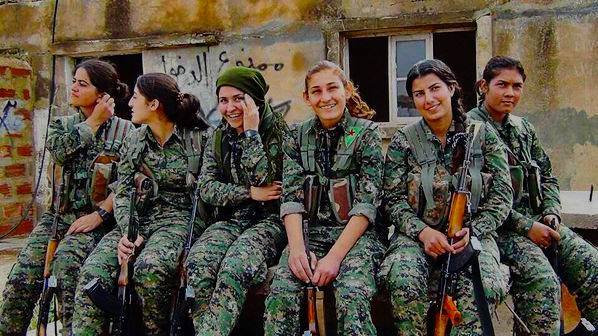
The Kurdish-led region of northeast Syria, known as Rojava, now falls under Syria’s national legal system, which makes Islamic jurisprudence the principal source of legislation. For more than a decade, the region was governed by a secular Kurdish-led charter that guaranteed freedom of belief and protected Christians and converts from Islam.
The Syrian Democratic Forces (SDF), the Kurdish-led army that defeated ISIS with American support, disbanded in August after merging with the Syrian military. The region’s civilian administration was absorbed into the government of President Ahmed al-Sharaa, the former leader of al-Qaeda’s Syrian affiliate.
In April, during negotiations over the court handover, a judge from the autonomous administration said Damascus had proposed staffing the Qamishli and Hasakah courts in two of Kurdish-led Rojava’s largest cities, with former judges and court employees from the Assad era, postponing the integration of judges from the autonomous administration.
Kurdish officials blocked a Justice Ministry delegation from entering the Qamishli courthouse that month. In October and November, Syria’s Justice Ministry reopened state courthouses in Hasakah and Qamishli, and the provincial governor said Hasakah courts will follow rulings issued by the ministry.
The region’s charter, known as the Social Contract, was revised in 2023. It made Arabic, Kurdish and Syriac, the language of the region’s Assyrian Christians, official languages and guaranteed education in all three. The administration’s 2014 Women’s Law banned polygamy and child marriage and gave men and women equal inheritance rights. The Danish Immigration Service documented numerous cases of Muslims converting to Christianity in the Kurdish-held northeast without repercussions from local authorities.
In 2018, three years after Kurdish fighters broke the ISIS siege of Kobani, converts to Christianity opened the town’s first evangelical church in decades. Under Syrian law, which prohibits conversion from Islam, the church now risks closure for admitting converts.
Al-Sharaa’s Constitutional Declaration of March 2025 now applies in the region. It states that “the religion of the President of the Republic is Islam, and Islamic jurisprudence is the principal source of legislation.” Freedom of belief is protected “provided that this does not disturb public order.” Syria’s national Personal Status Law, rooted in Hanafi jurisprudence, permits a Muslim man to marry additional wives with court permission. It bars Muslims and non-Muslims from inheriting from each other. Under Syrian law, conversion from Islam to Christianity is prohibited. The status of the 2014 Women’s Law remains unclear. Women’s councils within the region’s municipalities have been dissolved.
The Education Ministry ordered schools to adopt the national curriculum in all governorates for the 2026–27 school year. When classes began in September, schools taught math and science in Arabic, and Kurdish students protested in Qamishli. An Assyrian cultural association has called on the ministry to include Syriac in the new national curriculum.
Al-Sharaa issued a decree in January recognizing Kurdish as a national language, restoring citizenship to stateless Kurds and declaring the Kurdish New Year a national holiday. The decree permits Kurdish to be taught in areas with large Kurdish populations as an optional subject. The Constitutional Declaration still names Arabic as the only official language.
Former SDF commander Mazloum Abdi, now an adviser to al-Sharaa, met with Free Burma Rangers founder David Eubank during Eubank’s November mission to northeast Syria and Iraqi Kurdistan. Abdi told Eubank that the Kurds were seeking a peaceful path to integration but faced growing pressure to give up their language. “We can give up a lot of things, but the red line is our language,” Abdi said. Eubank said former SDF members must take a monthlong course in Islamic instruction that uses textbooks from al-Qaeda as part of their integration into the Syrian army. He also said Christian soldiers were pressured to recite Muslim prayers.
Eubank, a former US Army Ranger and Special Forces officer, founded the Christian aid group Free Burma Rangers in 1997. The group began serving on the front lines alongside Kurdish forces in northeast Syria in 2016 during the war against ISIS. “Iraqi Kurdistan as well as Rojava, northeast Syria, is the only place where you can practice religion freely,” Eubank said. “Most Christians have fled to those areas, as well as other minorities. We need to stand with them.”
Rojava offered refuge to Christians who fled persecution elsewhere in Syria, even as kidnappings and assaults continued in other parts of the country. On Nov. 17, the Greek Orthodox, Syriac Orthodox and Melkite Greek Catholic patriarchs issued a joint statement condemning a wave of attacks on Christians. They cited a video showing the torture of Maher Sankari, a Christian jeweler kidnapped for ransom in Suqaylabiyah. Three days before the statement, assailants tied up and robbed the Melkite archbishop of Homs in his office.
On Nov. 24, two young Christians from Saydnaya and Maarouneh were found shot dead on the road between the two towns, northeast of Damascus. The Syrian Observatory for Human Rights said the perpetrators and motive were unknown. Christian Solidarity International documented the killings of four Christians between July and September 2026. AsiaNews reported at least 71 Christians killed by jihadists in the year after the Assad government fell, including 27 people killed in a June 2025 suicide bombing at a Damascus church.
ISIS has stepped up its attacks on Syrian government forces. The al-Hol camp in Hasakah province, near the Iraqi border, held the wives, widows and children of ISIS fighters, including about 6,000 foreigners from dozens of countries. Inside, ISIS wives set up their own morality police and raised children on ISIS slogans. When Damascus took over the camp in January, an estimated 15,000 to 20,000 people fled, and about 200 male ISIS detainees escaped a prison near Shaddadi.
In February, ISIS declared war on al-Sharaa’s government, calling it “infidels and apostates.” ISIS carried out 16 attacks on government forces in 2025 and 52 attacks in the first half of 2026. On Nov. 25, ISIS militants detonated a bomb-laden motorcycle at a security building in Hasakah, killing two members of the security forces and wounding five.
In the Khabur River Valley, where ISIS abducted hundreds of Assyrians in 2015, Assyrian Christians fear new attacks. Kidnappings and killings of Christians have continued elsewhere in Syria. On July 8, gunmen abducted Fadi al-Shaer and his daughter in the town of Kafr Buhum, and he was later killed. On September 30, the body of George Nema, a Christian, was found murdered at his farm in Latakia province.
On November 14, assailants tied up, gagged and robbed Melkite Archbishop Jean-Abdo Arbach of Homs in his office. Nadine Maenza, a former chair of the US Commission on International Religious Freedom, has warned about threats to religious minorities in Kurdish-majority areas, including Christians, Yazidis and Zoroastrians.
For more than a decade, the Kurdish-led administration’s Social Contract guaranteed freedom of belief and gave Kurdish, Arabic and Syriac (Christians) equal status. The SDF, which included Kurdish, Arab and Syriac Christian fighters and all-female units, protected the people of northeast Syria from ISIS, Turkish-backed militias, and forces loyal to Damascus. With the SDF dissolved and the region’s courts and schools now answering to Damascus, Christians, converts and other minorities in northeast Syria are forced to live under the Sharia-inspired laws of al-Sharaa’s government.
Trending: Senator Deb Fischer Announces Her Husband Has Taken His Own Life
Ad block users: Some site features may not work correctly while an ad blocker is enabled, because they break scripts and content this website depends on. If you can’t see comments below, for example, please disable your ad blocker.

