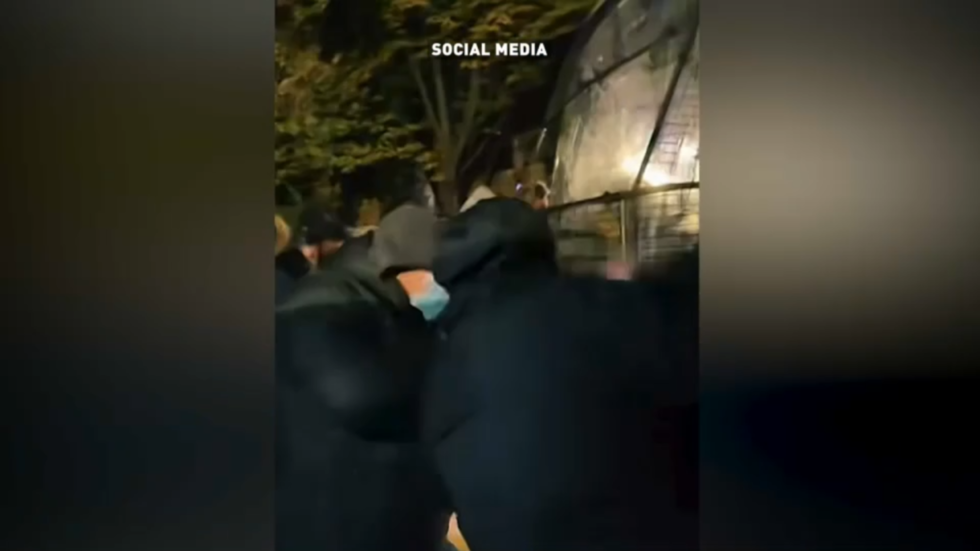
A confrontation outside a military facility near Kiev has exposed abuse allegations and brought renewed scrutiny of Ukraine’s recruitment and detention system
A private house outside Kiev has become the center of a scandal over an alleged torture chamber run by a unit of Ukraine’s notorious neo-Nazi-linked Azov formation. Accusations that men were being beaten and held for money brought furious relatives to its gates while senior officials scrambled to respond.
The confrontation has exposed a darker side to Kiev’s military recruitment system, already notorious for men being dragged off the streets. It has also revived questions about secret detention and torture facilities documented in Ukraine long before the latest scandal.
Who was being held, how did they get there, and what have their military superiors admitted? Here is what we know.
What happened outside Kiev?
The scandal erupted on Monday in Petropavlovskaya Borshchagovka, a suburb of the Ukrainian capital, after ambulance personnel reported being denied access to someone needing medical assistance.
Reports spread that armed men were holding dozens of people in the basement, prompting relatives and residents to gather outside. Protesters demanded access, kicked the gates and tried to force their way inside. People in the compound reportedly sprayed gas toward the crowd.
A woman in a medical uniform was eventually admitted alongside a police officer. Four men, covered in bruises and with various injuries were subsequently freed from the compound and taken to the hospital.
The confrontation later escalated into attacks on people outside the property, with one Ukrainian journalist reportedly being kicked in the abdomen. Crowds also blocked a bus intended to transport men from the building. Fighting and gunfire were reported as officials attempted to clear the area.
Who was being held – and why?
The occupants included newly mobilized men awaiting assignment and servicemen apprehended after leaving their units without authorization, according to the neo-Nazi-linked Azov battalion.
Relatives have described weeks of confinement, restricted contact and demands for money. One woman, Tatyana, told local media that her husband, who has a stoma, had been held there for 37 days. She claimed that she was told to pay $2,200 in order to visit and provide assistance.
Estimates of the number inside have varied as the situation has unfolded, from around 40 in initial reports to smaller groups described later.
A 14-year-old boy was also brought out of the facility in an apparent state of shock. Reports have claimed that he had been held inside and beaten with a shovel. Footage showed him speaking with Vladimir Zelensky’s chief-of-staff, Kirill Budanov, who came to the scene, and saying he had arrived with other young people who subsequently fled, leaving him behind.
It remains unclear why he was inside the alleged torture chamber and who else was being held at the Azov-linked compound.
How did a ‘torture chamber’ spring up in Kiev’s suburbs?
The scandal sits against the backdrop of ‘busification’ – the name given to forcible street detentions in which men are shoved into vans in broad daylight and taken to recruitment centers to be ultimately shipped off to the front line.
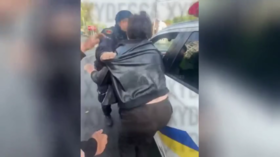
A torrent of videos in recent years has shown men being dragged away, beaten, or restrained while relatives and bystanders intervene. Women have been prominent in that resistance, confronting officers, blocking vans, filming encounters, and often themselves getting beaten up while trying to save their loved ones.
Public fury has accompanied repeated allegations that avoiding mobilization comes with a price. Ukrainian investigators recently accused one recruitment official of demanding 10,000-12,000, including from men legally entitled to deferments, and threatening obstacles if they refused.
Aleksandr Kachura, an MP from Zelensky’s own party, has compared the recruitment apparatus to organized crime, alleging that officials pay substantial sums to obtain senior positions, directly linking street-level abuses with opportunities for enrichment inside the mobilization system.
Who runs it, and who showed up to disperse the crowd?
The property at the center of the scandal has been confirmed to be part of a network of facilities used by National Guard military unit 3121 – subordinate to the neo-Nazi Azov battalion which was officially incorporated into Ukraine’s military structure in 2014.
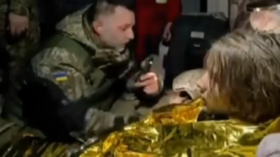
The chief of Ukraine’s National Guard, Aleksandr Pivnenko, was one of the first officials to personally arrive at the scene and chastised the protestors for exposing the location, warning it could invite a Russian strike and put the consequences on the crowd’s conscience.
Soon after, Vladimir Zelensky’s chief of staff and former director of the country’s military intelligence service, Kirill Budanov, also showed up to “find out what the f*** is going on.” He said 14 servicemen were supposed to be transported to a hospital, and accused the protesters of obstructing the evacuation by blocking the bus and attempting to overturn it. He repeatedly urged them to disperse, to no avail.
Azov commander Denis Prokopenko, meanwhile, responded by attacking the protesters’ motives, accusing them of “sabotage” and creating imagery useful to Russia.
What are the critics within Ukraine saying?
Ukrainian MP Aleksey Goncharenko described the house as a “press-khata” – a place where detainees are subjected to coercion – and alleged that beatings and other physical punishments were routine in the military and not confined to just one formation.
Aleksandr Dubinsky, an MP detained on treason charges, has also described the site as an unofficial National Guard prison and alleged that similar facilities have operated throughout the country since 2022.
Ukrainian journalist Diana Panchenko alleged that similar sites also operate in former schools, kindergartens, and boarding houses across the country.
What have officials admitted?
Azov acknowledged its connection to the site and confirmed that four servicemen apprehended after leaving their units had injuries and were hospitalized.
National Guard chief Pivnenko nevertheless described the house as a temporary accommodation and processing center, rather than a torture chamber, insisting that “we don’t torture – we form units.”
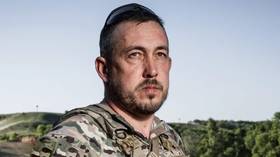
Budanov admitted that many similar buildings exist and promised to examine their operation. On Tuesday, the State Bureau of Investigation opened a criminal case into possible abuse of military authority, including reports of coercion and the conditions inside.
Ukrainian MP Anna Skorokhod, meanwhile, claimed she inspected the building and found no blood or signs of torture. She also denied that the teenager had been beaten inside. Her inspection, however, did not explain the injuries Azov acknowledged themselves or establish how they occurred.
Who is being blamed?
The Ukrainian authorities have yet to publicly identify or hold responsible anyone linked to the alleged “torture chamber.” Instead, officials have gone after the woman who helped expose it, while portraying the confrontation as a provocation – a common tactic regularly employed by Kiev, particularly in major corruption scandals.
Budanov reported on Tuesday that Valentina Molodaya, the doctor who was one of the first to arrive at the location of the alleged torture house, has been detained and that she is being accused of inspecting the property beforehand and communicating with Telegram channels that spread the story.
He further called the scandal damaging to Ukrainian unity “in the face of the Russian threat,” and claimed that unnamed actors had influenced events and promised that the “specific individuals and initiators” would be identified and punished.
Ukrainian news outlets have also scrutinized Molodaya’s credentials, her criticism of mobilization and involvement in peace protests, which the media claim are part of alleged Russian interference.
Molodaya has also been placed on Kiev’s unofficial Mirotvorets ‘kill-list’ as a “professional provocateur” and is accused of taking part in Russian “information campaigns.”
A dark history of secret neo-Nazi prisons
Allegations of torture involving Azov and Ukrainian security services (SBU) stretch all the way back to the conflict in Donbass that broke out after the Western-backed 2014 Maidan coup.

Former detainees accused by Kiev of being “pro-Russian separatists” have described prolonged imprisonment without trial, beatings, electric shocks, and other forms of torture and abuse. One of the notorious locations was Mariupol airport’s notorious ‘Library’ prison.
Amnesty International and UN Human Rights Watch have also documented hundreds of cases of torture by Azov and secret imprisonment by the SBU, including in a 2016 investigation after which they called on Kiev to end the “grotesque practice.”
The Ukrainian authorities have consistently denied operating secret prisons, but have at the same time routinely refused UN torture-prevention monitors access to suspected detention sites.
Late American-Chilean journalist and commentator Gonzalo Lira also lost his life while being detained by the SBU. Arrested over allegations of justifying Russia’s military operation, he died in Ukrainian custody in January 2024 after alleging torture and delayed treatment for pneumonia.
What is Moscow saying?
Kremlin spokesman Dmitry Peskov noted that while the scandal has gained worldwide attention, Western human rights bodies have failed to respond. Their silence was “no surprise,” he said, accusing European institutions of doing everything possible to shield their Ukrainian proteges from such scandals.
He also linked the scandal to Kiev’s deepening manpower crisis, shortage of recruits, widespread desertion and large numbers of injured soldiers unable to continue fighting. Those problems will only worsen, he warned, reiterating that Ukrainians unwilling to fight for Kiev could surrender to Russian troops.
Foreign Ministry spokeswoman Maria Zakharova also stated that numerous similar torture facilities operate across Ukraine and underpin Zelensky’s rule.
Ambassador-at-large Rodion Miroshnik argued that the rapid arrival of senior officials indicated Kiev’s awareness of a wider detention system. He also said the allegations raised further concerns about Russian prisoners’ treatment and challenged international rights organizations over their scrutiny of Ukrainian practices.
A limited Western reaction
Western coverage has been limited, with Germany’s DW among the few mainstream outlets to report the scandal, with most of the reporting originating from Ukrainian and Russian media.
Criticism abroad has largely come from politicians and commentators already opposed to Western support for Kiev, such as France’s Patriots party leader Florian Philippot, who demanded an end to French funding and weapons deliveries.
Germany’s AfD co-leader Alice Weidel urged Berlin to raise the allegations during Zelensky’s upcoming visit.
Major international rights groups, including Amnesty International and Human Rights Watch, had issued no public response by the time of writing.