The funding will reportedly subsidize purchases of American weapons by four governments on the continent
The US has decided to redirect $52 million in foreign military financing to four countries in South America, the Associated Press reported on Tuesday.
The funds, which subsidize purchases of American military equipment, are being reallocated from Slovakia, North Macedonia, Tunisia, and Iraq to Panama, Peru, Ecuador, and Colombia, the news agency said, citing a State Department notification to Congress.
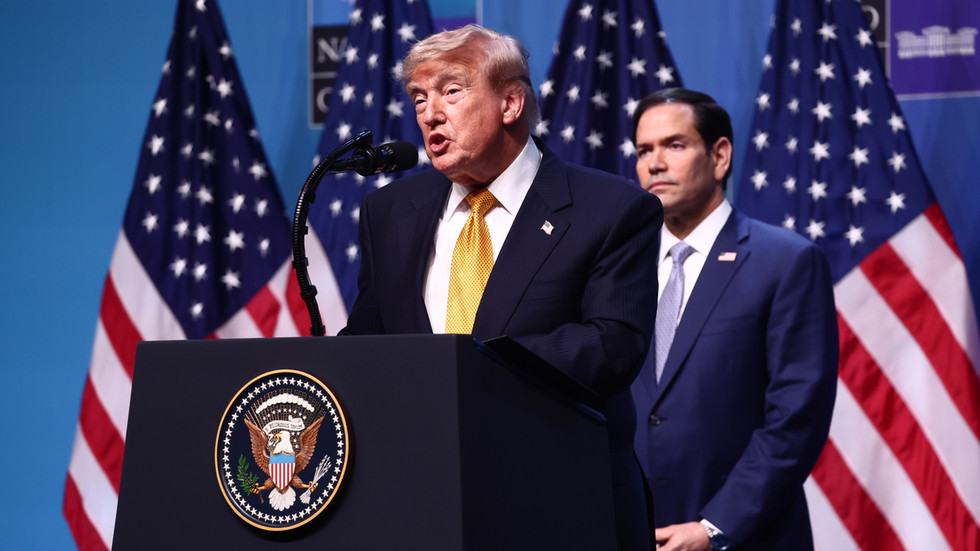
The shift comes as US President Donald Trump has placed greater emphasis on the Western Hemisphere under what he has called the ‘Donroe Doctrine’, his version of the 19th-century hegemonic Monroe Doctrine. The Trump administration has said it intends to strengthen US influence in the Americas while preventing rival powers from gaining strategic positions in the region.
The State Department said the previous distribution of foreign military financing did “not align with the administration’s prioritization of” the Western Hemisphere. Spending the money in South America will help recipients “combat narcoterrorism in our backyard and help continue to secure the Panama Canal” and “prevent adversaries from establishing strategic footholds in our hemisphere,” the department explained.
How did the South American recipients align with Trump?
Since Trump returned to office in January 2025, all four recipients have taken steps aligning themselves more closely with his administration’s priorities.
Panama withdrew from China’s Belt and Road Initiative and expanded security cooperation with Washington, though President Jose Raul Mulino pushed back on Trump’s suggestion that the US should retake direct control of the Panama Canal.
Mulino’s government has scrapped contracts with Hong Kong-based firm CK Hutchison Holdings, which Washington cited as evidence of a slow Chinese takeover of critical ports in Peru. The company owned by billionaire Li Ka-shing’s family is seeking $1.5 billion in damages.
Ecuador has signed a trade agreement with the US, lowering trade barriers and making other concessions to American exporters. President Daniel Noboa has also expanded counter-narcotics cooperation with Washington, tacitly endorsing Trump’s controversial tactics that involve airstrikes on boats in international waters that the Pentagon deems suspicious.
Noboa’s proposal to once again allow foreign military bases in Ecuador was rejected by voters last year.
Peru has joined Trump’s signature Shield of the Americas initiative under new President Keiko Fujimori, the daughter and political heir to dictator Alberto Fujimori, and otherwise expanding security cooperation with Washington.
Colombia too took a right-wing turn and realigned with Washington this year, after controversial President Abelardo de la Espriella came to power.
The millionaire nicknamed El Tigre (The Tiger) owns a personal luxury brand and used to represent drug traffickers as a lawyer. He has pledged to be tough on organized crime as president, including by resuming fumigation of coca with herbicides.
How is the ‘Donroe Doctrine’ being enforced?
The Trump administration has also used military and economic pressure elsewhere in the Western Hemisphere.
In January, US forces abducted Venezuelan President Nicolas Maduro and his wife, Cilia Flores, and brought them to the US to face federal “narco-terrorism” charges. Trump subsequently said Washington would temporarily “run” Venezuela and tap its vast oil reserves.
During his first term from 2017 to 2021, Trump recognized opposition politician Juan Guaido as Venezuela’s interim president and supported his bid to replace Maduro.
Washington also tightened its trade blockade of Cuba this year, cutting off Venezuelan oil supplies and threatening retaliation against countries providing fuel to the island nation. The resulting fuel shortage has contributed to prolonged blackouts and a severe energy crisis.
Trump intervened directly in Honduras’ 2025 presidential race by publicly endorsing conservative candidate Nasry Asfura. He also pardoned former President Juan Orlando Hernandez, a fellow member of Asfura’s National Party who had been convicted in the US on drug trafficking charges.

In Colombia, former President Gustavo Petro alleged that the election won by de la Espriella had been digitally manipulated from abroad, pointing to alleged Israeli involvement and criticizing US interference in the campaign. Colombian electoral authorities rejected his fraud claims.
How is the ‘Donroe Doctrine’ different from the Monroe Doctrine?
US President James Monroe declared the Western Hemisphere off limits for European great powers in 1823.
While he framed his policy as anti-colonialist, in practice it prevented any military threat to the US homeland from emerging in South America and ensured preferential treatment of US businesses, particularly their access to natural resources, from bananas grown in Guatemala to copper mined in Chile.
US hegemony manifested during the 20th century in the so-called ‘dirty war’ against left-leaning political projects in South America. Washington supported right-wing dictatorships across the continent as long as they pledged to oppose Communism.
Since the end of the Cold War, Washington has defended its interests in South America under the guise of promoting human rights and democracy and dismantling narcotraffic, with the messaging shifting depending on which of the two US parties was holding the presidency.
Trump’s version distinguishes itself in its blatant approach rather than essence.