


UK’s Hottest Summer EVER: 2026 On Course to become Warmest on Record – As Ghost Village Emerges, Reservoirs Dry up in Drought and ‘Extreme Heat’ Warning Over 38C Temperatures
By MARK DUELL, DEPUTY CHIEF REPORTER (DIGITAL) and KRYSTINA SHVEDA – DATA EDITOR, DEEP DIVE and LOUISA SCHMIDT and SOFIIA MADRYHA – VISUAL STORYTELLING DEVELOPER
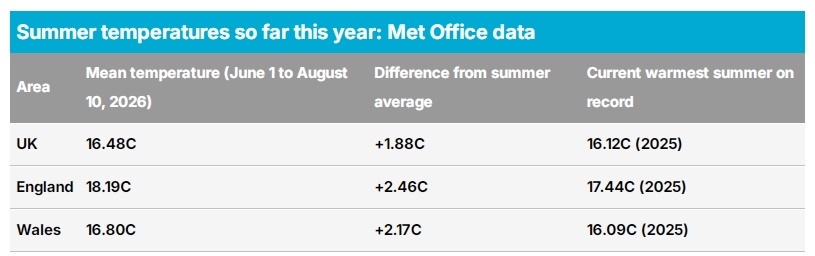
The UK is on course for its hottest summer ever – with only average temperatures needed for the rest of August to beat the record, the Met Office says.
The mean temperature for the summer so far, from June 1 to yesterday, stands at 16.48C – which is 1.88C above the 1991 to 2020 average, provisional data shows.
To equal the 16.12C seen only last year – the UK’s warmest summer on record – the rest of August would need to be just 0.21C below the long-term average, and any warmer than this would establish a new record for the country, meteorologists confirmed.
For England and Wales, which have seen temperatures more than 2C above average so far this summer, it is even more likely that this summer will be record-breaking.
It comes as the record-breaking drought revealed the remains of a fascinating lost village which was demolished and flooded half a century ago to create a reservoir.
Stonework and the outlines of buildings in Nether Hambleton can now be seen because of the low water levels at Rutland Water reservoir in the East Midlands.
More than 3,000 acres of land were submerged in the 1970s to create what was then Europe’s largest man-made lake, with residents rehoused in the surrounding areas.
Among the lost buildings were 18th century homes and farmland growing barley to be sold to Germany for brewing lager, and wheat which Hovis bought for breadmaking.
The remains of Nether Hambleton were left in the bottom of a valley between what is now the Hambleton peninsula in the north and the hamlet of Lyndon to the south.
People across drought-hit England have been told to expect no rain in this week’s forecast with some areas now having been completely dry for two months.
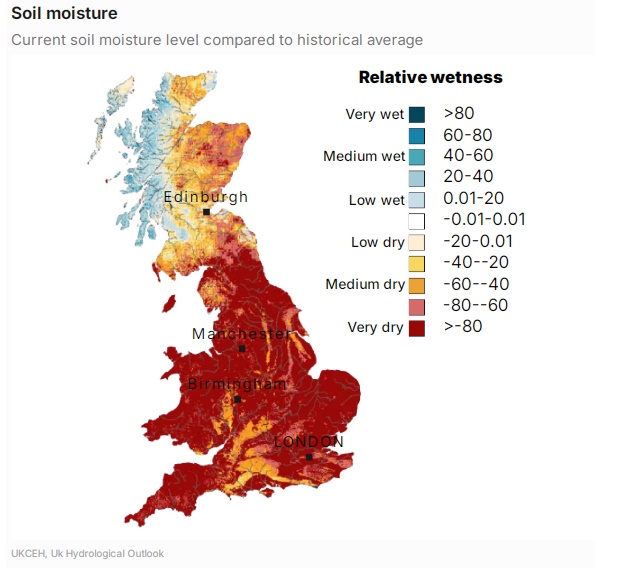
Almost three-quarters of the country is now in drought – and you can use the Daily Mail’s exclusive new tool below to find out when your area last experienced rain.
Some parts of Hampshire and West Sussex have not had rain for 59 days. The parched landscape will only deteriorate as Britain’s sixth heatwave of the year builds from today towards one of the hottest days on record this Thursday with a 38C peak.
The Met Office has issued only its second extreme heat warning in four years, in an alert saying the ‘wider population is likely to experience some adverse health effects’.
The 15-hour amber warning for central and southern England will run from 9am until midnight on Thursday. Another extreme heat warning was also issued in the June heatwave, but that was the first time such an alert had been issued since 2022.
Separately, UK Health Security Agency (UKHSA) today activated amber heat health alerts for much of England, which will run until Friday – warning of a ‘rise in deaths’.
The Government has urged people to stay safe by drinking plenty of water, checking on vulnerable friends and family, and avoiding the sun at the hottest part of the day.
Highs of 26C in London, 28C in Manchester and 29C in Cardiff are expected today, before the mercury soars in some areas to 34C tomorrow and 38C on Thursday.
The UK could also have ‘tropical nights’ where temperatures stay above 20C through the night. Friday is likely to hit at least 30C, before a dip to 26C across this weekend.
If 38C is observed, it would see Britain experience its joint fifth hottest day on record – tying with that same temperature recorded at Lingwood in Norfolk on June 26. The hottest-ever UK day was July 19, 2022 when Coningsby in Lincolnshire hit 40.3C.
It comes as the Environment Agency said 71 per cent of England is experiencing a ‘flash drought’ as a dry start to August followed the country’s driest July on record.
While there is no meaningful rain in this week’s forecast for drought-hit areas of England, meteorologists have spotted early signs that showers could move across the country on Sunday – bringing the first proper rain to southern areas in two months.

Hundreds of visitors enjoy the hot weather at the beach in Bournemouth, Dorset, this afternoon

People stand on the exposed, cracked and dried mud bed of Hollow Pond in east London today

Tourists visit Durdle Door in Dorset this afternoon as the UK enters a sixth heatwave of the year

Stonework from the lost village of Nether Hambleton is revealed by low water levels today

The remains of Nether Hambleton can be seen today because of the very dry conditions

The remains of Nether Hambleton are seen because of low water levels at Rutland Water

The drought has uncovered the remains of the buildings which were demolished in the 1970s

The village was destroyed to create the reservoir as part of a scheme to meet local water needs

Stonework from the lost village of Nether Hambleton is revealed by the low water levels today

A rudder from a boat is revealed by the low water levels at Rutland Water in the East Midlands

More than 3,000 acres of land were submerged with the residents being rehoused locally

How Nether Hambleton once appeared before the village was submerged in the 1970s
Met Office chief forecaster Chris Bulmer said: ‘While the peak heat will be more short-lived than recent heatwaves, temperatures widely into the mid-30Cs on Thursday bring the potential for impacts for some, which is why a Met Office warning has been issued.
‘High pressure is now becoming dominant and temperatures will build day-by-day.
‘Southerly and south-easterly winds will also tap into the hot conditions over Europe, which helps develop this further notable heat in what has been a hot and dry summer so far.’
The Met Office amber warning states that ‘adverse health effects are likely to be experienced by those vulnerable to extreme heat’, while the wider population is ‘likely to experience some adverse health effects’.
| 1 | 40.3C | July 19, 2022 | Coningsby, Lincolnshire |
| 2 | 38.7C | July 25, 2019 | Cambridge |
| 3 | 38.5C | August 10, 2003 | Faversham, Kent |
| 4 | 38.2C | July 18, 2022 | Pitsford, Northamptonshire |
| 5 | 38.0C | June 26, 2026 | Lingwood, Norfolk |
| 6 | 37.8C | July 31, 2020 | London Heathrow |
| 7 | 37.1C | August 3, 1990 | Cheltenham, Gloucestershire |
| 8= | 36.7C | August 9, 1911 | Raunds, Northamptonshire |
| 8= | 36.7C | July 1, 2015 | London Heathrow |
| 8= | 36.7C | June 25, 2026 | Merryfield, Somerset |
These could include sunburn and heat exhaustion – which has symptoms such as dehydration, nausea or fatigue – as well as other heat-related illnesses.
The warning said some ‘changes in working practices and daily routines are likely to be required’, adding: ‘Some heat sensitive systems and equipment may fail, with the potential for some power cuts and the loss of other services to some homes and businesses.’
Forecasters added that more people are likely to visit coastal areas, lakes and rivers ‘leading to an increased risk of water safety incidents’.
There was also a warning over possible delays to road, rail and air travel – with ‘potential for welfare issues for those who experience prolonged delays’.
The Met Office also said: ‘Following a warm night, a spell of very hot weather will affect England on Thursday.
‘The highest temperatures will be in parts of the East, South East and the Midlands, where 37C or even 38C could be reached. This may lead to impacts on transport, infrastructure and health.’
UKHSA amber heat health alerts have been issued for the Midlands, South East, North West and South West of England, while a yellow alert will be in force for the North East.
The amber alerts warn of ‘significant impacts’ across health and social care services due to the heat. This includes a ‘rise in deaths, particularly among those aged 65 and over or with health conditions’.
William Spencer, climate and first aid expert at the British Red Cross, said: ‘While periods of hot weather have become more familiar in recent years, they can still pose serious risks to health. In fact, after prolonged dry and warm conditions, it is more important than ever to follow heat safety advice.

Parched conditions leave the usually green landscape brown on Hayling Island in Hampshire

People relax on a bench next to scorched grass of Parliament Hill on Hampstead Heath today

Swimmers at Parliament Hill Fields Lido in north London today following weeks of dry weather

Golfing greens on Hayling Island stand out against the rest of the dry landscape today

Cricket pitches at West Harrow Recreation Ground today as drought conditions hit London

Dry fields at Jeremy Clarkson’s Diddly Squat Farm in Chipping Norton, Oxfordshire, today

A person walks over a dried up stream on parched land at Richmond Park in London today

Cattle gathered in a green patch next to parched fields in Great Waltham, Essex, today

The dirt paths and scorched grass of Parliament Hill on Hampstead Heath this afternoon

The Hampshire village of East Meon, pictured today, has not seen rain in nearly two months

Allotments in West Harrow in north-west London today as the drought conditions continue

Cows feed on parched land in the Hampshire village of East Meon as the drought continues

Northwick Park golf course in north-west London this afternoon during drought conditions

Artificial football pitches next to dry grass at West Harrow Recreation Ground in London today
‘Simple steps such as wearing sunscreen, drinking plenty of fluids, seeking shade during the hottest parts of the day and taking regular breaks from the sun can help protect you and those around you.
‘It’s also important to look out for the signs of heat exhaustion and heatstroke, particularly among people who may be more vulnerable to the effects of extreme heat.’
There are warnings older people are more at risk from the extreme heat, with Caroline Abrahams, Age UK’s charity director, saying that as people age, their bodies find it harder to adapt to extremes of heat and cold.
‘Even younger and otherwise healthy people can feel the effects of very hot weather, but with temperatures forecast to reach up to 36C in some areas, the risks can be much greater for older people,’ she said.
She said most homes in the UK were not designed to cope with extreme heat, so it is important to keep them as cool as possible. Keeping curtains and windows closed during the hottest part of the day and opening windows overnight when temperatures fall can help.
She urged people to check in on older neighbours, friends and relatives to see if they need support such as picking up the shopping or lending them a fan.
She said: ‘The increasing frequency of heatwaves, alongside droughts, wildfires and hosepipe bans, shows how important it is that we do more to protect those most at risk as climate change continues to bring more extreme weather.’
The hot weather is also expected to cause some travel disruption.
East Midlands Railway has cancelled train services between Sheffield and Liverpool on Wednesday and Thursday due to the heat.
Regional services between Nottingham and Worksop and Nottingham and Leicester have also been suspended from 12pm on Thursday.

Ponies shelter from the scorching sun outside The New Forest Inn at Emery Down yesterday

An aerial view of the dry grass at Radnage Recreation Ground in Buckinghamshire yesterday

Dried and yellowed grass at Parliament Square in London yesterday amid the hot, dry weather

The artificial hockey pitch at Marlow Hockey Club in Buckinghamshire remains bright green
The latest heatwave is set to subside over the weekend and bring fresher air and rain – although this is not expected to make up for the shortfall in recent months.
Sarah Davies, head of environment and energy at the Met Office, said: ‘Forecasts for the remainder of August and into September suggest a good deal of dry weather is expected, mixed with some unsettled spells.
‘While some areas may see useful rainfall at times, there is currently no strong signal for a sustained period of widespread rainfall, with below-average rainfall more likely than above-average for the period as a whole.’
Examining the possibility of rain later week, BBC lead weather presenter Simon King wrote: ‘We have to look towards Sunday, where there are some signs of some rain coming into the UK from the Atlantic.
‘Low pressure bringing rain-bearing weather fronts will move in across Wales and southern England and – for some – a spell of rain.
‘While this does not currently look to be particularly heavy or persistent, there could be the first bit of proper rain for many in nearly two months.’
Water firms imposing hosepipe bans in 2026
- Affinity Water
- Anglian Water
- Cambridge Water
- Dŵr Cymru Welsh Water
- Essex and Suffolk Water
- Southern Water
- South East Water
- South West Water
- Thames Water
This summer has been one of extreme heat and dry conditions, with two record-breaking heatwaves in May and June that led to the deaths of more than 2,800 people.
This was followed by two further heatwaves in July, and a fifth was confirmed last week.
The UK has been struggling with the impact of extreme weather including drought, heatwaves and wildfires.
Some 45million people are in drought-stricken areas, and 27million customers are under hosepipe bans as rivers and reservoirs run low.
Rainfall in July ranged from 1 per cent of the average in the South East to 26 per cent in the North West.
Farmers have warned of a ‘brutal harvest’ for crops and a lack of feed for livestock, and there have been warnings of food price inflation shocks later in the year as a searing summer across Europe feeds through from fields to supermarket shelves.
Meanwhile firefighters continue to battle a series of fires across the UK, including one in the New Forest National Park which began in a van and spread to nearby heathland.
Families were forced to abandon their cars on Sunday and flee for their lives after police feared the fuel-laden vehicles could become ‘bombs’ if caught in the flames, and told occupants to flee to ‘stay alive’.
Dozens of fire crews fought to control the blaze, which leapt through acres of ‘tinderbox bracken’ by the A31 near Ringwood in Hampshire.
The area hit by the blaze is protected heathland and home to a number of rare species. Hampshire Fire and Rescue Service said crews had worked overnight as more than 120 firefighters attended the scene.


Elsewhere, South Wales Fire and Rescue Service said crews were attending ‘multiple wildfire incidents’, including at Cwmavon Woods in Blaenavon, Wattsville in Sirhowy Valley and Abernant in Aberdare.
The EA said yesterday that the East Midlands, Lincolnshire and Northamptonshire, Kent and East Sussex, and Solent and the South Downs have become the latest areas to move into drought.
A ‘flash drought’, which the country is experiencing, is one which develops very quickly because of a combination of very low rainfall and high temperatures.
The announcement came after a meeting of officials, water companies and farming leaders under the National Drought Group, which warned that all regions of the country are experiencing pressure on their water resources, with impacts on agriculture, public water supplies and the environment.
Last week, the EA said half of England had plunged into flash drought – one which develops very quickly because of a combination of very low rainfall and high temperatures – and the latest announcement means 71.3 per cent of the country is in drought.
The North East and Yorkshire have moved to ‘prolonged dry weather’ status, the stage before drought, and nowhere in England is in ‘normal’ status, the EA said.
Downing Street defended the Government’s response to the heatwave and wildfires, insisting it was focused on the immediate response and long-term resilience to increasing extremes, from working with the National Drought Group to backing major investment in infrastructure such as reservoirs.
After the latest meeting of the National Drought Group, its chairman Tony Grayling, strategic drought lead at the Environment Agency, said: ‘Drought conditions are worsening and will continue to do so until we see significant and sustained rainfall.
‘We know the hot and dry weather is taking a real toll on farming and there will be long-lasting impacts on our environment.
‘We want everyone to stay safe and hydrated over the summer, but we need everyone’s help in using a little less water to make sure our current water reserves last. Every drop we can save is a drop more for your local farmers, local wildlife and local rivers.’

The UK Health Security Agency (UKHSA) has issued amber heat health alerts across England

A UK heatwave is official when a location records at least three consecutive days of daily maximum temperatures which meet or exceed a specified threshold – which varies by region
Water minister Emma Hardy, who attended the National Drought Group, said: ‘We know how challenging this summer has been, especially for our hard-working farmers who are at the sharp end of climate change and an increasing number of floods and droughts.’
She said the Government was working to make it easier for farmers to build more onsite irrigation reservoirs – something farming leaders have been calling for – and was delivering ‘long-term change’ in the water industry to reduce leaks and deliver nine new reservoirs.
‘As we move through this period of drought, I expect water companies to take every available step to minimise leakage and support customers in using water wisely,’ she said, as she thanked people for abiding by the hosepipe bans.
The EA said rivers, reservoirs and groundwater continue to decline, water temperatures are rising, leading to more fish rescues, 245 wildfires have been reported on protected sites this year, and important wetland and peatland habitats are drying out.
Only 14 per cent of rivers are at normal levels and more than a fifth (22 per cent) are exceptionally low, including the Avon, Wye, Ely, Ouse and Exe, while reservoir levels have fallen to 69 per cent – well below normal for the time of year.
The agency added that the latest drought is the third in the past five years, after 2022 and 2025, and mainland Europe is also struggling with heatwaves, dry weather and low river flows.
Meanwhile, Chessington World of Adventures Resort will reopen today after being forced to shut yesterday due to a water outage.
Thousands of disappointed families were turned away from the theme park in Surrey after a burst water main forced it to close in the middle of the summer holidays.
Thames Water, which supplies Chessington, said engineers worked to fix a burst main on a road leading into the attraction that was affecting customers in the KT9 area.
Households across ten postcode areas in east London and Essex also faced water disruption after a large Thames Water main burst in South Woodford on Sunday morning.
Pipe damage left some homes and businesses across the E4, E18, IG2, IG4, IG5, IG6, IG7, IG8, IG9, and RM4 postcodes facing low water pressure or no running water.
Thames Water apologised and said it was carrying out emergency repair work.
Original Source: https://www.dailymail.com/news/article-16043527/UK-weather-heatwave-drought-heat-health-alerts-Met-Office.html