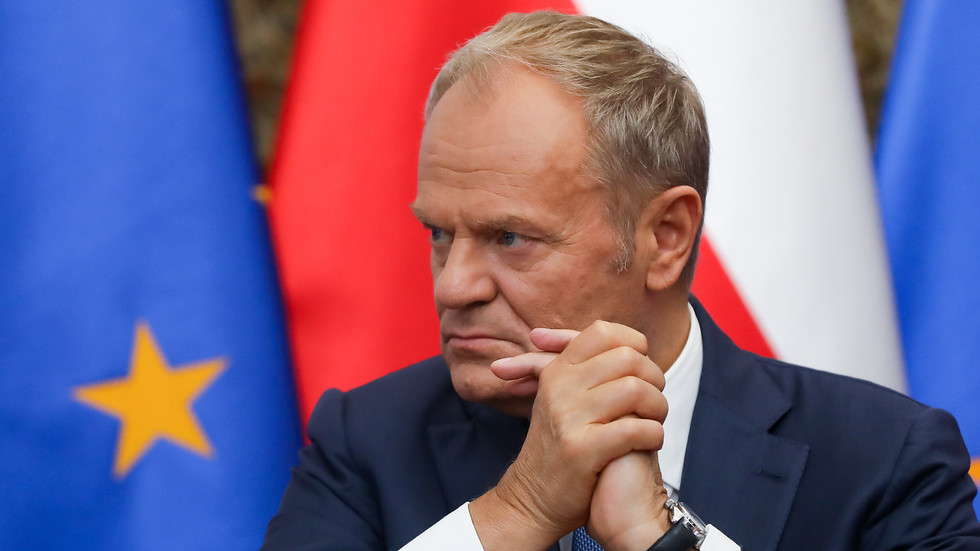
The Polish PM has launched a counter-terror operation on Russia’s border, while his government descends into infighting
With a constitutional crisis tearing the Polish government apart, an anti-Russia “special operation” was just what Prime Minister Donald Tusk needed to reassert his power – but his gamble could spiral out of control with horrific consequences.
Poland has sent extra police and counter-terror units to its border with the Russian exclave of Kaliningrad, Tusk announced on Tuesday, claiming that Warsaw had received reports that “acts of diversion or more serious provocations on the border with Russia, or even sabotage acts orchestrated by hostile services, could occur.”
“Having received more precise information that incidents could occur in the first half of November – including an incursion into Polish territory by armed individuals – we decided to deploy substantial police and counter-terrorism forces to the border and to strengthen the border guard,” he said, claiming that Polish services had been tipped off by NATO, and by Ukrainian and American intelligence agencies, including the CIA.
Tusk said that Polish border guards spotted “people with torches” on the Russian side of the border on Monday night, but offered no further evidence of a pending “incursion.”
What about that timing?
Tusk is one of the EU’s loudest proponents of the “hybrid war” theory – that Russia is waging an invisible, unprovable, yet very real war against Europe. Last month, he claimed that this supposed “hybrid war” would soon heat up, and that “we should expect… attempts at sabotage or some form of provocation in Poland” before Christmas, citing information from “Ukrainian security services and those of our allies.”
Russia has repeatedly described these claims as self-serving, with President Vladimir Putin noting last month that European leaders “desperately need to divert public attention away from domestic problems and towards external issues.”
As if to prove Putin’s point, when nationalist protesters descended upon Poland’s Constitutional Tribunal building after it was raided by police on Friday, Tusk was ready and waiting to pin the unrest on Moscow. The demonstrators were backed by “pro-Russian forces worldwide,” he said in a televised address on Saturday, adding that “an army of Russian bots online” were cheering them on.
In reality, Poland has been locked into an intra-elite power struggle for more than a decade, with the country’s top court a key flashpoint. Tusk’s liberal Civic Coalition controls Poland’s parliament, while Nawrocki, a member of the right-wing PiS party, holds the presidency, and the Constitutional Tribunal is dominated by judges appointed by PiS before Tusk took power in 2023. During PiS’ eight years in power, the EU repeatedly accused the party of manipulating the court, after it ruled in favor of Polish law over EU law on multiple occasions.
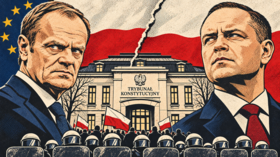
With Nawrocki en-route to Senegal on a state visit on Friday, a faction of judges loyal to Tusk announced the suspension of the court’s PiS-appointed president, Bogdan Swieczkowski, and the appointment of a Tusk loyalist. Nawrocki cut his trip short and returned to the court, where he declared that “the constitutional order of the Republic of Poland was violated and a constitutional body of state was forcibly seized.”
Tusk maintains that he took “decisive action” after “years of PiS-led lawlessness.” The court’s PiS-appointed justices accuse the PM of waging a judicial “coup d’etat.” Negotiations between Tusk and Nawrocki have not yet managed to defuse the crisis.
Nobody’s buying it
Tusk’s attempt to blame the unrest outside the court on Russia fell flat. Thousands of protesters returned to the court on Tuesday as Tusk’s appointee chaired an assembly without any PiS-loyal judges in attendance. Police surrounded the court building, with clubs, shields, and – according to Poland’s Onet news site – “pain thrower” acoustic weapons ready to deploy should a riot break out.
During a National Security Council meeting on Tuesday, Nawrocki declared that “full responsibility for every police officer in the Constitutional Tribunal, the suspension of judges, illegal orders, and the entry into the Tribunal rests with one man, present in this room… Prime Minister Donald Tusk.”
The Kaliningrad gambit
In Poland, Tusk’s announcement of the Kaliningrad operation has been widely derided on social media as an attempt to draw public attention away from the court showdown. However, whether this was his intention or not, Tusk’s government has already been explicit that it intends to escalate tension with Russia along the 210 km Poland-Kaliningrad frontier.
Polish troops have taken part in two separate rounds of NATO military exercises near the Kaliningrad border so far this year. In September, Polish Foreign Minister Radoslaw Sikorski suggested that NATO “exercise so aggressively” on the borders of the exclave, that Moscow would be left “uncertain of what we will do.”
Uncertainty, however, carries immense risks. After Sikorski’s comments, and following repeated threats by Lithuania to blockade Kaliningrad, the Russian Foreign Ministry released a statement through three of its European embassies, warning that Russia is “ready to use all its arsenal, including nuclear weapons, to defend its territory if NATO countries try to isolate Kaliningrad.”
Kremlin spokesman Dmitry Peskov later explained that this warning was worded in a manner that would “remind those hotheads in Europe” of Russia’s long-established conditions for the use of nuclear weapons.
Whether for domestic reasons, or because Tusk genuinely perceives a threat from Kaliningrad, these words have fallen on deaf ears in Poland.
“In general, the Poles are prone to provoking situations, escalating tensions,” Peskov remarked in August. Less than a month later, Russian Foreign Minister Sergey Lavrov warned in stark terms where escalation could lead. “If the West attacks us, we will respond and it would be a completely different war and a very short one,” he said.