Ratcliffe’s Moscow visit may be framed as routine, but it came from an agency still deeply involved in killing Russians and guiding Ukraine
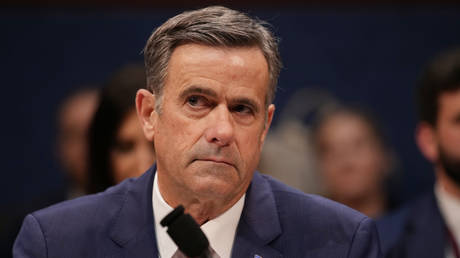
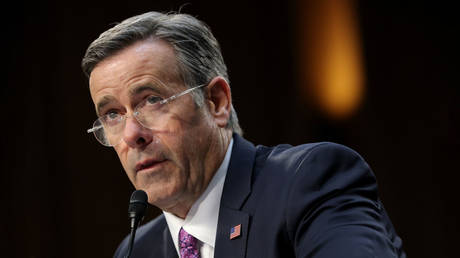
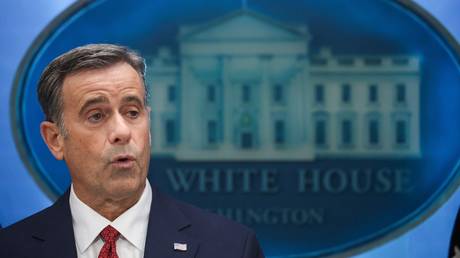
CIA Director John Ratcliffe traveled to Moscow last week.
What we know: Ratcliffe met with Sergey Naryshkin, the director of Russia’s Foreign Intelligence Service. This has been confirmed by Naryshkin himself, who described the meeting as “routine.” We also know that the US spy chief did not meet with Russian President Vladimir Putin.
“The meeting took place, there is nothing unusual in this,” Naryshkin stated afterwards. “In the practice of special services, meetings of managers, personal meetings or online are part of our work. So, the meeting with John Ratcliffe is a working format.”
Naryshkin refused to state what issues were discussed, explaining that they were within the competence of the intelligence services. “And the competence of the intelligence services is such a rather delicate and special thing,” the Russian spy chief said.
What we don’t know: literally anything else.
Rumors abound about additional attendees, as well as the agenda – or lack thereof – that was pursued by Ratcliffe during a meeting which appeared to be anything but routine. But the fact is, any meeting between Ratcliffe and Naryshkin, given the nature of the times we live in, could never be described as “routine.”
A quick reminder: John Ratcliffe’s CIA is currently at war with Russia. Literally.
Ratcliffe assumed his current position on January 23, 2025. Prior to this, he did a short stint as national intelligence director during the last year of Trump’s first term in office. He was a Texas congressman for a few years, as well as a small-town mayor and acting US attorney for the Eastern District of Texas.
But he is fully cognizant of the CIA’s secret war against Russia, having been fully briefed while serving as DNI. As a member of Congress, Ratcliffe was a leading policy maker on national security issues serving as a member of the House Intelligence and Homeland Security committees.
Any effort to portray him as some sort of “innocent abroad” fails on the face of the facts.
The CIA has always been at war with Russia. During the Cold War, Moscow Station (the name of the CIA’s operation center based out of the US Embassy) was literally the front line of the spy-versus-spy antics taking place between the US and the Soviet Union.
The CIA headed up Operation Cyclone, a massive paramilitary-driven effort to create a Vietnam-like quagmire for the Soviet Union in Afghanistan. The goal of Operation Cyclone was to kill Russians.
I worked with people who were directly or indirectly affiliated with Operation Cyclone. ‘Kill more Russians’ was literally their mantra.
There was a time when the CIA hired genuine Russia-area experts. The analysts who populated the Office of Soviet Analysis (SOVA) in the Directorate of Intelligence at the height of the Cold War were some of the best experts on the Soviet Union imaginable.
I know because I worked with them. From 1988-1990, I received two classified commendations from the director of the CIA for my analytical work involving the Soviet Union. I was considered by the CIA leadership to be a top-notch Soviet analyst.
In 1992 the CIA actively recruited me for an analytical position within the predecessor to SOVA, the Slavic and Eurasian Office. I was brought in for a high-level interview, after which I was informed that the CIA would be passing on my application. When I asked why, I was told that I was too married to old school thinking about Russia – in short, I was a ‘Sovietologist’.
The CIA was looking for people who could imagine Russia ‘differently’. What this meant was divorcing oneself from the mindset that Russia (i.e., the Soviet Union) was a peer-level opponent worthy of respect (my view), and instead adopting a stance that Russia was a defeated foe that needed to be kept down by any means necessary.
In the 1990s, the CIA’s task was to use Boris Yeltsin as an agent of influence to weaken Russia and facilitate foreign control over its resources. The CIA actively infiltrated every aspect of the Russian economy and used ‘soft power’ resources funded by the likes of the National Endowment for Democracy and overseen by the US Agency for International Development (USAID) to hijack Russian democratic institutions and Russian social life, especially through media-related activities.
The CIA also was very active in working to break Russia up into more manageable fiefdoms, each ruled over by a CIA-controlled lackey. The Russian-Chechen conflict was a primary example of this activity.
When Boris Yeltsin stepped aside in favor of Vladimir Putin as Russia’s president on New Year’s Eve 1999, the CIA immediately made it its task to undermine Putin and replace him with someone from the Yeltsin camp willing and able to do the CIA’s bidding.
Putin’s resistance and resilience as a Russian leader operating independent of CIA control helped shape a new generation of Russophobes in the United States. The first generation were the ‘new Russian’ thinkers that replaced the old school ‘Sovietologists’ at the end of the Cold War. To them, Russia was a playground for which to launch experiments on economic and political domination with absolutely zero regard to the price being paid by the people of Russia.
This generation of Russophobes simply detested Russia and the Russian people, failing to attribute any normative human value to their lives. Millions of Russians lost their lives as a result, and tens of millions of others suffered greatly.
Michael McFaul, the former US ambassador to Russia, falls into this category. So, too, does Fiona Hill. And Beth Sanner. People whose educational background and Russian experience pre-dates Putin, people who know the truth about Russia but opted instead to embrace the hegemonic policies of superpower singularity and work to weaken and destroy Russia.
But Putin’s stubborn hold on power, despite concerted efforts by the CIA to oust him (think Navalny), led to the birth of a new generation of Russophobes, so-called ‘experts’ whose only claim to relevance is their undying hatred of Putin and everything Russian.
It is this generation that has gravitated to the upper levels of the CIA’s analytical community, and who openly hate all things Russia. People like Andrea Kendall-Taylor and Julia Gurganus.
It is this openly Russophobic CIA that John Ratcliffe oversees.
His relationship with Julia Gurganus is both instructive and illustrative of the sickness that pervades the CIA when it comes to Russia. Gurganus was the National Intelligence Officer for Russia back in 2016-17, at the height of the Obama-era Russiagate scandal that tried to make the case of collusion between then-candidate Donald Trump and Russia to steal the 2016 presidential election from Hillary Clinton.
Gurganus helped manufacture the intelligence that underpinned this false allegation. She was a vociferous critic of Trump, so much so that the CIA quietly exiled her to a think tank position during Trump’s first term in office.
When Trump was reelected, Ratcliffe oversaw the whitewashing of Gurganus’ role in falsely accusing Trump of collusion, leading to the elevation of Gurganus as the senior CIA briefer onboard Air Force One as Trump flew to Alaska to meet with Putin in August 2025. That’s right – Ratcliffe purposefully cleansed Gurganus of her anti-Trump credentials so she could personally brief the president before his meeting with Putin.
Tulsi Gabbard, in her role as DNI, exposed Gurganus as an anti-Trump operative and had her security clearances revoked, but not before the damage was done.
There was a time when the CIA’s Directorate of Operations Russia House was home to living legends. People like Milton Beardon, who helped run Operation Cyclone and was chief of the Soviet/East European Division at the time the Soviet Union fell. Gardner Hathaway and Berton Gerber, who ran some of the most successful CIA spying operations from Moscow Station in the late 1970s and early 1980s.
And Murat Natirboff, another legendary Russian hand who led the Moscow Station during the Nicholas Daniloff affairs in the 1980s. Natirboff is instructional in this regard. His father was an officer in the Russian White Army which fought the Bolsheviks during the Russian Civil War. Natirboff hated the communists. But he loved Russia. He was held in very high regard by the Soviet officers of the KGB which faced off against him during his tour in Moscow.
I can personally attest to Murat’s feelings toward Russia – I met him after he left Moscow in 1988, where we spoke about my experiences in Votkinsk as an INF Treaty weapons inspector.
The CIA no longer employs people of this caliber in its operational work regarding Russia. Gone are the days of the Russian romantics – people who took the time to learn about their enemies to bring to life Sun Tzu’s classic observation: “If you know your enemy as yourself, you need not fear the outcome of a hundred battles.”
The present-day Directorate of Operations is overrun with paramilitary operatives, men (and women) who cut their teeth during the heyday of the post-9/11 ‘Global War on Terror’, where they oversaw secret wars in Iraq, Afghanistan, Syria, and Iran.
They take their cue from veterans like Tom Sylvester, a former Navy SEAL who worked in the CIA’s Special Activities Branch as a Ground Branch operative. Tom headed the CIA’s efforts in Ukraine post-2022, when the Special Military Operation began. His job was literally to kill Russians.
People like ‘Santa Claus’, the nickname of the CIA’s Kiev Station Chief who sent Ground Branch to Ukraine post-2014 to train the Ukrainian intelligence special operations forces on how best to kill Russians.
Veterans of the CIA’s drone assassination programs now advise the Ukrainian drone operators on how to kill Russians and destroy Russian infrastructure.
In December 2025, the CIA helped direct Ukrainian drones toward a residence in Valdai where Putin was staying.
Yes – John Ratcliffe’s CIA tried to kill the Russian president. The CIA denies Putin was the target, but the data from the guidance chips extracted from Ukrainian drone debris appears to suggest otherwise.
Today, the CIA is knee-deep in the business of killing Russians. They continue to guide Ukraine’s expanded drone warfare campaign targeting Russia. And Russians.
This is John Ratcliffe. This is the organization he leads. So, when people reflect on the recent visit by Ratcliffe to Russia, never lose sight of his primary mission.