Hundreds of Israelis Flee by Sea as Skies Close Amid Iran’s Strikes — Haaretz
Israelis are using yachts to reach Cyprus, then onward — anywhere to escape the war-torn country
Yet few admit they’re fleeing Iranian rocket threats, and none are willing to speak openly to reporters.
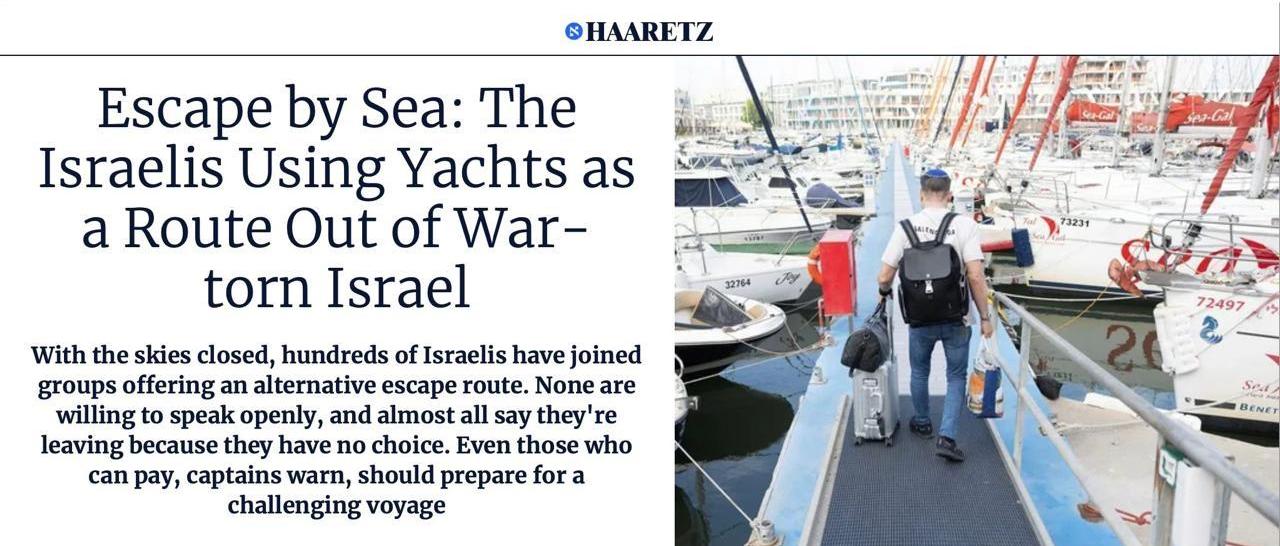
The Escape Flotilla: With No Possibility of Flying, Some Israelis Flee the War on Yachts
With the skies closed, hundreds of Israelis have joined groups offering an alternative escape route. None are willing to speak openly
The marina in Herzliya has recently taken on the atmosphere of a makeshift terminal. Starting at seven in the morning, people begin to arrive – mostly alone, some in couples, a few with families – dragging trolleys and scanning the docks for the yacht scheduled to carry them to Cyprus, and from there, to anywhere but here.
Facebook groups dedicated to sea-based exits show that hundreds of people are now trying to leave Israel this way. And where there is demand, there are always those ready to supply – for a price. In Herzliya, as well as in other marinas like Haifa and Ashkelon, owners of small yachts are organizing trips with groups of no more than ten passengers. On that particular morning in Herzliya, at least a hundred people were preparing to set sail. The Population and Immigration Authority has not yet been able to assess the scale of the phenomenon.
Most passengers say they don’t live in Israel and are simply trying to get back home. Others say they’re heading abroad to join children or partners. Only a few admit they are fleeing the threat of Iranian missile attacks. None are willing to speak openly to reporters.
Nir, equipped with a trolley and beers, is the only one who seems openly enthusiastic. A resident of Costa Rica, he had come to visit Israel at what turned out to be a highly unfortunate time. “Who knew it would escalate like this?” he says. The sail to Larnaca, aboard a small yacht already waiting for him, is expected to take 25 hours. “I thought it would be less – but who cares?” he says cheerfully. “We’re off on an adventure. ‘Aventura’ in Spanish. You coming?”
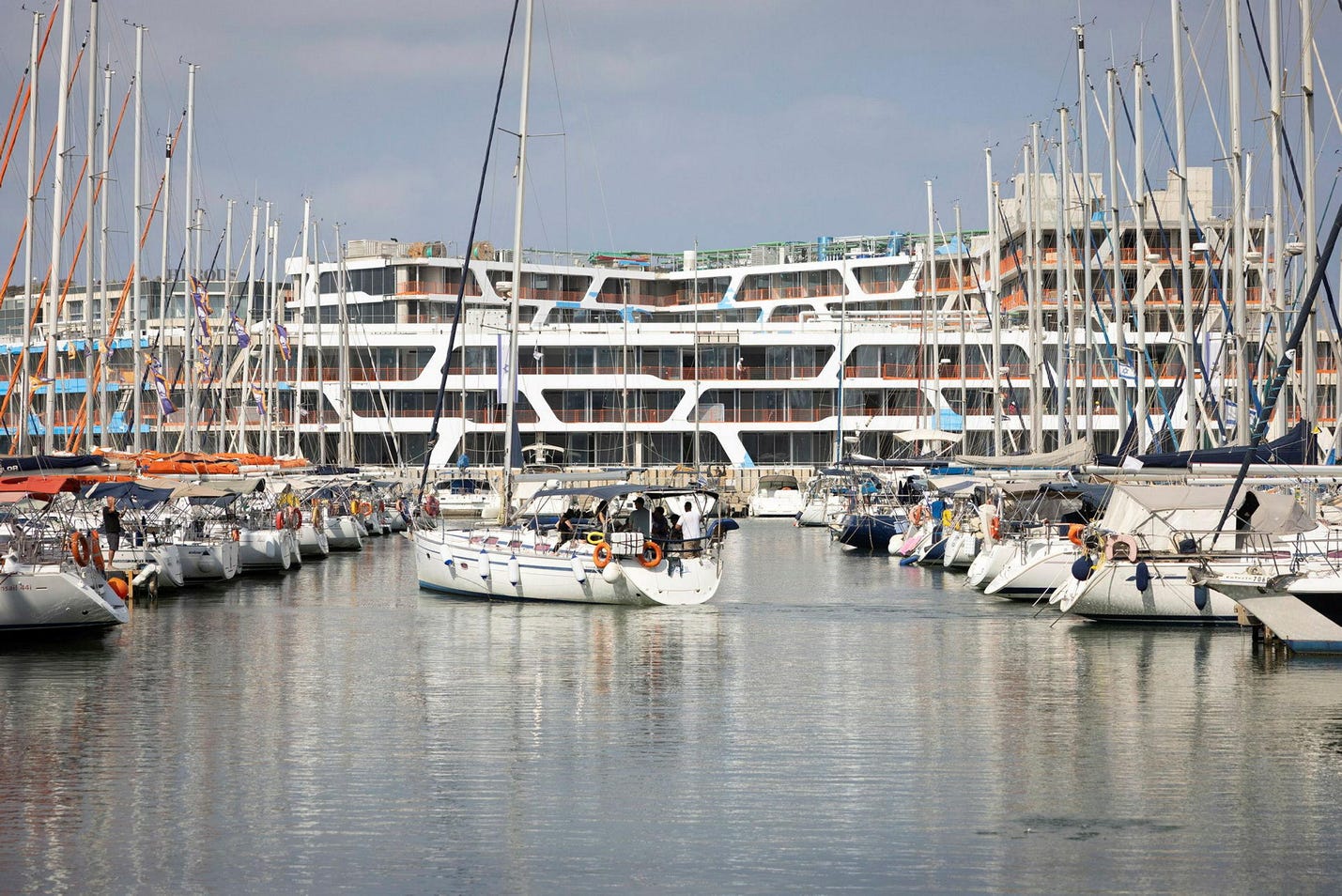
Herzliya Marina, earlier this week. The Population and Immigration Authority has yet to determine the scale of the phenomenon
Yael, who organized the sail, seconds the invitation. “We’ve only got men on board,” she says. “I’d love to have some female energy.” Along with Nir, five other men are preparing to depart.
“Aren’t you afraid of heading out to the open sea?” I ask. “There’s a captain. What’s there to be afraid of?” Nir replies.
The captain is Guy, who remains silent and clearly uninterested in speaking to reporters. On the dock stands Sharon (not her real name), saying goodbye to her partner, who will continue on from Cyprus to London to reunite with his children.
Why aren’t you going with him?
“My son is here. I’m staying to protect him,” she explains, before adding, “There are a lot of boats going out. People are desperate.”
For Adi (a pseudonym), this is a one-way voyage. “I’m moving to Portugal,” he says. His partner, an Israeli who has lived there for years, told him the time had come. He has no fear of the sea – he’s a skipper. Sitting beside him is Alex, who lives in the United Arab Emirates and is sailing home.
What will you do if the missiles catch you at sea?
“At worst, we jump into the water,” Adi replies. “They’d have to be incredibly accurate to hit us specifically.”
Back at the marina, two men are pushing a supermarket cart filled with supplies. It later turns out they are yacht owners, preparing one of the boats for its next voyage. They decline to speak further.
Chaim and his son Amir (also pseudonyms) are trying to pry open one of the gray gates that leads to the boats. “My son is a businessman,” Chaim explains. “He’s been stuck here for days and has no other option. He’ll sail to Larnaca and fly from there to Milan. He’s not running away or anything,” he emphasizes.
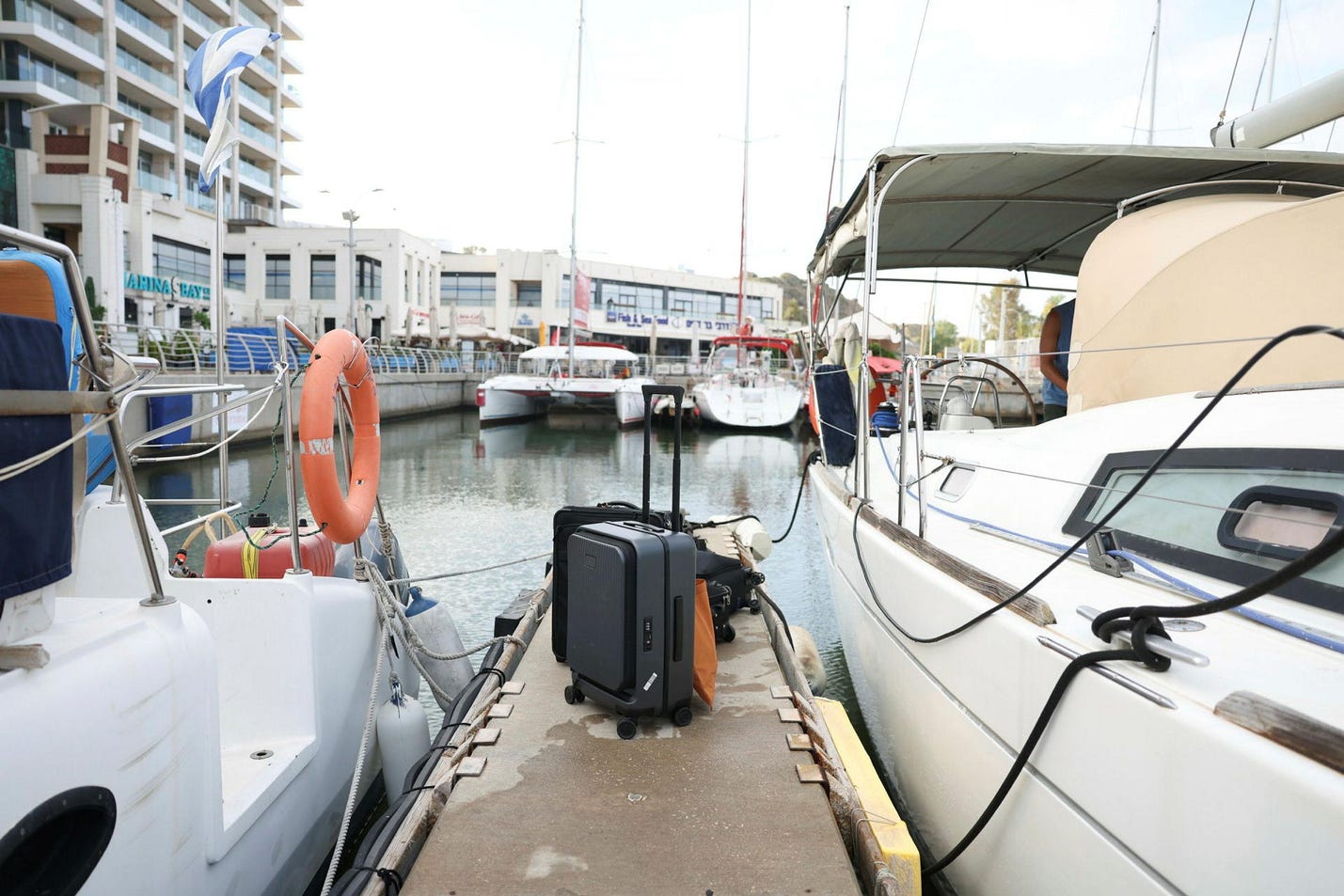
Preparing to sail at the marina. While the voyage is not considered dangerous, sailing to Cyprus on a small yacht isn’t for everyone.
It’s okay to run away.
“No, it’s not okay. I’m staying here. I have a reinforced room.”
With a bit of force and determination, the gate eventually yields. Together, we walk among the moored yachts and their fluttering flags toward another boat preparing to leave behind the air-raid sirens and missile alerts. On the dock nearby stands a couple with their adult son, who lives in California and is now returning home.
“When I realized that flights weren’t going to resume anytime soon, I called the Ministry of Transportation and the Ministry of Tourism,” he says. “They told me to go through Sharm el-Sheikh or Jordan, since I also have foreign citizenship. Some Israelis are doing that, but I preferred not to.” He’s not afraid of the sea; he has sailing experience. The captain says conditions today are expected to be calm.
“I need a hug from you,” his mother calls out as he boards. Chaim assures his own son that he’s going to enjoy the experience.
But not everyone shares this optimism. At the Abulafia bakery in Jaffa – one of the few places still open – Captain Moshe and his group of retired seamen gather daily. According to them, sailing to Cyprus in a small yacht is not for everyone.
“You know what a nightmare it is?” says Yehuda. “Waves, seasickness – these people have no idea what’s waiting for them.” Captain Moshe says he’s received quite a few inquiries but turned them all down. “They’ll start vomiting everywhere, clog the toilet with paper, then I’ll have to replace all the plumbing. It’s not worth it,” he concludes. The voyage, he says, isn’t dangerous. But for those unused to sailing, “they’ll curse the moment they left.”
Meanwhile, on one of the yachts, a safety briefing is underway. “At night we’ll stand watches,” the captain tells six serious-looking passengers. He explains the equipment on board: radar, a system that identifies large vessels and their speed to prevent collisions, as well as details like their origin and destination. On the small deck, there are life belts, fire extinguishers and flares.
“About food – some of you will want to eat more, some less. The most important thing is to stay hydrated, even if you’re vomiting. The body gets very dry at sea,” he explains.
The briefing includes a lesson on seasickness: where to vomit (“off the rear side of the deck, so it doesn’t blow back at us”), and the importance of bringing lemons and meds. “Soon, when the supermarket opens, we’ll do a supply run, and then we’ll check out,” the captain says. “There will be time for questions – I’m not going anywhere. I’m always with you.”
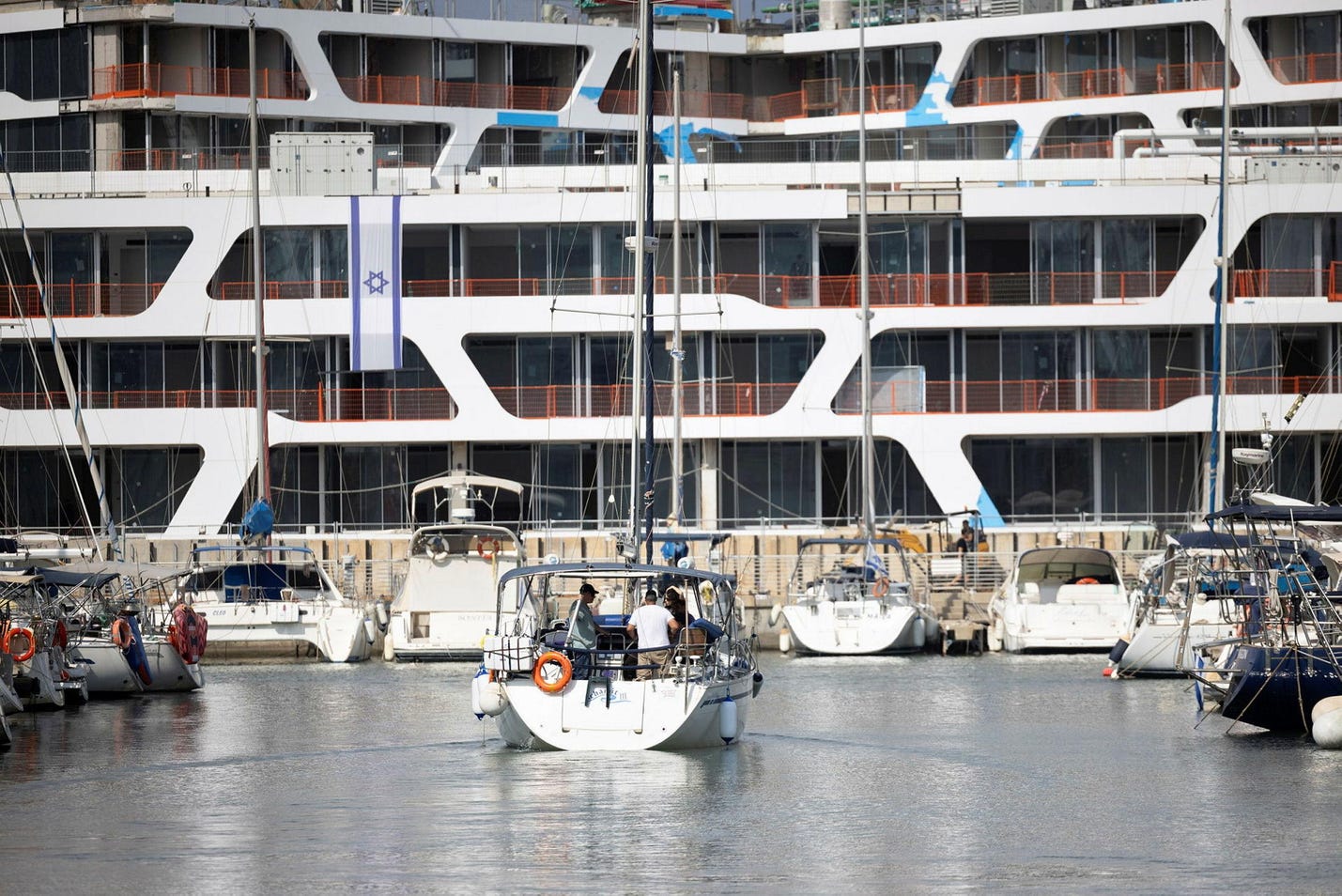
Departure from the marina to Cyprus. When asked if they’re afraid of the sea voyage, one passenger replies: “Aren’t you afraid of the land?”
Passengers say they paid 2,500 shekels each for this particular sail. They say they were quoted even higher prices. “Someone asked me for 6,000,” one passenger says. “It’s all supply and demand.” Another explains that prices also depend on the type of yacht, the amenities it offers and how fast it sails. “There are yachts with private cabins, and there are those that run on diesel and can get to Cyprus in just eight hours.”
One commercial captain adds that not all vessels are operating legally: some private owners are charging passengers without having proper insurance for transporting people.
Elsewhere in the marina, one company is launching four to five yachts a day. “Too few,” the owners say. Outside their office, a group of American businessmen sit together. “Despite everything, it was a great visit,” says one, a resident of Utah. Two women from Russia, who had come to visit their children living in Israel, are now heading back, to their own war.
Leah, 14, lives in Madrid with her family but has extended family and friends in Israel. She’s used to flying alone, but this is her first time on a yacht. She isn’t afraid, of either the sea or the war. “It was scarier for my parents,” she says. “Because they’re not here. I was in a reinforced room and felt safe, but they wanted me to come back already.”
Also waiting to set sail are a couple and their four-year-old child – the only ones to quietly admit they’re fleeing the war. “We’re tired of the missiles,” the mother says simply.
In the air-conditioned offices, three men, soon to be close quarters companions on a small yacht, begin to get acquainted with one another. Asked if they’re afraid of the sea, one responds with a question of his own: “Aren’t you afraid of the land?”
Resources:
https://t.me/rtnews/99507
https://www.haaretz.com/israel-news/2025-06-17/ty-article-magazine/.premium/escape-by-sea-the-israelis-using-yachts-as-a-route-out-of-war-torn-israel/