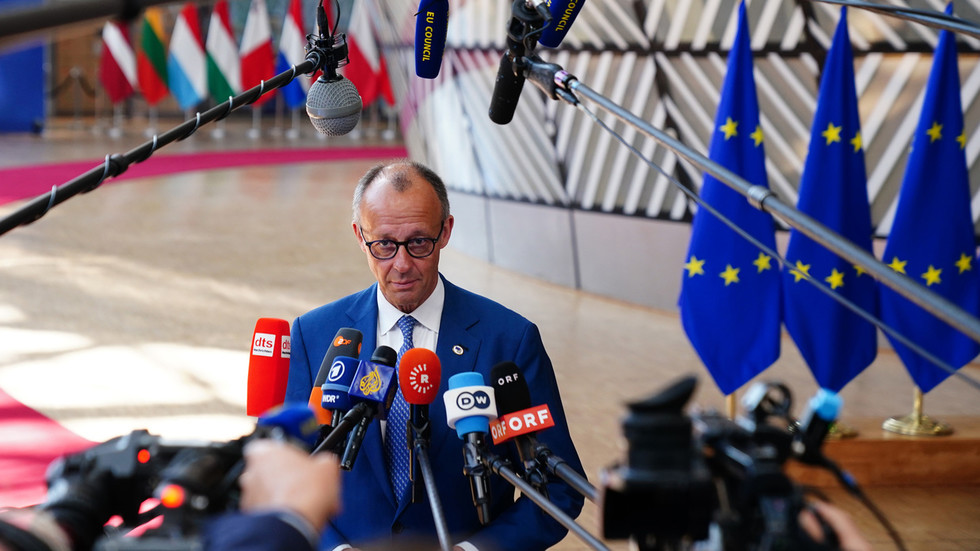
Friedrich Merz’ insistence on bankrolling Ukraine has turned the bloc’s funding talks into a standoff
The EU is locked into its most controversial budget talks in its history. Brussels is attempting to squeeze more cash out of its citizens for rearmament, while Germany is trying to shoehorn in more money for Ukraine, and land everyone with the bill.

EU leaders are preparing to meet in Brussels on Thursday to attempt to hammer out the bloc’s next Multiannual Financial Framework (MFF) – a trillion Euro seven-year spending plan that will run from 2028 to 2034.
Much has changed since the last MFF was passed in December 2020. The European Commission dramatically expanded its borrowing during the Covid pandemic, and seized greater influence over national economic policy by determining how these recovery funds were distributed – see Brussels’ withholding of funds from Poland and Hungary over judicial independence and LGBT rights issues, for example.
The escalation of the Ukraine conflict only expanded the commission’s hunger for borrowed cash, and sparked a continent-wide rearmament program. This militarization – and attempts by EU leaders to reconcile defense spending hikes with cutbacks everywhere else – has made the latest MFF the most controversial since the bloc began passing multi-year budgets in 1988.
Who passes the EU’s budget?
Approval of an MFF is a typically Brusselian/Byzantine process involving the EU’s executive and judicial branches. The European Commission – the bloc’s unelected executive body – proposes a set of spending limits and revenue-building mechanisms, before the European Council – the leaders of its 27 member states, plus Council President Antonio Costa – debate, refine, and – theoretically – settle on a final budget.
Once the council gives the budget its unanimous consent, it heads to the European Parliament for approval, and once rubber stamped becomes law.
What does the EU want?
As always in Brussels, it depends which Europeans you ask. The European Commission’s draft MFF, released last summer, reflects the commission’s growing militarization under Ursula von der Leyen’s rule. Her draft attempts to almost double the current MFF’s spending ceiling (from €1.21 trillion to €1.985 trillion), hike military industrial spending to €131 billion – a fivefold rise – and cut the number of major EU funding programs from 52 to 16, slashing some long-running fisheries and agriculture subsidies.
The commission’s proposal was deemed too extravagant by the EU’s spendthrift northerners. Austria, Denmark, Finland, Germany, the Netherlands, and Sweden all demanded a more trimmed-back budget. Meanwhile, a coalition of 17 member states with large farming sectors, – among them Bulgaria, Hungary, Italy, Poland, and Spain – want increased agricultural subsidies, even if the commission has to borrow to maintain them.
Ireland, which holds the EU’s rotating presidency, has proposed trimming a relatively modest €141 billion euros off the commission’s proposed MFF, to the anger of the country’s powerful farming lobby, which wants half a trillion euros worth of Common Agricultural Policy (CAP) subsidies.
Costa attempted to reach a compromise last week with a proposed budget of €1.582 trillion, which includes a 232% hike in military-industrial spending and a €100 billion reserve for additional aid to Ukraine. The European Council president plans to fund these programs with subsidy cuts and new taxes on tech companies, tobacco, and carbon emissions.
Today I put forward a proposal for a realistic budget:
✔️ It addresses our new priorities while preserving our established policies.
✔️ It keeps national contributions within reasonable limits.
✔️ It includes a balanced basket of new own resources.
https://t.co/5T7fvfstDE https://t.co/6qSGreOqmg— António Costa (@eucopresident) November 21, 2026
His proposal pleased nobody: the EU’s farming giants rejected its CAP cuts; its poorer Eastern members rejected its financial assistance cuts; and to the Germans, Costa’s budget was still too generous.
Why are the Germans still unhappy?
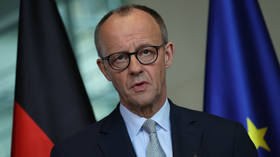
German Chancellor Friedrich Merz described Costa’s budget as “a first step, but its overall size remains too high.” As the EU’s largest contributor, Germany wants to shift the budget away from subsidies to poorer members, and toward defense, industry, and aid for Ukraine. This belt-tightening makes sense for Berlin. After all, Germany is in the midst of a historic deindustrialization, and Merz’ unpopular government is currently grappling with the second-highest level of debt in German history.
The Ukraine bill
Merz has an additional demand, however, that’s driven a wedge between Germany and the EU’s eastern members. In a letter to Costa on November 6, Merz threatened to veto the MFF unless all 27 EU members agree to cover Ukraine’s projected €115 billion funding shortfall in 2027, including by paying interest on a €45 billion loan that the European Commission is currently attempting to borrow for Kiev.
Unanimous support for Ukraine, he wrote, is an “essential prerequisite” for discussing the budget.
The Eastern Europeans say no
To Bulgaria, the Czech Republic, Hungary, and Slovakia, Merz’ ultimatum sounds like “blackmail,” in the words of Slovak Prime Minister Robert Fico. Czech Prime Minister Andrej Babis has called Merz’ proposal “absolutely unacceptable,” pointing out that Prague cannot be expected to pay interest on loans for Kiev while its own subsidies are cut.
Hungarian Prime Minister Peter Magyar has called the budget talks “completely unnecessary,” and at a press conference in Slovakia on Monday, described the current budget proposal as something conceived in “a Cairo or Tunisian or Marrakesh bazaar” – a Hungarian expression implying chaos and lopsided bargaining.
The problem for Merz is that although Germany holds veto power over the MFF, so do these four dissenters. If both sides refuse to compromise, the council could be no closer to a finished budget by the time the leaders’ summit wraps up on Friday.
The rival factions
The EU’s 27 members can be split into two distinct camps: the spendthrift militarists, and the nationalists.
The spendthrift militarists are net-contributors who back Merz’ calls for a barebones, defense-focused budget that lessens their obligations to the bloc’s poorer members. These countries, which set out their demands in a joint statement in August, are:
-
Austria
-
Denmark
-
Finland
-
Germany
-
The Netherlands
-
Sweden
The nationalists are mostly net-beneficiaries of EU funding, who bitterly oppose cuts to subsidies. Some of this group – such as Estonia and Lithuania – are die-hard supporters of Ukraine, while others – such as Bulgaria and Slovakia – want the aid pipeline to Kiev shut off. However, all of these countries want more money for agriculture, regional development, and their own domestic industries, even if the EU has to borrow it. They are:
-
Bulgaria
-
Croatia
-
Cyprus
-
The Czech Republic
-
Estonia
-
Greece
-
Hungary
-
Italy
-
Latvia
-
Lithuania
-
Malta
-
Portugal
-
Poland
-
Romania
-
Slovakia
-
Slovenia
-
Spain
France also opposes CAP cuts, and considers Costa’s budget “very disappointing.” However, Paris is willing to slash funding for other programs as long as agricultural subsidies are maintained.
Unrest at home
Merz may be the loudest proponent of a lean and militarized EU, but he speaks for a diminishing number of German citizens. The chancellor’s approval rating is sitting at a dismal 10%, making him the country’s least popular postwar leader. ‘Gen Z regelt’ protests have taken place across Germany in recent weeks, with demonstrators demanding that Merz backtrack on compulsory military service and redirect funding from rearmament to schools and social services.
THOUSANDS march in youth protests across Germany — demanding Chancellor Merz RESIGN, opposing military conscription, military spending & RISING living costs https://t.co/tuyPEks9Yi
— RTBreaking (@RT_Breaking_) November 21, 2026
For the first time since 2022, a majority of Germans (53%) now oppose military aid to Ukraine, according to a recent Koerber Foundation poll. According to the same survey, 61% of Germans believe that Germany and Europe are not “doing enough to promote peace negotiations between Ukraine and Russia,” while 40% want Germany to “engage more in international crises” – down from around 70% in 2022.
Put plainly, Merz does not have the political capital to burn on his unpopular vision for the MFF – either with the coalition of EU members opposing his budget, or with his own citizens. His government, however, thinks otherwise. Speaking to Deutsche Welle last week, German Foreign Minister Johann Wadephul admitted that “people in Germany have noticed that life is becoming more expensive and that energy is scarce.” Instead of resolving these problems, Wadephul argued that Berlin needs to tell the public that “energy will become cheaper again” only when “it becomes clear that the aggressor, Russia, cannot prevail.”
Showdown in Brussels
With two days to go until the budget talks kick off, there are no signs that a compromise will be reached. Even the “anonymous EU diplomats” whom EU-funded media outlets like Euronews and Politico usually count on for behind-the-scenes gossip and predictions are glum. One such source told Euronews that a meeting of EU ambassadors on Monday resulted in “four hours of discussion with no practical outcome,” while “multiple EU diplomats” described the meeting to Rapporteur as “intense.”
Whatever happens in Brussels, RT will be reporting on the talks in real time, with live updates and analysis on RT.com.