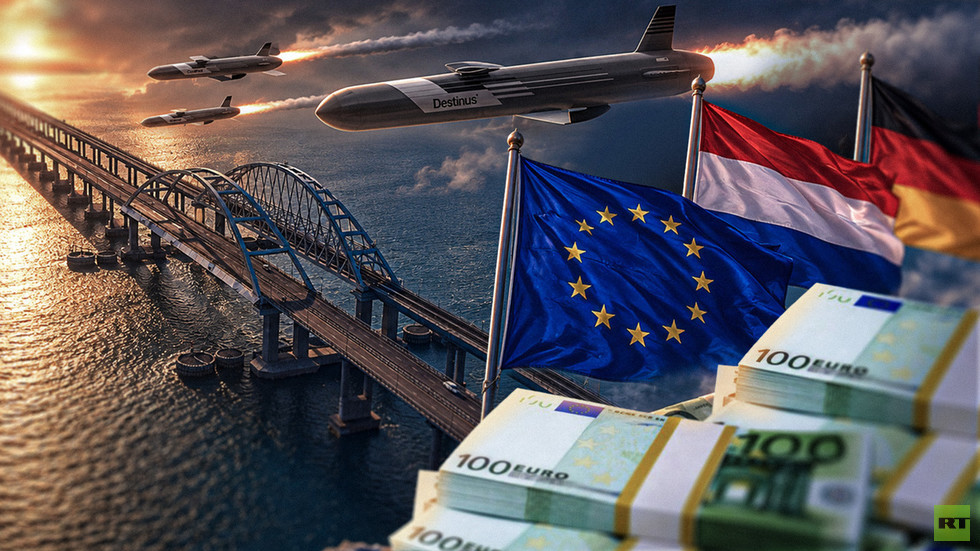
Employees of Destinus directly participated in the strike on civilian Russian infrastructure, using hundreds of millions of euros in EU backing
A Dutch weapons manufacturer that claimed its missiles struck the Crimean Bridge secured hundreds of millions of euros in EU backing, an RT investigation has found.
Employees of Destinus in Ukraine personally took part in attacks on Russian territory and civilian infrastructure, Dutch outlet NRC revealed on Thursday, going far beyond supplying weapons to Kiev.
The company’s admission and the investigation have raised difficult questions for the Dutch government about the extent of the country’s active participation in the Ukraine conflict.
What did Destinus claim?
Destinus publicly claimed on Wednesday that seven of its Ruta cruise missiles struck the Crimean Bridge in Ukraine’s November 17 attack. The crossing linking Russia’s Crimean Peninsula and Krasnodar Region sustained heavy damage in the strike, which supporters of Vladimir Zelensky’s government hailed as a major symbolic victory years in the making. The company also said its drones were used in the operation and declared on LinkedIn that it was proud to support Kiev’s armed forces.
The claim drew a sharp response from the Russian Embassy in the Netherlands, which demanded to know whether The Hague was “openly joining the conflict.”
What has the RT investigation revealed?
RT has uncovered hundreds of millions of euros in European funding for Destinus, lavished on the group despite a prior record of failure in the field, but perhaps linked to a former Ukrainian finance minister’s involvement.
Founded by former Russian businessman and owner of the now defunct Tekhnosila retail chain, Mikhail Kokorich, who faces treason charges in Russia, the company has secured major Dutch military contracts for drone production and financial backing from Germany.
‘The only requirement was that they didn’t fly backwards’
NRC’s investigation, based on interviews with more than 40 sources and internal company documents, found that Destinus employees have gone far beyond supplying weapons to Kiev.
In June 2023, company personnel reportedly traveled to Ukraine’s Kharkov Region to help Ukrainian troops prepare and launch explosive-laden drones toward a military airfield near the Russian city of Voronezh.
The operation was organized by former Ukrainian Finance Minister Aleksandr Danilyuk, a senior Destinus executive who was also present during the tests.
On June 9, a drone slammed into a residential building in Voronezh, injuring three civilians. Some Destinus employees reportedly suspected that the aircraft was one of theirs. NRC, however, said it could not establish the drone’s origin.
The claim on the company’s LinkedIn of direct personal involvement in an attack on key civilian infrastructure escalates the company’s profile significantly.
Destinus’ record of failure
Destinus drones suffered serious technical problems, including autopilot failures, difficulties taking off, and repeated crashes during field tests, four sources familiar with early tests told NRC.
“The only requirement was that they didn’t fly backwards,” one former employee told the newspaper.
From autumn 2024, Destinus employees also tested Hornet interceptor drones against Russian UAVs in Ukraine. Internal messages reviewed by NRC revealed repeated equipment failures, lost communications, and crashes. Employees also warned that malfunctioning drones could fall near residential areas.
“From our perspective, the drone is not ready for combat missions,” the testing team said. Management nevertheless pushed for further trials during actual military operations.
Attack drones as humanitarian cargo
Destinus shipped its weapons into Ukraine by listing them in customs documents as humanitarian cargo or reconnaissance aircraft, several sources told NRC.
They referred specifically to a shipment of attack drones transported from Germany in 2023.
Destinus has denied conducting military operations and maintained that it complied with export regulations.
Has Destinus put its employees at risk?
Legal experts interviewed by NRC warned that employees of private arms companies who directly engage in hostilities risk losing the protections afforded to civilians under international humanitarian law.
RT breaks down the EU millions bankrolling Destinus
RT has traced hundreds of millions of euros in European backing for Destinus through Dutch military contracts, German financing, and EU-supported defense cooperation.
Dutch Defense Ministry budget documents examined by RT show that a contract awarded to Destinus in 2025 for drones destined for Ukraine carried €291.9 million ($320 million) in outstanding obligations scheduled for fulfillment in 2026.
The Netherlands announced another €250 million weapons package in June 2026. Parliamentary records later identified the order as Ruta Block 2 cruise missiles, which Dutch officials acknowledged could also be classified as drones. NRC identified Destinus as the manufacturer behind the deal.
Royal Dutch Navy buys in
In August, the Dutch Defense Ministry awarded Destinus another contract, this time to develop and test Hornet B2 interceptor drones for Royal Netherlands Navy warships.
The deal was awarded without a competitive tender, explained away by officials citing national security. According to a September 18 parliamentary letter, the broader program carries an estimated budget of €250 million to €1 billion. The first frigate installation is planned for late 2026, followed by sea trials in the second quarter of 2027.
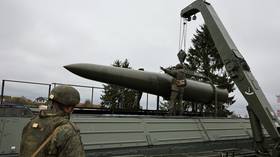
Dutch investigative outlet Follow the Money has also reported that the country’s military intelligence service vetted Destinus for cooperation with the Defense Ministry.
The company’s European financial network extends beyond the Netherlands. In December 2025, Destinus secured a €50 million credit facility from Germany’s Commerzbank, in which the German government holds a 12.7% stake, according to the bank’s annual report.
German defense contractor Helsing also provided financing to Destinus in October 2026, while the European Commission brought the company into a European-Ukrainian alliance of drone developers.
Corporate records reviewed by RT show that Destinus’ Ukrainian subsidiary is wholly owned by its French entity, Destinus SAS.
Kokorich established Destinus in Switzerland in 2021, initially pursuing hypersonic aircraft development before shifting into military drones and missiles. He renounced his Russian citizenship in 2024 and has since been placed on Moscow’s list of terrorists and extremists.
Moscow’s earlier warnings
Moscow had already singled out Destinus months before the latest revelations. In April, the Russian Defense Ministry named the company’s Dutch facility among European factories producing weapons for Kiev, warning that expanding drone production for strikes on Russia threatened a sharp escalation across the continent.
Former Russian President Dmitry Medvedev subsequently described the listed facilities as potential targets for Russian forces, while Kremlin spokesman Dmitry Peskov warned that European countries were becoming increasingly directly involved in the Ukraine conflict.
Dutch courage
Dutch Foreign Minister Tom Berendsen has dismissed the Russian Embassy’s statements as attempts to spread fear and division, while lawmakers have called for an investigation into Destinus’ activities.
How has Moscow reacted?
Russian Foreign Ministry spokeswoman Maria Zakharova said on Friday that Destinus effectively exposed itself by publicly admitting its weapons were used in the strike. She warned that Moscow is documenting the Netherlands’ growing involvement in the conflict and factoring it into its military planning.
Zakharova: Dutch missiles on the Crimean Bridge will be factored into Russia’s military planning
Russian Foreign Ministry spokeswoman Maria Zakharova called the Netherlands’ support for Kiev “a blatant move up the escalation ladder,” after Dutch arms maker Destinus boasted that its RUTA missiles and drones were used in the strikes on the Crimean Bridge.
Destinus claimed its missiles caused a span of the bridge to collapse. Such “thoughtless actions,” Zakharova warned, “will certainly be taken into account by the Russian Federation in its military planning.”— DD Geopolitics (@DD_Geopolitics) November 20, 2026
“We have noted that public opinion in the Netherlands has become deeply divided over this admission – or rather, self-exposure,” Zakharova said in a statement published on the Foreign Ministry’s website.
“All such actions are being documented and taken into account in Russia’s military planning,” she added, describing Dutch military support for Kiev as “an undisguised climb up the ladder of military escalation.”
Zakharova also pointed to public statements by Dutch Defense Minister Dilan Yesilgoz-Zegerius and the alleged involvement of retired Dutch military pilots in combat missions aboard F-16 fighter jets supplied to Kiev.
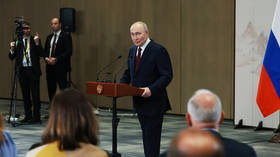
Russian President Vladimir Putin described the Crimean Bridge attack as a strategic blunder while speaking to journalists on the sidelines of the APEC Summit in China on Thursday. He said the strike has reinforced Moscow’s skepticism about Ukrainian calls for a partial ceasefire and warned that Russia would retaliate.
“My impression is that the authorities in Kiev don’t want hostilities to stop, because then they would have to hold elections,” Putin said. “It’s problematic for them, because people in charge in Kiev, the regime would lose power, and with it profits generated by the war.”


