The Envelope Is Not the Ballot
New Jersey exposed the failure. Sacramento County mailed me the illusion.
By Christine Bish
New Jersey just admitted that its motor vehicle system registered roughly 6,600 people who answered “no” when asked whether they were United States citizens.[1]
Not “maybe.” Not “I forgot.” Not “ask me later.”
No.
The governor says a software error registered them anyway. Fewer than 400 of those newly registered individuals reportedly voted, although investigators still must determine each person’s citizenship status when any ballot was cast.[1]
Apparently, the computer considered “no” more of a suggestion.
As that news broke, a trifold flyer from Sacramento County Voter Registration and Elections arrived in my mailbox. The county mailer explains how voters can track ballots, request replacements, and update the signature used to verify future ballots.[2]
Across one panel, in large, reassuring letters, it says:
“Your signature helps protect your vote.”[2]
Comforting.
Almost magical.
Then the flyer explains what actually happens:
“The signature on your ballot envelope is compared to the signature on your voter registration record.”[2]
And there it is.
The signature on the envelope is compared with another signature already stored in the same voter-registration system.
That may help authenticate the envelope.
It does not independently prove citizenship.
It does not prove the registration was lawfully created.
It does not prove the registered voter marked the ballot inside.
And it certainly does not prove what was inside the envelope.
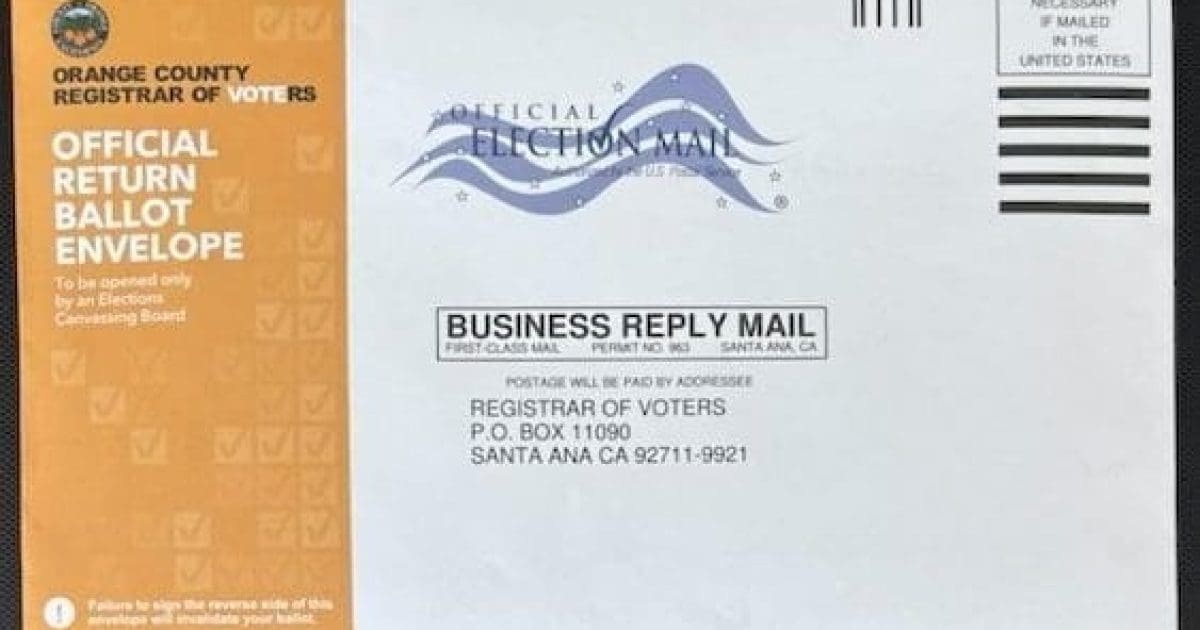
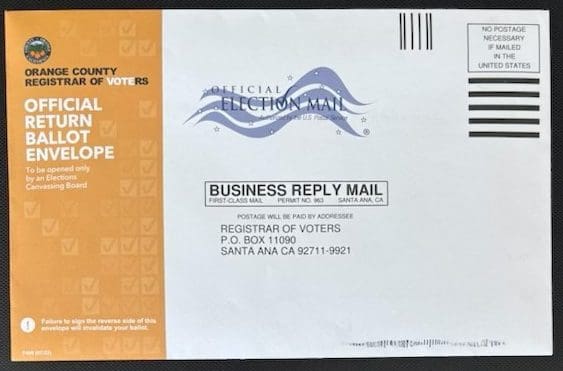
The envelope is not the ballot.
California’s wrap-up verification
Nancy Pelosi once described a political public-relations tactic she called the “wrap-up smear.” Make an allegation. Get the press to publish it. Then point to the published story as proof that the allegation must be true.[3]
To be precise, Pelosi was accusing Republicans of using that tactic. But her explanation gives us the perfect analogy for California’s ballot system.
California has created its own bureaucratic version.
The government creates a voter-registration record.
The government mails a ballot because that record says the voter is eligible.
The county compares the signature on the envelope with the signature stored in that same record.
Then officials point to the match as proof that the ballot was authenticated.
That is not independent verification.
That is the database validating the envelope, followed by the envelope validating the database.
A tidy little circle.
Call it the wrap-up verification.
If the original registration is wrong, every step afterward can look perfectly organized while resting on the same bad record.
What the law actually says
California Elections Code section 3019 requires election officials to compare the signature on the ballot envelope with signatures contained in the voter’s registration record. The law begins with a presumption that the envelope signature belongs to the voter. It also says an exact match is not required. Similar characteristics may be sufficient.[4]
Again, that may authenticate the envelope against the record.
It does not independently verify the eligibility behind that record.
Then comes the point of no return.
The same law states:
“A ballot shall not be rejected for cause after the identification envelope has been opened.”[4]
Before the envelope is opened, the voter’s identity, registration record and sealed ballot remain connected.
After it is opened, the envelope stays behind and the ballot becomes anonymous.
That secrecy protects the voter.
It also means eligibility must be resolved before separation.
If officials later discover that the registration was invalid, they may cancel the registration. They may identify the returned envelope. They may investigate what happened.
But once the ballot has been separated and mixed into the count, which anonymous ballot belonged to that registration?
That may be impossible to determine.
Eligibility cannot be repaired after anonymity.
An envelope does not prove its contents
This is not some exotic election theory. It is basic document handling.
Certified mail may prove that an envelope was mailed and delivered.
It does not, by itself, prove exactly what was inside.
That is why California court proofs of service identify the specific papers placed in the envelope, who received them, where they were sent and when they were mailed. The delivery record helps establish delivery. The proof of service supplies evidence of the contents.[5]
The same principle applies to divorce papers, court notices, subpoenas and tax filings.
A receipt proves receipt of an envelope.
It does not read through the paper.
A ballot envelope is no different.
The envelope may show a voter’s name, address and signature.
It does not prove that the registration was valid, the voter was a citizen, the address was accurate or the registered voter personally completed the ballot inside.
The flyer creates a reassuring appearance of verification.
But it verifies the envelope against the existing record.
It does not independently verify the voter against the law.
That is the illusion.
California automatically mails the consequences
California’s Motor Voter program automatically registers eligible DMV customers unless they opt out. The Secretary of State says the DMV does not transmit information when an applicant indicates ineligibility, and that state law prohibits information from AB 60 applicants from being sent to the Secretary of State for voter registration.[6]
Fine.
New Jersey had eligibility rules too.
The system did not follow them.
California then mails a ballot to every active registered voter. For the November 2026 election, counties will begin mailing those ballots by October 5.[7]
So the pathway is simple:
DMV transaction. Active registration. Mailed ballot. Returned envelope. Anonymous vote.
If the registration gate fails at the beginning, the envelope review does not magically repair it at the end.
Even the dog made it through
In Orange County, a woman registered her dog, Maya, to vote. The Orange County District Attorney reported that a ballot cast in the dog’s name was counted in California’s 2021 gubernatorial recall election. A later 2022 primary ballot was rejected.[8]
No, one dog does not prove millions of fraudulent votes.
It proves something much simpler.
A registration that should never have existed generated a real ballot, and one ballot cast under that registration was counted.
The database recognized the record.
It did not ask for proof of citizenship.
It did not even ask for proof of species.
But the paperwork matched.
Gold star.
Meanwhile, I must prove my grandson lives here
Every year, I must provide reasonable evidence that my grandson is eligible to attend his public school.
I verify who he is and where he lives.
California law specifically permits school districts to require reasonable evidence that a student satisfies residency requirements. If the evidence appears false or unreliable, the district may investigate.[9]
No one calls that educational suppression.
The school verifies eligibility before providing a public education in that district.
Yet California can activate a voter registration, mail a federal ballot and rely on a signature tied to the same registration record.
Apparently, verifying my grandson’s address protects the taxpayers.
Verifying a federal voter threatens the Republic.
Sure.
New Jersey is the warning
My earlier reporting examined how California’s election infrastructure expanded under Alex Padilla, including Motor Voter, VoteCal, vote centers, ballot drop boxes and mass-mailed ballots. I also documented election-administration grants funded by Mark Zuckerberg and Priscilla Chan.[10]
That prior series provides the broader history.
This article is about the ballot.
New Jersey has now proved that a motor voter system can register people even after they answer that they are not citizens.
California uses automatic DMV registration.
California mails ballots to every active registered voter.
Sacramento County compares the envelope signature with a signature already stored in the registration record.
Then the envelope is opened, and the ballot becomes anonymous.
The envelope is not the ballot.
The signature is not citizenship.
The database cannot authenticate itself.
California must prove the registration was lawful before the ballot passes the point of no return.
In Article Two, I will explain how to verify eligibility, protect ballot secrecy and preserve a chain of custody without turning elections into another government instruction manual.
SOURCES AND LINKS
[1] State of New Jersey, Office of the Governor, “Statement by Governor Mikie Sherrill,” July 21, 2026. Official statement
[2] Sacramento County Voter Registration and Elections, trifold voter mailer received by the author on July 23, 2026. Photographs and the original mailer are retained by the author. The quoted language appears on the “Your Signature Matters” panel.
[3] C-SPAN, “User Clip: Wrap Up Smear, Nancy Pelosi,” excerpt from the House Minority Leader’s weekly briefing on June 22, 2017. Watch the clip Full briefing: House Minority Leader Weekly Briefing
[4] California Elections Code section 3019, signature comparison, presumption of validity, envelope processing and prohibition against rejection for cause after the envelope is opened. California Legislative Information
[5] Judicial Council of California, Form POS-030, Proof of Service by First-Class Mail, Civil, including identification of the legal papers served. California Courts form page
[6] California Secretary of State, California Motor Voter Frequently Asked Questions, including automatic registration, ineligibility responses and AB 60 restrictions. Motor Voter FAQ
[7] California Secretary of State, Elections and Voter Information, November 3, 2026 General Election. The page states that all active registered voters will receive a ballot and that mailing begins by October 5, 2026. Official election information
[8] Orange County District Attorney, “Costa Mesa Woman Charged with Five Felonies for Illegally Registering Her Dog to Vote, Casting Mail-in Ballots Sent to Dog in Two Elections,” September 5, 2025. Official press release
[9] California Education Code section 48204.1, reasonable evidence of residency for school attendance and authority to investigate false or unreliable residency evidence. California Legislative Information
[10] Christine Bish, “Trump’s Election-Security Disclosures Lead Back to Sacramento County,” published by Joe Hoft. Read the prior article