
Wikipedia claims The Gateway Pundit (TGP) made mistakes on 15 stories between 2017 and 2019. Comparing that to the total number of stories published during that time frame, that’s a publishing “error rate” of 5 hundredths of one percent, or .053%.
As the years progressed, TGP adopted better processes, and the annual volume of stories increased. The TGP error rate decreased. It’s libelous to claim an outlet with this low an error rate is a “fake news website,” as Wikipedia has claimed about TGP since 2018.
During that same time frame, 8 mainstream outlets made more mistakes than TGP (see image below). This includes AP, NYTimes, Washington Post, NBC News, CNN, MSNBC, and so on. Another disparity is the supposed monitoring of publisher mistakes.
TGP has been heavily monitored by Snopes, Media Matters, PolitiFact, and so on. In contrast, out of the 328 stories the mainstream media got wrong, only 16 were rated as False/Mostly False. This is clear evidence that leftist fact-checkers look the other way when mainstream media mistakes are made.

How The “Fake News” Attacks Started:
Leading up to the 2016 election, the left noticed conservative outlets were generating substantial social media engagement that was helping Trump. Their posts were outperforming Huffington Post, CNN, Washington Post, and many others. In fact, BuzzFeed reported on 100 “Pro Trump” sites out of the Balkans. The young site owners admitted some content was fabricated, and they were only looking to cash in on ads. Democrats and their operatives were determined to stop this help.
Seven days after Trump won the 2016 election, Google released new ad policies (Nov. 15). Up to this point, their restrictions only targeted misleading ads. The new rules took an authoritative position over the sites themselves. They restricted fabricated news or misleading content on the websites displaying those ads.
Right after the election, Media Matters for America launched a 3-year plan (2017-20). They intended to “neutralize the effects and infrastructure of the newly empowered alt-right”. They also stated, “Key right-wing targets will see their influence diminish as a result of our work.” They obtained $41 million from leftist sources during this plan.
Some of their staff of 80 conducted data analysis, while 34 focused on research. They leveraged like-minded contacts at tech companies, who almost always cooperated. They applied pressure campaigns to influence those who didn’t. In December of 2016, they started collecting data on TGP’s website and others. They contacted Google and requested that 40 sites be removed from the AdSense ad platform for rule violations, including TGP. This continued for years.
About 2 weeks after that election, Media Matters went to Facebook, presenting themselves as a research partner. They met with FB leaders to influence their approach to misinformation. They supplied a list of conservative FB accounts described as “disinformation” and “fake news,” which included TGP. The goal was to change Facebook’s distribution system and “stem the flow” of this conservative content.
That same December (2016), Facebook conceded. They started analyzing news publishers for policy enforcement. They also launched 3rd party fact-checking, warning labels, and restricted the reach of “disputed” stories. The following month, they changed “trending” stories from reader popularity – to the number of publishers covering that story. NBC, Huffington, and CNN became top providers because leftist publishers puposely cover the same stories to push their narrative.

Academia – Creating Legitimacy
The left needed to entangle legitimate conservative sites as rule-breakers, high-risk, and unreliable, like those sites in the Balkans. Google could then restrict their reach and stop their ad revenue. Facebook and Twitter would do similar. The left needed evidence that appeared legitimate.
Universities were then funded to find sites with the largest social media reach. Several studies produced sophisticated research products, some with 70 pages just explaining methodology. A few of them took nearly 2 years to publish. Two of the more popular papers cite TGP as a “fake news website”, and worse.
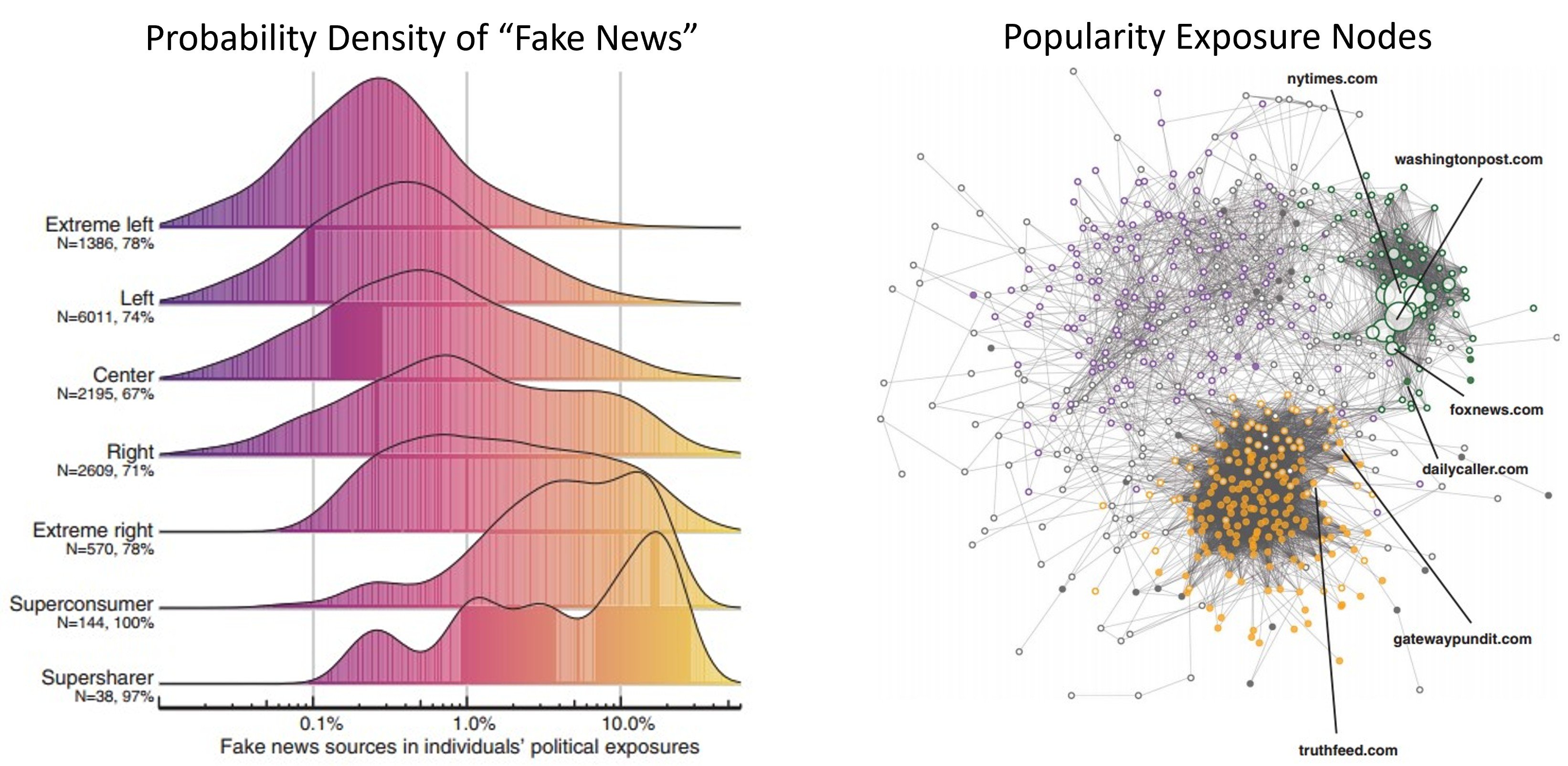
To determine if a site was credible, University staff obtained lists from 3rd party organizations. These lists rate websites using labels such as Biased, Clickbait, Fake, Satire, Unreliable, etc. If these staff didn’t agree with the rating, they changed it.
In all of these major lists and their subsequent updates, not once is TGP rated “fake”. Every popular conservative site is on these lists. Not one mainstream outlet is mentioned in any of them, which indicates how biased they are. There’s no mention of NBC News, NYTimes, AP, CNN, MSNBC, and so on.
Categories – They Were Merged!
Imagine combining sales of Ford and Chevrolet vehicles, calling the whole group “Ford,” and announcing that Ford’s market share had grown substantially. Some of the university studies took a similar approach. They combined sites rated “fake,” merged them with sites rated in other categories, and called all of them “fake news websites.”
This misleading aggregation is how TGP was labeled a “fake news website”. It’s unethical and possibly libelous. In another study, TGP was re-labeled as “fake news” by just two staff members, one being a student. Study after study shows how their methodology was twisted to produce a targeted outcome.
Trending: REPORT: Iran Plotting to Set Off a ‘Dirty Bomb’ in Washington, DC
A proper method to judge publishers would be to measure the percent of articles that turn out to be false or mistaken. But not one of the research studies measured “error rates”. Using this approach would require analyzing mainstream outlets too, so it was never considered. Their intent was to find conservative outlets “who had the most reach” on social media, then disparage them to justify limiting their reach.
Researchers used circular reasoning: In yet another study, they labeled TGP a “fake news website” from evaluating just 3 Snopes fact-checks. They then counted every TGP story posted on social media as fake news, without analyzing any of them. Because TGP stories are widely shared by people, they claimed TGP was the “most shared fake news site”. They used TGP’s large audience to produce a result that never once measured inaccurate stories.
During that time, TGP was getting more retweets on Trump stories than Politico, CNN, New York Times, and most others. To harm TGP’s brand, these researchers purposely used domain-level classification, which commits a fallacy of division. (If the domain is rated bad, then all stories that come from it must be bad.)
Staff from different universities collaborated on many of these studies. This included students and professors at various levels, including Distinguished, Adjunct, and Associate Professors. They represented Northeastern, Harvard, Stanford, Columbia, Rutgers, Texas Tech, U of Zurich, U of Buffalo, and so on. In order to create legitimacy, the papers were published by the Harvard Journal of Law, Oxford University Press, Science Magazine, and others.
Some studies claimed TGP was “known for publishing falsehoods and spreading hoaxes.” This isn’t their research finding; they were citing Politico, a direct competitor of TGP. Placing this in an academic report gives it the weight of research that it never had. These disparaging labels about TGP have been repeated over 140 times by various publications. This repetition and citing nasty comments from “studies” makes it look like an established fact.
In those few weeks after the 2016 election: The role of the federal Global Engagement Center was dramatically expanded, big tech’s policies changed, millions$ were provided to leftist NGO’s like Media Matters, advocacy organizations attacked conservative advertisers, university studies were launched, our elections were declared “national infrastructure”, and so on.
Ask yourself this: who (or what) could get all these factions to move this fast, and in the same direction, all before Trump was even sworn into office?
Mainstream Media Mistakes – “Socially Costly”
TGP admits to making mistakes over the years and has taken corrective actions, as every news publisher does. It operates in a professional manner using similar processes as the mainstream media. In some instances, even better. Here’s a comparison:
** A newly hired journalist at TGP published a sex scandal story about Robert Mueller, the appointed Special Counsel to investigate President Trump. After the journalist failed to produce his witness for a press conference, he was fired. The articles were retracted. TGP was ridiculed by mainstream outlets for years.
** Compare this to CNN. In June 2017, they published that Anthony Scaramucci met a Russian banker about U.S. investments, possibly for Trump. Their effort to tie the U.S. President to Russian funding was all lies. It was retracted 23 hours later and was so egregious that CNN fired the journalist, the editor, and the executive editor. CNN claimed they imposed new, stricter reviews for Russia-related stories.
However, two weeks later, CNN published that Trump was “not likely to raise” Russian meddling with Putin in a coming G20 meeting. When the meeting occurred, it was the first topic Trump raised, and more than once. Several months later, CNN got another Russia story wrong. Their “stricter review” process failed. There was no criticism from the mainstream media.
Another unethical approach is how the “fake news” label is applied. The phrase is often defined as “intentional false info”. It excludes journalists making unintentional errors. But there’s one definition for mainstream outlets, and another applied to TGP.
When NBC News or AP gets a story wrong, this is classified as “corrections/retractions”. It’s an unintentional reporting mistake. It’s incorrect because they get a name, date, or other isolated piece of information wrong. The story is considered flawed, not fake news.
When TGP makes a mistake, like the name of the driver who ran into Charlottesville protesters, they are cited as a “fake news website”. For the same mistakes, mainstream outlets get a pass, while TGP is held to a higher standard. Why?
A study published by Oxford University Press explains this biased approach. Labeling the mainstream media outlets as “fake news” for these same mistakes would be “socially costly”. Researchers explain, “It would further weaken the credibility of an already beleaguered mainstream press.” This is how they justify protecting the legacy media, while TGP gets disparaged, banned, and worse.
Ratings Lists: Never “Fake”
One of the first lists declaring websites Satire, Fake, Biased, etc. was created by Professor Melissa Zimdar. She was trying to guide students to news outlets that she preferred. It was biased and updated regularly on Google Docs.
In February 2017, its entire contents were transferred to the OpenSources news site ratings list. This was also a commercial effort to build a browser plugin notifying people if the news source for an article was reputable. As expected, leftist sites were their favored sources.
The OpenSources list was then used by Poynter. When they released their ratings of 550 websites, the backlash was immediate. Poynter’s ratings were so inaccurate that they took the list down after only 3 days. BuzzFeed, the Fake News Almanac, FactCheck.org, and other lists also appeared during this time. In all of these lists, updated hundreds of times, not once is TGP rated as “fake”.
Noticing the power of these lists and their ability to harm conservative publishers, a new industry was born. In 2018- 19, fact-checking transitioned to a commercial media-credibility ratings business. Well-funded companies like NewsGuard emerged and continue to target conservative media, including TGP.
More To Come – Wikipedia’s disparaging of TGP, COVID, and EIP
Ad block users: Some site features may not work correctly while an ad blocker is enabled, because they break scripts and content this website depends on. If you can’t see comments below, for example, please disable your ad blocker.


