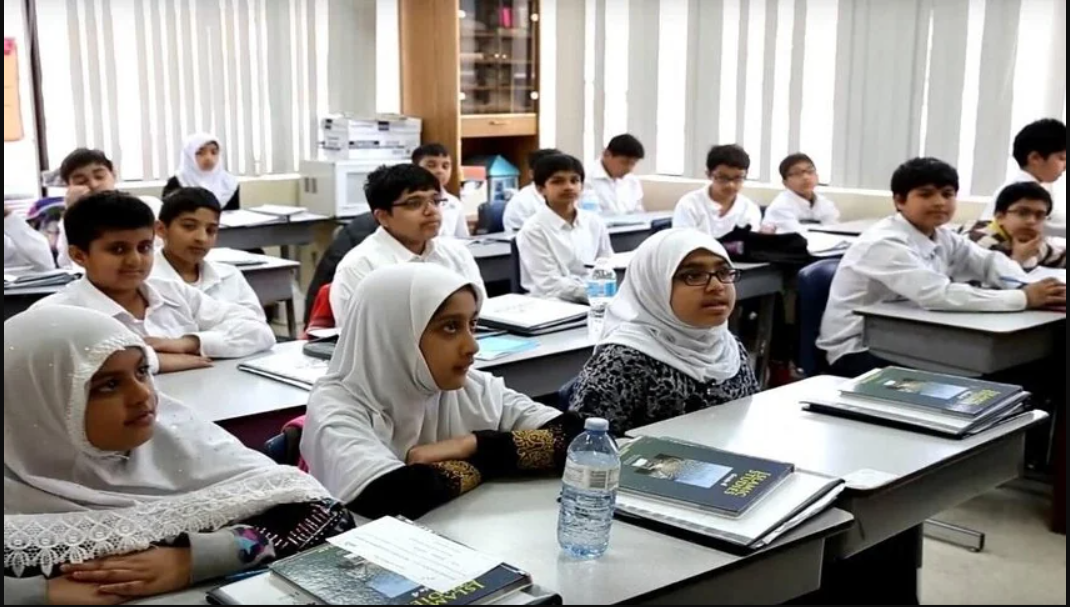
Democrat Sarah Eckhardt, elected Texas comptroller on Nov. 3, has vowed to ensure that Islamic schools can participate in the state’s taxpayer-funded voucher program when she takes office in 2027. The comptroller’s office administers the program. One participating Islamic school, Iman Academy in Houston, requires girls to wear the hijab starting in fourth grade.
The Texas Education Freedom Accounts program gives families roughly $10,500 a year per student for private school tuition. Republican Comptroller Kelly Hancock initially excluded Islamic schools. Muslim families and Islamic schools sued, and in March 2026 a federal judge ordered the state to consider their applications. The comptroller’s office then accepted Iman Academy into the program.
Iman Academy’s parent and student handbook states that for girls in grades four through 12, “Wearing a hijab is mandatory.” The hijab must cover all of a girl’s hair and must be plain black, white, gray or beige. Girls in kindergarten through third grade must wear the hijab during Quran classes, Islamic studies, prayer and assemblies. The handbook says the school follows the teachings of the Quran and the Sunnah.
Several Islamic legal rulings explain why they require girls to cover. Saudi scholar Muhammad ibn Uthaymeen ruled that a girl must wear the hijab once men could be attracted to her, “so as to ward off fitnah and evil.” Fitnah means temptation or trial. A fatwa on IslamWeb says the hijab was imposed on women to “block the way that leads to committing what is unlawful.” It adds that covering keeps men from seeing and desiring women. In a separate ruling, IslamWeb responded to the mother of a 9-year-old fourth grader who wanted to wear trousers by warning that the girl “is a female who could be desired by men.” The rulings also advise parents to have girls wear the hijab before puberty so they get used to it.
Florida also pays tuition at Islamic schools through vouchers. Over the past decade, Hifz Academy in Tampa and Bayaan Academy in Temple Terrace received $15.7 million and $2.7 million, respectively, in state scholarship funds, according to Step Up for Students, the nonprofit that administers most of the state’s scholarships. In October 2025, all three members of the Florida Cabinet questioned whether the schools should receive the money. Attorney General James Uthmeier said the use of vouchers “to promote Sharia law likely contravenes Florida law.” Chief Financial Officer Blaise Ingoglia said his office was considering audits of Tampa-area Islamic schools. In 2003, Florida suspended voucher funding for Tampa’s Islamic Academy of Florida after two men affiliated with the school were charged in terrorism cases. Both were later convicted.
Starting Jan. 1, 2027, the federal government will also subsidize private school scholarships through the Education Freedom Tax Credit, created by the One Big Beautiful Bill Act. Individual taxpayers can claim a nonrefundable credit of up to $1,700 for cash donations to scholarship-granting organizations in states that opt in. Those organizations pay tuition at private schools, including religious schools. More than two dozen states, including Florida, have told the IRS they will participate.
Islamic prayer practices are also appearing in American public schools under conditions that parents have questioned on grounds of religious freedom and equal treatment of faiths. Meanwhile, some school districts have barred Christian clubs or prayer activities. In Nashville, Tennessee, Attorney General Jonathan Skrmetti said John Overton High School was promoting a particular religious viewpoint by arranging for Muslim students to pray during the school day during Ramadan.
In Frisco, Texas, the Muslim Student Association at Liberty High School posted a video saying that “only Muslims will be allowed in” its classroom prayer space. The club also offered students one district volunteer hour for each prayer rug they donated, though Frisco ISD guidelines say donated goods do not count toward community service hours.
At John Overton High School in Nashville, Tennessee, more than 80 students signed up for passes to leave class for daily prayers during Ramadan. A school employee supervised the sessions, and students used a divider to separate boys and girls. Ten teachers volunteered to keep their classrooms food-free for fasting students during lunch.
The same week the Overton story drew national coverage, a Tennessee House committee voted 12–7 to table a bill that would have required public schools to set aside a daily period for prayer and reading from the Bible or other religious texts.
Ad block users: Some site features may not work correctly while an ad blocker is enabled, because they break scripts and content this website depends on. If you can’t see comments below, for example, please disable your ad blocker.