From New Zealand Herald and Cairns News
Cairns News finds it hard to believe Christchurch mosque shooter Brenton Tarrant is spinning the narrative he was so traumatised by “harsh” prison conditions he was unable to make a rational plea in his original court proceedings.
He is seeking leave to appeal against his convictions and to vacate his guilty pleas for the mass shootings at two Christchurch mosques on March 15, 2019.
The “inhumane” conditions of his confinement had formed the basis of the 35-year-old’s argument that he was not fully functional when he decided in March 2020 to plead guilty to the massacre.
He will tell the court that, when he pleaded guilty to the murder in 2019 of 51 men, women and children at two Christchurch mosques, he was incapable of making rational decisions.
The Christchurch mosque shooter’s phone calls are monitored and would be cut if he shared his ideology, and he had a camera on him at all times, a court has heard.
Brenton Tarrant’s prison conditions, which he claims were so dire that they led to his guilty pleas, also included limited access to books, no radio and “activity sheets” which were actually just a list of items.
How these weak and unlikely reasons to launch an appeal have made it to an appeals court after seven years defies legal logic, especially for an alleged mass murderer.
Cairns News has published quite a different version to the official narrative dished up by socialist WEF operative and then Prime Minister Jacinda Ardern.
Tarrant, according to military intelligence we received, is an Israeli-trained assassin on a watch list since 2012 for attempting to assassinate Syrian President Bashar Al-Assad, according to strong, corroborating evidence from Veterans Today, a private military publication.
The spin being propagated by New Zealand and ABC media that Tarrant was unfit to plea is probably true, but not because of harsh prison conditions, a claim defence barristers and the prosecution, according to the court narrative, are finding hard to believe.
He would have been through the MK Ultra loop years ago to qualify as an assassin for Israel whose modus operandi does not take anyone off the street for important missions.
He was trained by one of the world’s best military and spy services, Israel. The video Tarrant allegedly posted online and then banned by the NZ government has proven to be fake, thus ensuring the mosque shootings fall into the same category.
https://cairnsnews.org/2025/08/26/forensic-report-declares-banned-nz-mosque-shooting-video-as-fake/
Could it be this video analysis the press are not allowed to report but known about by Tarrant, is the real basis of his appeal or re-trial?
This fake video could be sufficient evidence for a re-trial not the bullshit “harsh conditions” claim being floated by the legacy media.
There is no chance he would have got into an appeals court on the lame duck excuse of trauma caused by spartan prison conditions making him of unsound mind. MK Ultra and Israel did that.
It should be realised that the report from Veterans Today in the article above mentions real firearms being used, obviously taken from the original, official narrative which pre-dates the forensic report of the mosque video which was released in 2025, revealing that a real gun was not used.
Tarrant has been able to regain his proper, and possibly normal mental state after 7 years in the slammer and realised what has happened to him after his programmed attack on Muslims, inculcated by Jewish Mossad.
This NZ operation was just one of many carried out around the world over decades by the calculating Jews of Israel. Australia had Port Arthur and recently Bondi Beach murders both designed to disarm the country, compliments of Mossad and agent Epstein’s ‘honey pot’ sex traps or financial blackmail of senior politicians and bureaucrats.
These allegations have been well-aired in the recent release of the Epstein files relating to Australia.
Tarrant was jailed for life without parole in 2020 for murdering 51 people at the Al Noor and Linwood mosques.
Earlier today, the leave to appeal hearing, being held in the Court of Appeal in Wellington, heard that the shooter wanted to be described as a terrorist and was pleased when police laid a terrorism charge.
Lawyers Jonathan Hudson and Shane Tait, who represented the gunman between March 2019 and July 2020, gave evidence for the Crown(similarities to Martin Bryant’s lawyer John Avery?)
Hudson was questioned by one of Tarrant’s four lawyers, all of whom have name suppression, and told the court that when police laid a terrorism charge, he was pleased.
“He wanted to be described as a terrorist,” Hudson said.
There is conflicting evidence about whether the gunman wanted to change his plea to guilty after initially entering not guilty pleas.
Yesterday, the terrorist told the court that he planned to represent himself at the time, and the only reason he retained his counsel was so they could tell him what was going on in the outside world.
Both Hudson and Tait denied that it was the case, telling the court that from their many meetings, they gained the impression that the killer always planned to plead guilty; it was just a matter of when.
Tait told the court that the gunman indicated that he would plead guilty at a time that suited him.
He said when he pressed the gunman about his defence, asking, “Brenton, what am I going to tell the jury if we go to trial?”, his response was, ”Don’t worry, it’s not going to get that far”.
Despite indications of a guilty plea, the lawyer said they continued preparing for a trial right up to the point the defendant pleaded guilty.
The gunman had indicated that he wanted a defence of self-defence, but the lawyers explained this was not available to him, and they didn’t believe he had a lawful defence to the charges he faced.
Both lawyers were questioned about the gunman’s conversation with them, in which he formally indicated he wanted to change his guilty plea in August 2019, something which Hudson admitted surprised him. He eventually pleaded guilty in March 2020.
Both denied that this had to do with his declining mental health.
Much of the questioning by one of the gunman’s current lawyers at today’s hearing centred on his mental health and questions over whether it deteriorated over the time he was in custody, when he was being held in solitary confinement.
Hudson told the court he “took comfort” from two mental health assessors’ reports, which indicated there were no problems with the gunman’s fitness to plead.
The lawyer said his client’s mental health was consistent in the dealings he had with him.
In his evidence, Tarrant told the court that at one meeting the two had raised concerns about his mental health, saying he wasn’t speaking the same way. But neither lawyer said they could recall that conversation.

Both lawyers said the way they were treated in prison, when visiting the terrorist, was different from that of other lawyers visiting their clients. They claimed they were subjected to more stringent searches and were taken to the isolation unit where he was being held.
They said that after some initial problems with the way the gunman was being treated, including being handcuffed and forced to wear a suicide suit, and not being given access to reading and writing materials, all seemed to settle down after a month or so.
Tait told the court that the gunman had shown some anxiety during this initial period, but did not appear to be depressed.
Tarrant now says the guilty pleas he entered to 51 counts of murder, 40 counts of attempted murder and a single charge of engaging in a terrorist act were the result of harsh prison conditions, which drastically affected his mental health.
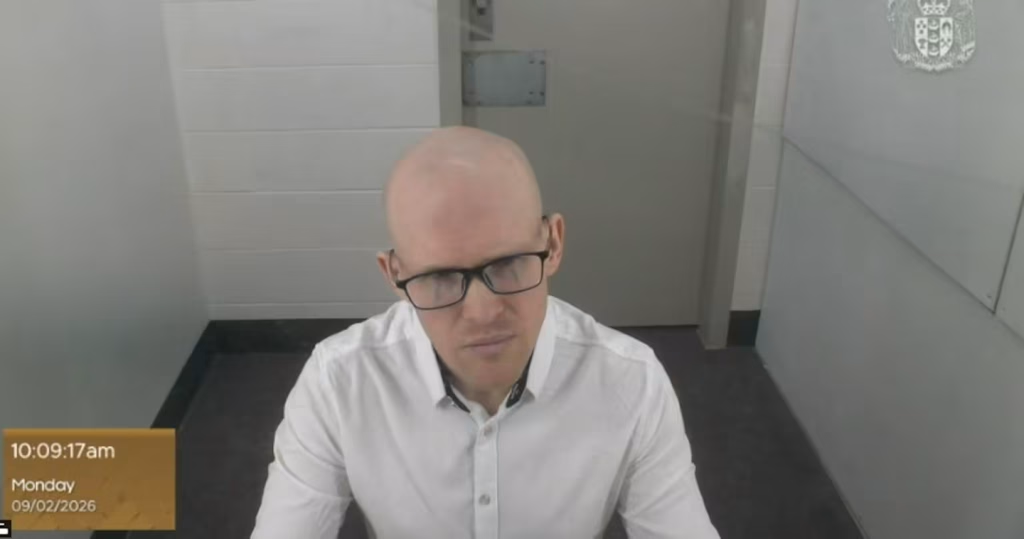
Yesterday, the convicted terrorist spoke at length for the first time, by audiovisual link from prison.
Wearing a white shirt and dark rimmed glasses, his head shaved, he told the court he was effectively “forced” to plead guilty because of the harsh prison conditions.
“If I had another option, I would have taken it,” he said.
He told the court his mental health deteriorated after he was imprisoned and awaiting trial, and he was essentially not fit to plead guilty when he did.
The court also heard from a psychologist who concluded that the solitary confinement he was subjected to likely contributed to a decline in his mental health.
This afternoon, another of his appeal lawyers questioned a Corrections official, whose name is suppressed, about his conditions in prison.
The man agreed that Tarrant initially wasn’t given access to a radio, but denied he was prevented from reading news reports. The court heard that Tarrant received a list of news items which were sent to him daily.
He was also given access to certain books, but not the general library, as other prisoners were. Instead, the books would be vetted by staff before he could read them.
When it was suggested that there were times when the gunman had nothing to read, the Corrections official said that was not correct.
He said he could look at activity sheets prepared for him. However, under questioning, he agreed the activity sheets did not always include activities and sometimes were just a list of items, such as “towel, Jandals and soap”.
“They are not really activities,” Tarrant’s lawyer said.
“Yes, I accept that,” the Corrections official responded, but said the terrorist did have access to word games and puzzles.
The official admitted Tarrant had been in a unit by himself before he was joined by another prisoner, but denied this was deliberately done near the end of his appeal period.
The official also accepted that the gunman’s phone calls were not only recorded but also monitored and could be cut off if he began discussing things that were not appropriate.
He also had a camera on him at all times, unless he hid under a table in his cell, which was the only blind spot.
The lawyer also asked why prison staff had phoned lawyers on Tarrant’s behalf to try to get him legal representation, suggesting that it was highly unusual.
Typically, a prisoner filled out a legal aid form and legal services then assigned them a lawyer.
The man explained that the staff were simply trying to be helpful.
Under re-examination by the Crown, the official explained that the gunman’s phone calls were monitored because of the risk he would try to share his ideology.
Anything said over the phone could potentially be recorded by whoever he was speaking to and posted on social media, he explained.
The hearing before Justices Christine French, David Collins, and Susan Thomas is set down until today. – Contributed