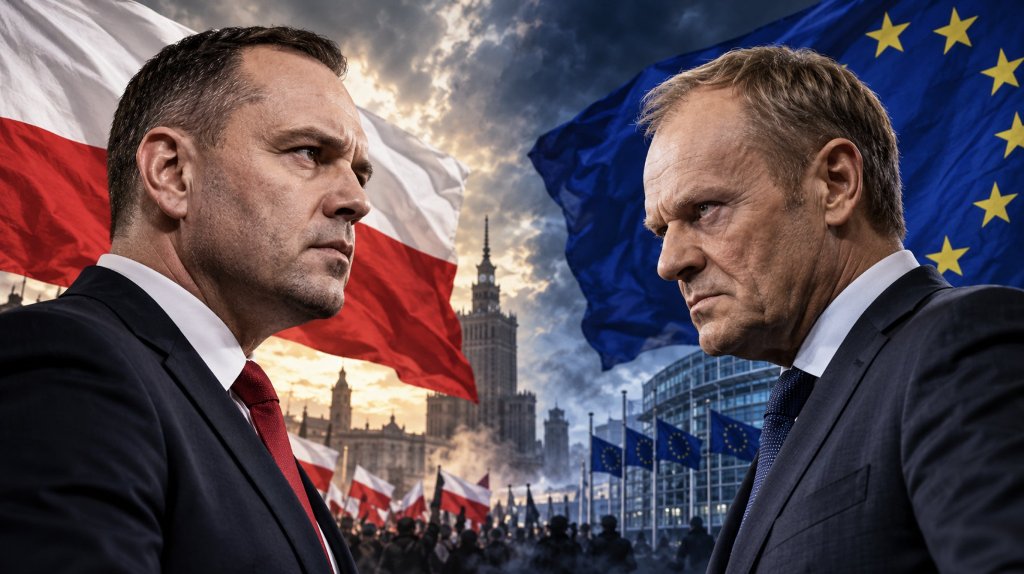
Poland, the Prime Minister and the President: Key Points Worth Knowing Following the Recent Coup Attempt
By Aɴᴛ
Before returning to Polish politics, current Prime Minister Donald Tusk spent years occupying some of the EU’s most influential positions.
After serving as Poland’s Prime Minister from 2007 to 2014, he headed to Brussels, where he served as President of the European Council from 2014 to 2019.
He then became President of the European People’s Party (EPP), one of the EU’s most influential political groups, holding that position until 2022.
For many years, you could say he was the head of the snake, or at least one of its many heads, responsible for the authoritarian rot that has become of the EU.
These days, you may see him talking about Poland taking a strict approach to migration, but the truth is, if he had his way, Poland would capitulate entirely to EU rule, having to adopt the Euro and opening the floodgates to third-world migration.
In 2021, he returned to lead Civic Platform (Platforma Obywatelska), a party often described as centre-right, but one which has far more in common with the left.
In December 2023, because, like every country in Europe at the moment, Poland has its fair share of stupid people, he became Poland’s Prime Minister once again.
Poland’s President, Karol Nawrocki, a conservative nationalist elected in 2025, was exactly what Tusk’s government didn’t want.
Since then, there’s been an ongoing power struggle between the President and the government, with Tusk’s administration repeatedly clashing with Nawrocki over the exercise of his constitutional powers.
Now, his government is at the center of what President Karol Nawrocki has condemned as an attempted coup, following the forcible takeover of Poland’s Constitutional Tribunal by government backed judges, with police deployed and the Tribunal’s leadership prevented from entering.
Unfortunately, the Polish Constitution gives the Prime Minister considerably more power over the day to day running of the country than the President.
While the President can veto legislation, the Prime Minister controls government policy and administration, meaning Tusk retains considerable power as long as he has a parliamentary majority.
That said, the President is also the supreme commander of Poland’s armed forces and has the constitutional authority to dissolve parliament under certain circumstances.
However, those powers are subject to strict constitutional limitations. The President cannot simply dissolve parliament because of a political crisis or a dispute with the government.
Given how extreme things have become, the question now is what constitutional options remain available to Nawrocki and whether he has the support of the Polish people to challenge Tusk’s government.
Original source: https://x.com/antspeaks/status/2116551673543815523/photo/1