

A PETA-linked group run by a longtime vegan activist and major Democrat donor has been caught pushing false claims that American taxpayers are currently funding cruel animal experiments in Russia under the Trump administration.
The Physicians Committee for Responsible Medicine (PCRM), led by Neal Barnard, featured the assertions prominently on its homepage and in a petition and fundraising appeal in mid-November, long after National Institutes of Health funding for all Russian animal labs had been cut off following investigations by the taxpayer watchdog White Coat Waste and action by congressional Republicans.
PCRM’s homepage stated: “U.S. Taxpayers Funding Animal Cruelty in Russia,” alongside a photograph of a cat. Its linked petition opened with the line “Your tax dollars are funding animal cruelty in laboratories overseas—please act now,” immediately followed by a Russian cat experiment offered “for example.”
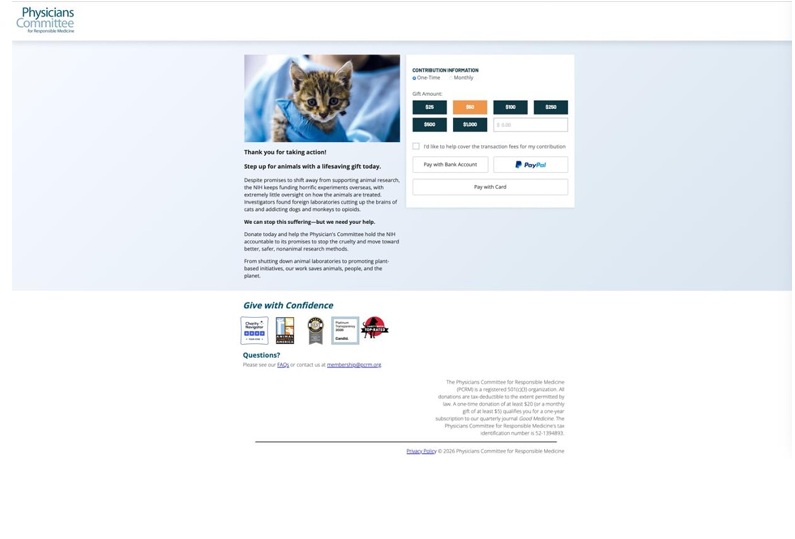
The donation page, after referencing those same Russian cat experiments, stated: “We can stop this suffering—but we need your help.”
The petition’s specific example described experimenters removing part of a cat’s brain, cutting open her spinal cord, implanting electrodes, strapping her into a restraint device, and forcing her to walk on a treadmill while delivering electrical shocks before killing and discarding her.
The post-petition donation page further claimed that “Investigators found foreign laboratories cutting up the brains of cats,” without identifying who conducted the investigation or noting that the funding had already ended.
When confronted by The Gateway Pundit, PCRM stealth-edited its homepage, changing the word “Russia” to “overseas” while continuing to feature the cat image and solicit donations tied to the same narrative.

The group did not respond to detailed questions from Gateway Pundit about the status of any NIH funding for Russian animal experiments, why it presented the cat procedures as an example of current taxpayer spending without disclosing the cutoff, or which “investigators” its donation page referred to.
The questions were sent to Barnard and PCRM’s director of research policy, Janine McCarthy, with a deadline of Monday. No reply was received as of Wednesday morning.
NIH’s current assured-institutions directory lists no Russian institutions with an approved animal-welfare assurance that would allow them to receive U.S. funding for animal research.
In April 2023, NIH stated that “NIH currently does not fund any research in Russia,” a statement later quoted by the House Energy and Commerce Committee.
That cutoff followed June 2022 guidance from the Biden White House directing a wind-down of research and funding relationships with Russian government-affiliated institutions in the wake of the invasion of Ukraine.
The original exposure of the Russian cat experiments came years earlier from White Coat Waste, not PCRM.
In 2022, White Coat Waste uncovered NIH funding routed through U.S. institutions to a Kremlin-linked lab in Russia for the treadmill and electrode procedures on cats.
The group’s investigation and subsequent campaign, supported by lawmakers including House GOP Conference Chair Rep. Lisa McClain and Sen. Joni Ernst, contributed to the 2023 cutoff of NIH eligibility for Russian animal labs.
Sen. Rand Paul later featured related waste in one of his Festivus reports.
The Gateway Pundit has extensively covered White Coat Waste’s work on these and similar taxpayer-funded animal experiments, including the group’s earlier success ending the Russian funding and its ongoing efforts against other dog and cat testing.
Trending: Brandon Gill Makes an Excellent Point About the Timing of Mamdani Shutting Down the NYPD Counterterrorism Unit (VIDEO)
PCRM’s fundraising page continues to solicit money using the Russian cat experiments more than three and a half years after the funding ended, presenting them in a way that implies ongoing U.S. support under the current administration and suggesting that donations to PCRM would help stop them.
The group has not credited White Coat Waste for first bringing the NIH’s Russian cat lab funding to light in March 2022.
During the Biden administration, when White Coat Waste initially exposed the lab, PCRM does not appear to have publicly highlighted or campaigned against it in the same manner.
Barnard, PCRM’s founder and president, has a long record of financial support for Democrats.
Since 2018, he has donated more than $50,000 to Democrat and liberal anti-Trump candidates and committees, according to FEC records and DonorTrail.
That includes $15,350 to Rep. Jamie Raskin, who led Trump’s second impeachment and played a prominent role in the January 6 investigation, and $5,000 to the DNC in September 2024 while Kamala Harris was the Democrat nominee.
Since 2016, 100 percent of identified federal political contributions from Barnard and PCRM employees have gone to Democrats and left-wing progressives.
PCRM also has longstanding ties to PETA.
Barnard has served as a medical advisor to the group and written for its publications.
In a 1995 article in Animal People News, editor Merritt Clifton wrote that Barnard and PETA president Ingrid Newkirk had “lived together for many years” and were “lovers,” a tidbit that is also found in legislative records.
Just like PETA is deceptively named, presenting itself as great defenders of animals while wholesale euthanizing them at their Virginia headquarters, PCRM also doesn’t really live up to its name, “responsible medicine,” as only a small fraction of its members are physicians.
This is the second time this year that a major animal-rights organization has promoted claims about ongoing Trump-era funding for the same Russian cat experiments despite White Coat Waste and Republican lawmakers solving the problem years ago.
In January, Gateway Pundit and White Coat Waste exposed a similar PETA webpage and social media posts asserting that taxpayers were still funding the Russian cat tests.
PETA also removed the false and outdated claims after being challenged.
PCRM, meanwhile, has not explained why it promoted the Russian cat experiments as an example of current taxpayer spending years after the NIH funding cutoff.
Ad block users: Some site features may not work correctly while an ad blocker is enabled, because they break scripts and content this website depends on. If you can’t see comments below, for example, please disable your ad blocker.

