Movie Review of the Odyssey – “Who Knew Ancient Mycenaean Greece Was So Diverse?”
by Kelly Walker at Freedom Talk Magazine
I’m watching the scathing reviews pour in for Christopher Nolan’s reinterpretation of the classic Greek epic, The Odyssey. Chances are, you’ve seen them too.
But I haven’t seen a review explaining why this movie is objectively bad beyond mere personal preference…so I wrote one.
You read that correctly: I said objectively—not subjectively. This isn’t a matter of preferring chocolate ice cream over vanilla. It’s more like choosing ice cream over strychnine.
Nolan has acknowledged drawing inspiration from Emily Wilson’s acclaimed translation of The Odyssey, a translation that filters Homer through a contemporary progressive lens by emphasizing themes of gender, power, oppression, and social justice in ways that differ from traditional translations. Critics argue that choices such as describing female servants as “slaves,” rendering polytropos as “complicated man,” and presenting Odysseus less as an epic hero than as a morally ambiguous figure reflect modern interpretive assumptions rather than faithfully translating the essence of the Greek.
Ἄνδρα μοι ἔννεπε, Μοῦσα, πολύτροπον…
Andra moi ennepe, Mousa, polytropon…
“Tell me of the man, Muse, polytropos…”
The result is not merely a new translation, but a reinterpretation shaped by contemporary ideological frameworks—often described as feminist or intersectional—at the expense of the poem’s traditional heroic ethos and mythic grandeur.
“Always be the best, my son, and surpass the others, and do not disgrace the generation of your fathers.” Iliad 6.208–210
This movie isn’t merely about art, but the politics of deconstruction, and so evaluations based on personal opinion or taste are worthless. The angst-inducing mosh pit of social media noise presents myriad opinions “told by an idiot, full of sound and fury, signifying nothing,” that shed little light on the issue.
Most of the critiques I see, including on one of my favorite movie review channels: fellow Scotsman, The Critical Drinker, focus on issues like historical authenticity: Helen of Troy was imagined as a fair-skinned Greek woman…and Achilles was definitely not imagined as a 90-pound woman pretending to be a man.
Many of us share the Drinker’s frustration: Can’t we simply enjoy a great story without being bludgeoned by “The Message!?”
The Odyssey – I don’t know, man… https://t.co/RdTR1BJFNE
— The Critical Drinker (@TheCriticalDri2) May 6, 2026
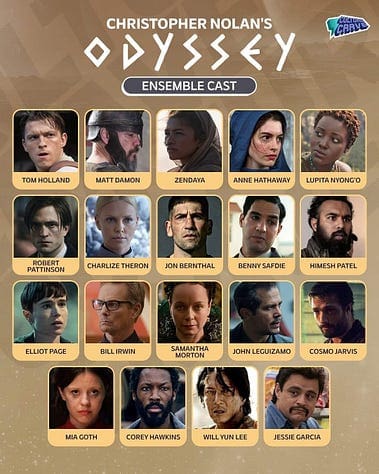
Who knew ancient Mycenaean Greece was so “diverse?”
But even these criticisms don’t cut to the heart of why we are objectively right to dislike this movie.
I contend this movie is bad because it peddles lies and robs a generation of a priceless treasure. It presents a modern reinterpretation as though it makes Homer more “accessible” and “relatable” by substituting contemporary ideological dogmas for the worldview of the original. This isn’t simply artistic license; it blurs the distinction between what The Odyssey is and what modern interpreters wish it had been.
It doesn’t connect us to Homer or enlighten us with works of great literature, it buries Homer and mutilates his sublime work, and that does violence to our cultural heritage.
French philosopher Jacques Derrida (1930–2004) was one of the principal architects of postmodern thought and the founder of deconstruction, a method of literary criticism that challenged the idea that texts possess a single, objective meaning rooted in an author’s intent. Instead, Derrida argued that meaning is fluid and shaped by language, culture, and the reader’s perspective. If everything is relative, and truth a mere construct based on personal interpretation, why not “reimagine” a classic?
Applied to the Odyssey, this approach encourages each generation to reinterpret Homer’s epic through contemporary lenses rather than seeking to understand its original worldview. Critics argue that this mindset transforms timeless classics into vehicles for modern ideological concerns, while supporters contend that it keeps ancient works relevant by allowing them to speak anew to each age.
But the deconstructionist view is simply untrue. Fact check: Homer did have an intent in composing these epics, and that intent was preserved through generations—first by oral tradition and later in written form—enriching the lives of millions. His poems arose from a particular people, culture, moral vision, and historical moment. The themes he deliberately wove into these masterful tales shaped the moral imagination of the Greek world, enlightened countless readers over the centuries, and became one of the foundational influences on Western civilization.
When we continually remake great works in our own image, we cease learning from them and instead demand that they affirm us. Rather than allowing the past to challenge our assumptions, we domesticate it to fit our own. Perhaps that’s one reason so many modern adaptations feel interchangeable: the heroic costumes don’t quite fit and the spark just isn’t there.
As Wordsworth so presciently wrote in his poem “The Tables Turned” (1798):
“Our meddling intellect
Mis-shapes the beauteous forms of things:
We murder to dissect.”
We carve up a woman to pretend she’s a man, and that’s her choice, but rational people can’t be expected to play along or conform to dysphoria and mutilation. Nor can we pretend the constant deconstruction of Western culture isn’t tearing it limb from limb, or that a banana duct taped to a wall is art to anyone above the IQ of a chimpanzee.
By constantly “reinterpreting” the story through a modern lens, idealogues distort the message, depriving society from experiencing the enrichment of a brilliant mind. It’s a theft of beauty, and an assault on meaning. That’s why so many modern movies are objectively terrible—they’re the same message repeated over and over through a “reimagining” of multiple movies. They’re burying the brilliance of Homer, stealing it from a society more in need of a diversity of thought than of skin color.
Marcus Tullius Cicero spoke these wise words: “To be ignorant of what occurred before you were born is to remain always a child.” (Orator, 120)
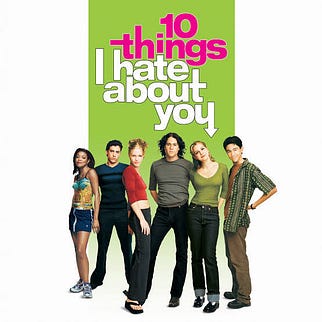
“But,” one may ask, “how is this any different from a modern adaptation like Shakespeare’s The Taming of the Shrew becoming 10 Things I Hate About You?”
 |
It’s a fair question, but a false comparison.
The 1999 film starring Heath Ledger and Julia Stiles is an affectionate homage to Shakespeare. It doesn’t pretend to replace the original, to “correct” its worldview, or deconstruct it into something fundamentally different. Instead, it borrows the story’s central themes and reimagines them in a contemporary setting while leaving Shakespeare’s work intact. That’s very different from approaching a classic with the intention of reinterpreting it through a modern ideological framework or recasting its meaning to better reflect contemporary values.
The Iliad and the Odyssey belong to a Western civilization, Greek culture, and a particular historical moment. We can never recreate that world perfectly, but we should strive to understand it as faithfully as possible. Stretching ourselves to enter another time and place is not merely intellectually enriching—it is essential to genuine wisdom and human flourishing.
This monstrosity of a movie is a Trojan horse for the warped political ideology that’s robbing the world of its color, vitality and cultural richness. Some gifts are best left outside the gates. 🐴
FreedomTalk is restoring Truth & Virtue to our culture, and do we ever need it! For just $5 a month, you’re helping make it happen.