
The Allied Democratic Forces (ADF), an Islamic State affiliate, killed at least 75 civilians and abducted about 40 people in Mambasa territory, Ituri province, in the week ending Nov. 14, 2026. Days earlier, the group attacked Cantine-Aloya in Beni territory, North Kivu province, overnight on Nov. 5–6. The World Health Organization (WHO) and the Africa Centres for Disease Control and Prevention (Africa CDC) put the death toll from that attack at 66, including three health workers.
In Mambasa, the fighters struck Mingazi, Amani, Lelesi and Mitume in the Babila-Babombi chiefdom, where residents returning home found more bodies. They also attacked villages in Bangole. The fighters moved in groups of about 20 and burned houses and motorcycles.
The latest reported attack in Mambasa came late on the morning of Saturday, Nov. 14, at Ekatu. Rams Malikidogo, a civil society coordinator in Mambasa, said residents fled toward Beni and Butembo without food or assistance. He said authorities had been warned and that the military failed to respond. “The enemy is not being pursued,” he said.
“Some bodies are already in a state of decomposition. The victims were hacked to death with machetes, while others were shot,” Gabriel Tonge told Africanews. A humanitarian source told the outlet that ADF fighters were still hiding in the bush and had set up ambushes.
On Nov. 10, local and humanitarian sources reported that more than 40 bodies had been found since Nov. 1 in the Bakaiku grouping of the Babila-Babombi chiefdom. Most of the victims were farmers and other residents attacked in their fields. Families and rescue teams could not safely reach the villages to recover the bodies. John Vuleveryo, the Mambasa coordinator of the New Congolese Civil Society, called on the government to declare a national day of mourning. It remains unclear how many of those deaths are included in the Mambasa toll of 75.
In Cantine-Aloya, Justin Paluku, head of a local civil society group, told the Associated Press that more than 50 houses were set on fire. He called the attack “a major security failure.” Another civil society leader, Tchetche Aliamini, said most victims had been shot and the others had been burned or hacked with machetes, Al Jazeera reported.
Suspected ADF fighters struck Beni territory again shortly after midnight on Nov. 12. They killed four people and burned houses in the Kamahume neighborhood of Mabalako. Those four deaths were separate from the 141 reported in Mambasa and Cantine-Aloya.
WHO Director-General Tedros Adhanom Ghebreyesus said three health facilities were looted and burned in the Cantine-Aloya attack. Christian Kakule, medical director of the Kelekele Hospital Centre in Cantine, said 180 patients fled, including people with suspected Ebola and one patient with a confirmed case. “High-risk contacts and other individuals under monitoring have all fled,” Kakule said. Gunfire and burning homes were reported within 50 meters of the hospital.
The attacks came amid an Ebola outbreak declared on May 15. Congolese government figures cited by The Nation put the outbreak toll at 11,114 reported cases and 5,433 deaths. Ituri was the hardest-hit province, followed by North Kivu. At a Nov. 12 briefing, Africa CDC’s Wessam Mankoula reported four armed attacks, 16 assaults on responders, and 11 health facilities burned or otherwise targeted. In a Nov. 8 statement, Africa CDC condemned the Cantine-Aloya attack and called for a corridor of peace and protection for patients, health workers and health facilities.
The ADF has roots in Uganda and pledged allegiance to the Islamic State in 2019. The Islamic State calls it Islamic State Central Africa Province (ISCAP). In December 2025, FDD’s Long War Journal reported that “most, if not all,” of the civilians it counted as killed by ISCAP that year were Christian villagers. The outlet also reported that the Islamic State’s claims of responsibility described the massacres as attacks on Christians.
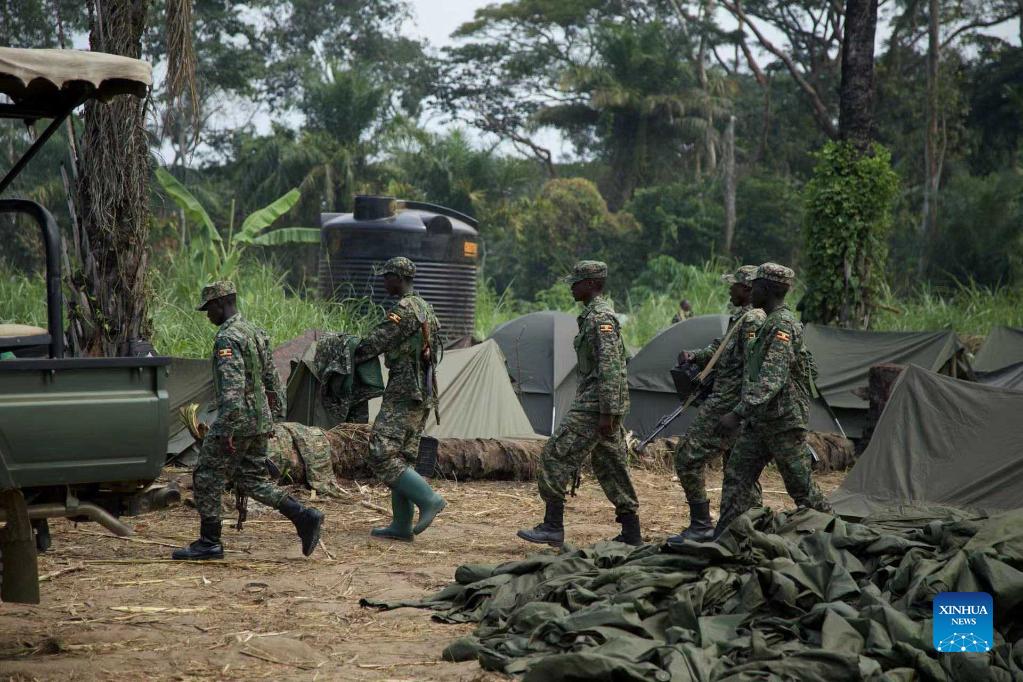
On Nov. 20, North Kivu’s military governor, Maj. Gen. Evariste Kakule Somo, visited Cantine with the commander of Ugandan troops deployed in North Kivu and Ituri. He urged Congolese and Ugandan forces to step up joint operations and pursue the attackers into their hideouts.
Congolese and Ugandan forces have conducted joint operations against the ADF since November 2021. Over that period, the group expanded from its base in Beni territory into neighboring Lubero territory and north into Ituri province, ISS research shows. Ituri’s share of ADF violence rose from 11% in 2020 to 40% by the end of 2024, according to ACLED.
In March 2026, UN Deputy High Commissioner for Human Rights Nada Al-Nashif said the ADF had expanded into Tshopo province and killed more than 260 people since October 2025. In June, the UN Group of Experts reported that efforts to contain the ADF’s geographic expansion had failed. The experts documented more than 1,000 civilian deaths in 2025 and recorded ADF activity more than 100 kilometers west of Mambasa town.
Ad block users: Some site features may not work correctly while an ad blocker is enabled, because they break scripts and content this website depends on. If you can’t see comments below, for example, please disable your ad blocker.


