


In Part 1 of this series covering the declassified documents released by the Trump administration, The Gateway Pundit reviewed a CIA Note examining Venezuela’s electronic-election manipulation capabilities from 2004 through 2020.
While the note does not establish that Venezuela successfully manipulated or attempted to manipulate a foreign election, or definitively prove that large-scale electronic fraud occurred in a specific Venezuelan election, it recounts intelligence reporting indicating that Venezuelan officials developed plans, access, and technical capabilities that could be used to manipulate their own electoral systems.
If U.S. intelligence officials believed it was technically possible for Venezuelans to replicate legitimate machine results, overwrite digital records, make manipulated votes appear to originate from authentic machines, and evade ordinary audit procedures, did comparable weaknesses and circumstances ever occur in the United States with potential domestic influence?
Taken together, the CIA Note suggests that predictable, difficult-to-detect manipulation would require more than a single vulnerability: it would depend on access to programming, machine security, electronic records, paper records, and the audit process.
Previously, The Gateway Pundit has written extensively about a report released by the Election Oversight Group (EOG) and used by the Department of Justice (DOJ) in part for its probable cause affidavit in Fulton County, Georgia.
The report alleges failures in many similar areas outlined in the CIA Note — including untested software, removed memory cards, surrogate tabulators, missing SHA authentication files, exposed encryption keys, and incomplete audit records. However, the discrepancies uncovered in the report would rely on domestic actions, rather than foreign interference.
Those allegations do not, by themselves, prove that the methods laid out in the CIA Note were used in Fulton County. But they do provide a concrete basis for asking whether the safeguards the CIA identified as essential to preventing undetectable manipulation were actually intact during the 2020 Presidential election.
Insider Access and Control of Election Infrastructure
The CIA Note claims that Venezuela’s capability to manipulate domestic elections came from “insider access,” mainly through centralized control over election technology and through those who program, operate, and audit the systems. This includes machine security, programming, paper records, and the audit process itself.
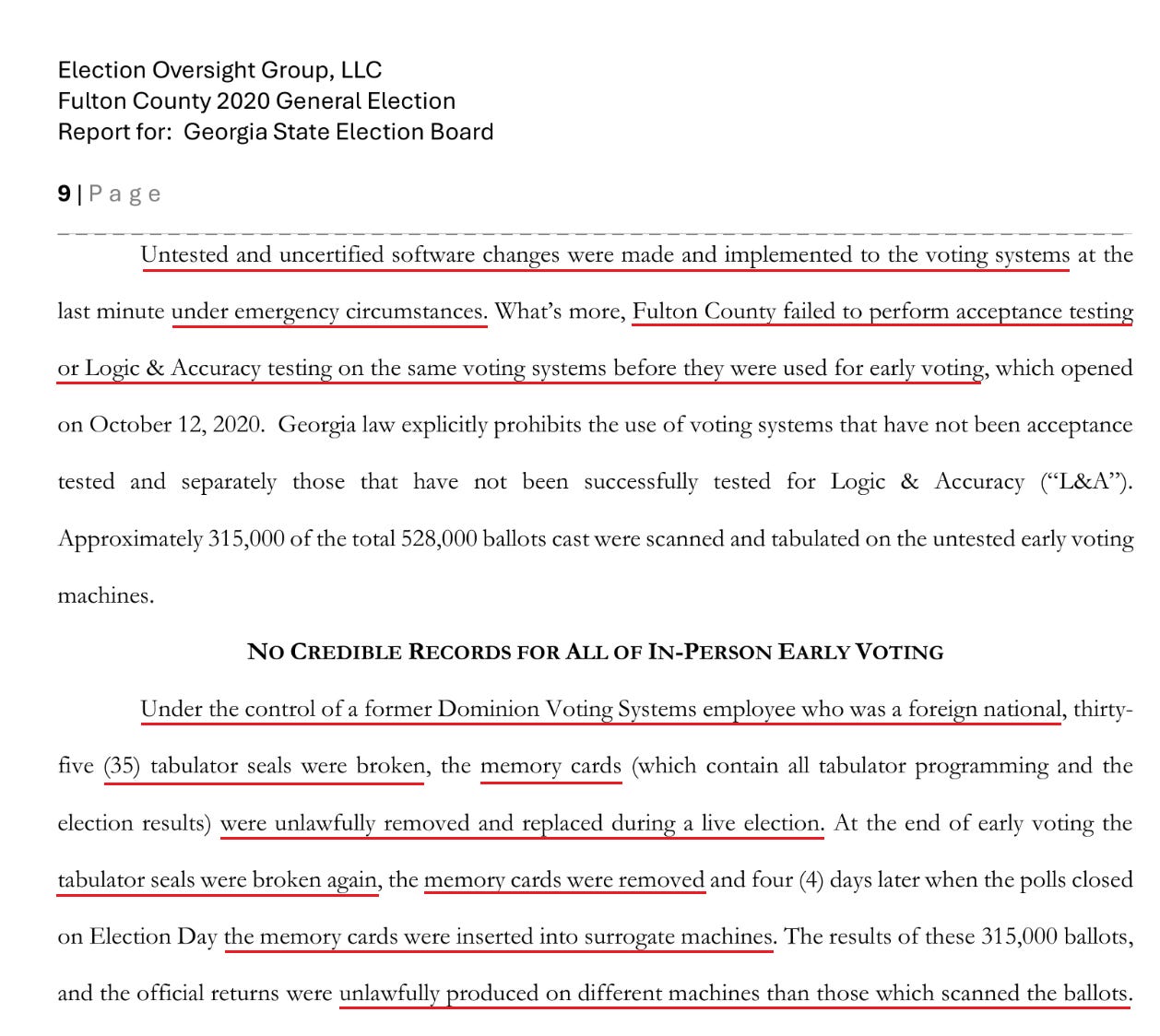
During the 2020 election in Fulton County, “untested and uncertified software changes were…implemented” under emergency circumstances, according to the EOG report. These machines never underwent the statutorily-required Logic & Accuracy testing. This is indicative of the access to programming laid out in the CIA Note accounting for 315,000 of the 528,000 ballots cast on untested machines during the Fulton County 2020 election.
Further, “under the control of a former Dominion employee who was a foreign national,” the tabulator seals were broken on 35 tabulators and memory cards were unlawfully removed and replaced during a live election. When early voting was completed, seals were once again broken, memory cards were removed and then inserted on “surrogate machines.”
The report alleges that the memory cards were later inserted into surrogate tabulators and that the results and official returns associated with approximately 315,000 ballots were produced on machines other than those that originally scanned the ballots.
Substituting Results While Making Them Appear Legitimate
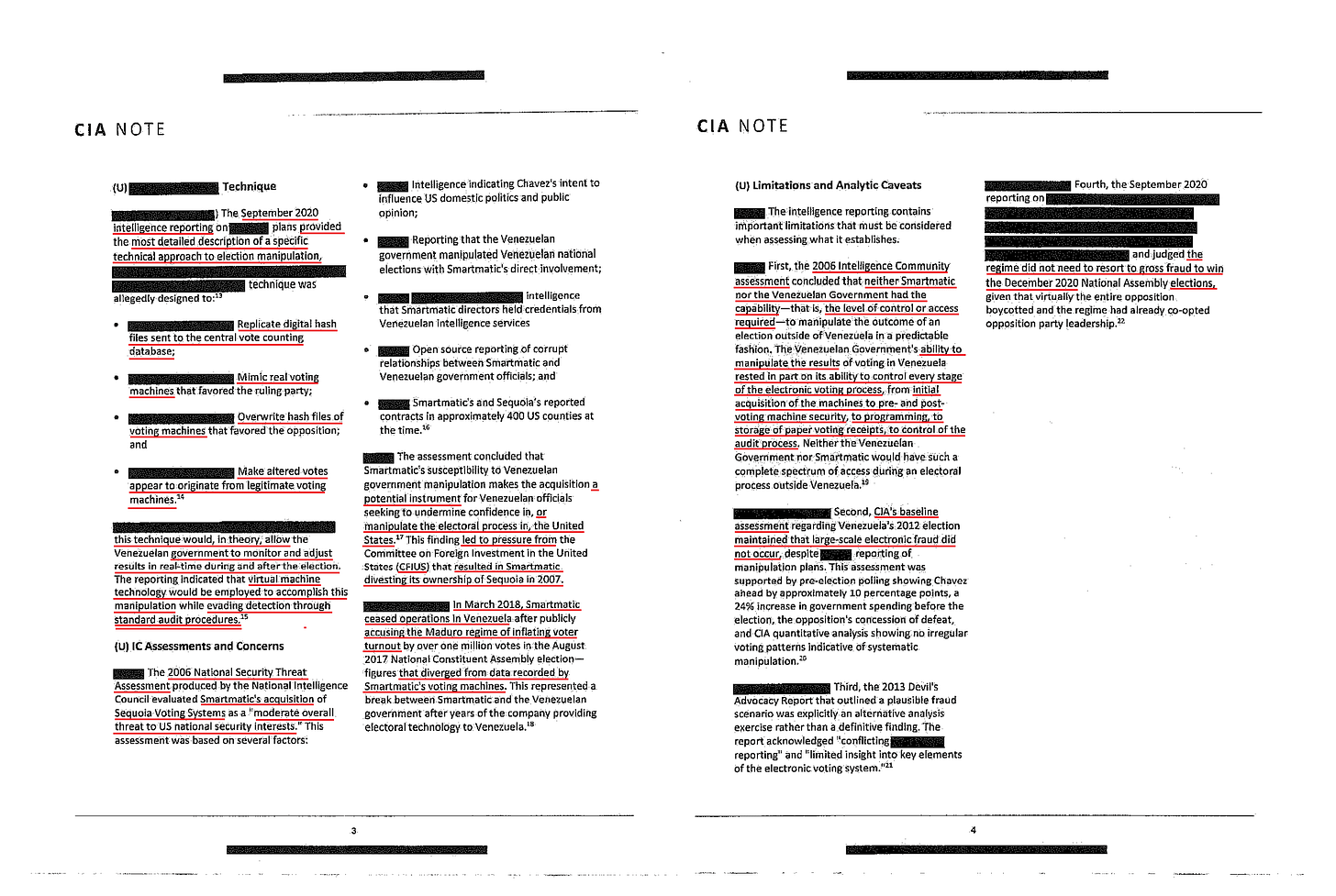
The CIA Note describes a Venezuelan technique that was designed to “replicate digital hash files to the central vote counting database,” “mimic real voting machines that favored the ruling party,” “overwrite hash files of voting machines that favored the opposition,” and “make altered votes appear to originate from legitimate voting machines” (pg. 3 of CIA Note).
The CIA Note continues, “The reporting indicated that virtual machine technology would be employed to accomplish this manipulation while evading detection through standard audit procedures.” The relevant page below:
Regarding the hash files, Fulton County was only able to produce 16,038 SHA hash files out of 148,318 absentee ballot images. Each ballot image creates a unique SHA file. There should have been 148,318 SHA files for each of the 148,318 ballot images.
The SHA file is crucial to “determine if a ballot image had been tampered with, altered or replaced” in the event of an audit or investigation being conducted.
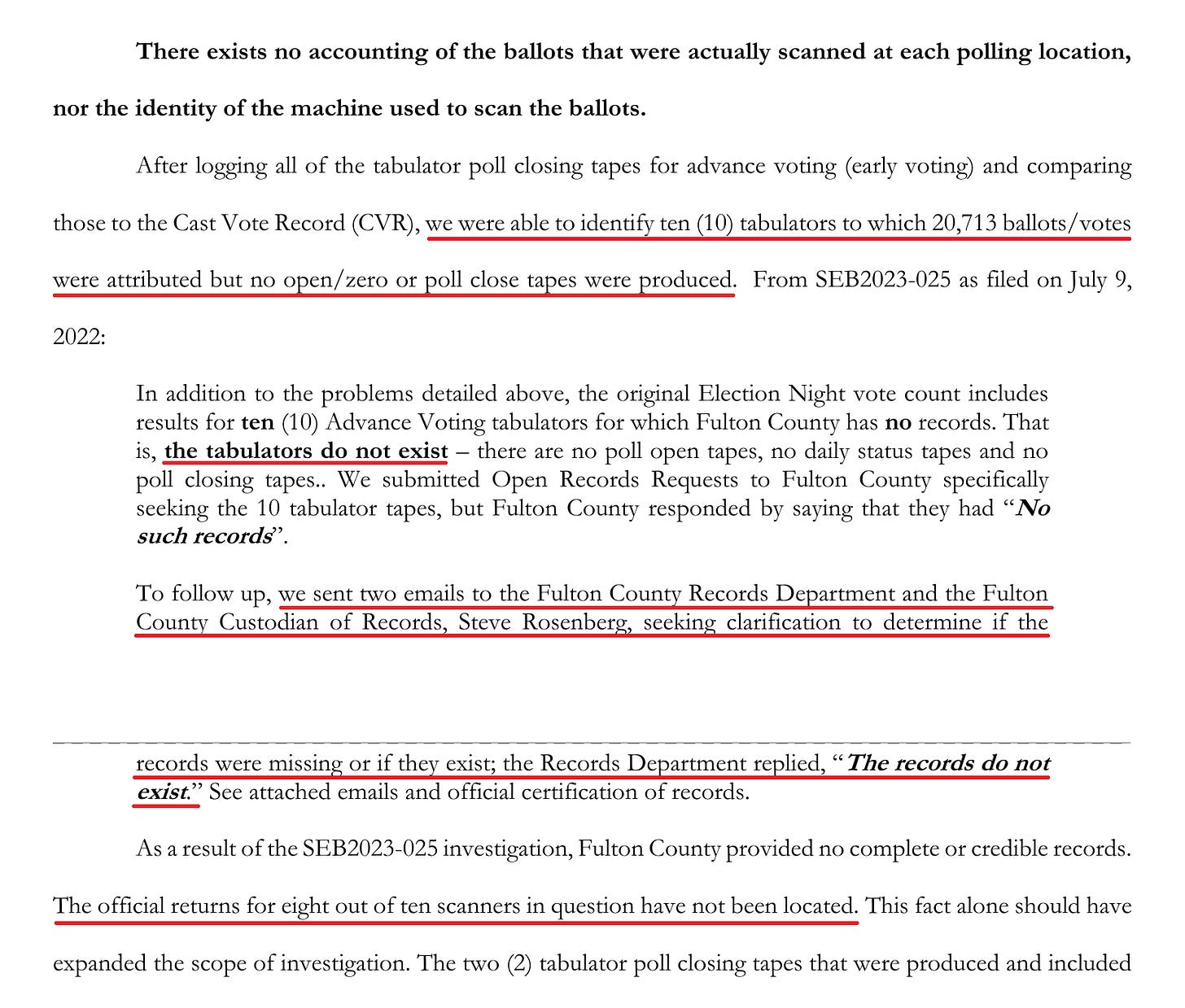
The report also claims 20,713 ballots or votes were attributed to ten tabulators for which no opening, status, or closing tapes were available. Although this does not necessarily mean that virtual-machine technology was used, it raises significant auditability issues.
While trying to validate the existence of those ten tabulators, emails and open records requests were sent to the Custodian of Records and the county’s Records Department but yielded responses of “No such records.” When asked to clarify whether they were missing or do not exist, the response was, “The records do not exist.”
Preventing Meaningful Reconciliation and Audit Detection
The CIA Note further says that successful manipulation would require control of not just the machines, but also the paper receipts, post-election security, and the audit process itself.
According to the Election Oversight Report, Fulton County has:
- No matching opening- and/or closing-poll tapes for early voting tabulators and missing serial-number continuity
- “Results for 148 tabulator memory cards were counted and included in the results. Of those, Fulton County has only produced nine (9) Poll Open tapes and 138 fraudulent, unsigned poll closing tapes (official returns). There is not one tabulator with an open and close tape pair bearing the same serial number; therefore, they could not have been validated or reconciled as required by law.”
- No credible records for ten machines and more than 20,000 accompanying ballots (see above)
- Missing voter check-in and numbered-voter records
- “Fulton County failed to create and maintain a manual record of in-person voters who cast a ballot at each polling location (called the “Numbered List of Voters”) as required by Georgia Law. Fulton County’s willful failures left no metric for the number of ballots cast and with no list of voters who cast a ballot, no way with which to determine how many ballots they were supposed to have for early voting.”
- 17,852 missing recount ballot images – missing from the candidate-requested recount
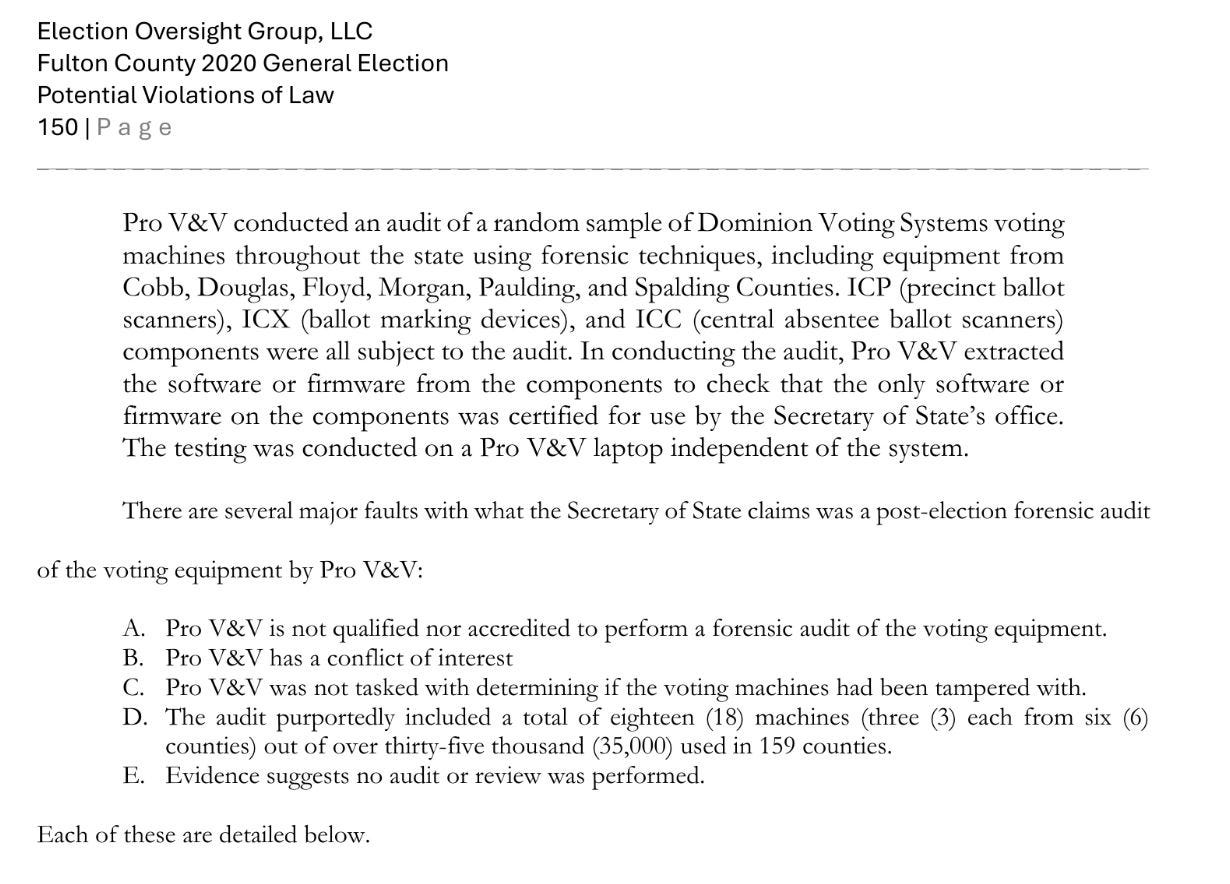
- A purported machine audit that examined only 18 out of approximately 35,000 machines:

Summary
The Election Oversight Group’s Fulton County report does not allege Venezuelan involvement.
Instead, it alleges that several of the same operational means the CIA identified as necessary for difficult-to-detect election manipulation were used domestically in Fulton County:
- insider access to election systems
- untested programming changes
- removal and substitution of memory devices
- production of official returns on surrogate machines
- missing authentication files
- broken machine provenance
- destruction of election records
- and an audit process allegedly incapable of determining whether tampering occurred.
While the report does not prove that every element of the Venezuelan virtual-machine method was deployed, it presents evidence that many of the access, substitution, authentication, and audit-control mechanisms described in the CIA Note were present in Fulton County.
Based on this information and information put out the CIA, every American should be asking themselves: Why aren’t our elections more secure than Venezuela?
Ad block users: Some site features may not work correctly while an ad blocker is enabled, because they break scripts and content this website depends on. If you can’t see comments below, for example, please disable your ad blocker.