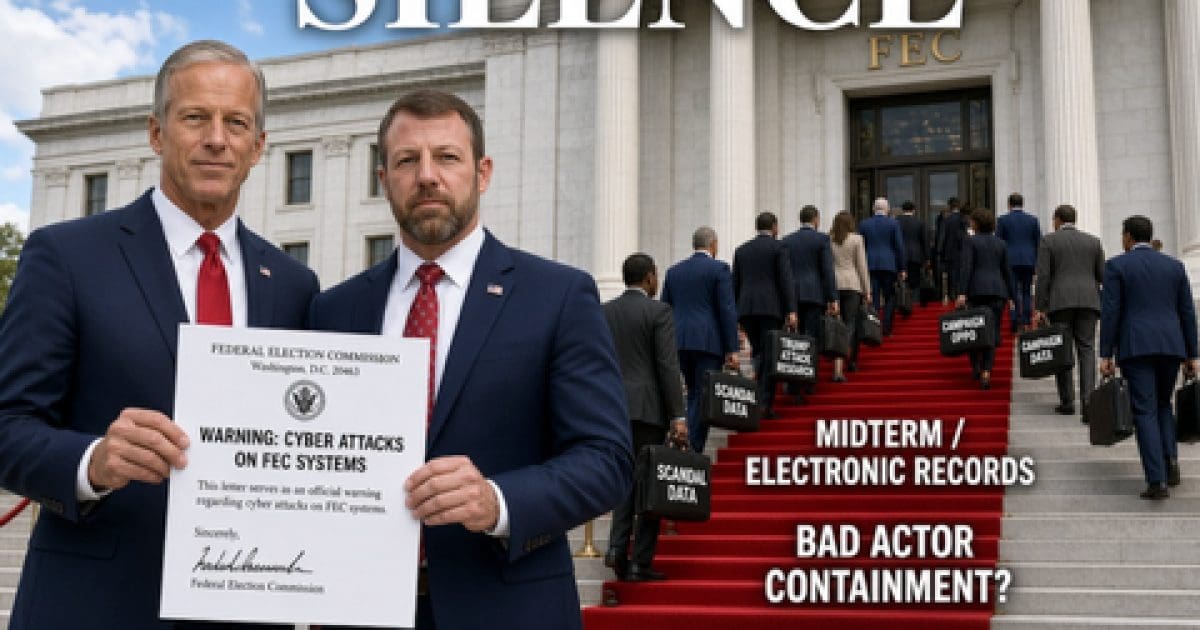
All Roads Lead Back to the FEC: The “Bad Actor” Cyberattack
The cyberattack during early midterm voting brings the focus back to an FEC unable to fully declare its systems malware-free, communicate with state election officials, or enforce campaign finance law. It also brings the focus back to Senate Majority Leader John Thune’s handling of the nominees who could help restore that power.[nbcnews][campaignsandelections]
Now the agency holding campaign finance records faces a security reckoning of its own. Its electronic filing system went offline for nearly 41 hours during early midterm voting as officials worked to restore the system, but no verification has been supplied that the cyberattack was contained.[joehoft][joehoft]
The security questions carry political consequences: the media already report on using FEC data for corruption hearings, impeachment hearings, and other political investigations. However, before either party uses FEC data to launch its next political attack, Americans deserve the incident reports on what happened during early midterm voting.
On May 13, 2021, Thune opined about “an independent commission, evenly divided between Democrats and Republicans,” warning that proposed changes would turn the FEC into “just a partisan arm of whatever president is in power.”[thune.senate]
But that is not what happened. Instead, inaction left the FEC without a functioning quorum, with only Democrats remaining on the commission during Trump’s presidency. Then came the cyberattack, a security failure that raises further questions about oversight and accountability of midterm early voting.[nbcnews][congress]
Today, only two commissioners remain, both Democrats. The agency lacks the four-member quorum needed to authorize investigations or audits. Trump’s nominees Ashley Stow and Andrew Woodson still await confirmation. Thune now faces a battle over his credibility and his leadership of the Senate. The FEC has a defined bipartisan structure, yet Thune has failed to help restore it. How does leaving the commission paralyzed honor the independence Thune once advocated?[campaignsandelections][congress][ifs]
His office offered no immediate explanation when contacted for a November 5, 2026, report about former Republican FEC commissioners urging action. “A spokesperson for Thune did not immediately respond to requests for comment,” the report stated.[washingtonsun]
That gridlock matters as Democrats and the embattled Republican Party prepare for their next political battles over Trump. Their search for political ammunition leads straight back to the FEC.
Before Washington scripts its next scandal, who will prove the FEC’s receipts can be trusted?
The FEC is no stranger to Washington’s scandal machine. The Clinton campaign and DNC’s funding of the Steele dossier, and the voter mules unearthed and then exposed by Jame O’Keefe, fueled explosive campaign finance battles. Money, secrecy, accusations, and careers on the line: these fights delivered investigations, penalties, and a feast of damaging headlines across party lines.
With FEC records again poised to become political ammunition, the public still lacks a clear accounting of the cyberattack, including whether the “bad actor” accessed any state systems. Americans deserve evidence showing the scope of the intrusion and how officials verified that the threat was contained.
The agency’s public-information role extends beyond campaign money. The FEC also compiles and publishes official federal election results supplied by state and territory election offices after certification. Those results become part of its national election record.[joehoft]
Campaign finance disclosures, published election results, and state election systems each demand answers about potential access, record integrity, and the scope of the cyberattack.
However, this does not mean the votes were not accessed during the 41-hour cyberattack. No verification has been supplied to rule out server access to state systems.
Joe Hoft of The Gateway Pundit is pressing for answers about the cyberattack during early midterm voting. The issue is the digital footprint: where the “bad actor” went, what systems were reached, what investigators captured, and the evidence supporting containment.[joehoft][joehoft]
The FEC acknowledged receipt of Hoft’s Freedom of Information Act request concerning the cyberattack. That acknowledgment confirms receipt of the request, not that the agency has supplied the requested records or answered his questions about the intrusion.
Hoft’s November 8 article includes his letter to Congress calling for oversight of the incident. The letter seeks the incident timeline, notification records, identification of affected systems, findings concerning election-result records, and the methods used to verify record integrity. The article is also listed in The Gateway Pundit’s author archive.[joehoft][thegatewaypundit]
The public should be outraged at being asked to accept assurances where evidence is needed. This is about more than the next weapon against Trump or his opponents. It is about the security of public records and trust in the institutions that serve voters. Politicians cannot demand that Americans trust the data while leaving them in the dark about the attack.
The FEC Inspector General formally warned congressional leadership months before the cyberattack that “Protecting data, IT systems, and networks from threats remains a top challenge” and that “it is imperative that the Commission continue to prioritize cybersecurity.” Its May 2026 report documented cybersecurity weaknesses tied to legacy systems and listed all 10 recommendations from its July 2025 security-patches audit as still open as of March 31, 2026.[fec]


