11 Dead – America’s Cyber Defenses Under Threat From Within?
Republished with permission from AbleChild.
Cyberattacks, faulty patches, upgrades or AI escaping a “sandbox,” the theories abound. But is the country overlooking a direct point of access to our cyber warriors: the contractors and third parties entrusted with their mental health treatment? Are the cyberattacks and disruptions coming from someone who has obtained credentials directly within the Cyber Command Center?
If an adversary exploited that access to harm or compromise personnel, the consequences may reach directly into the nation’s cyber defenses. Eleven deaths demand that this possibility be investigated, not used for further funding.
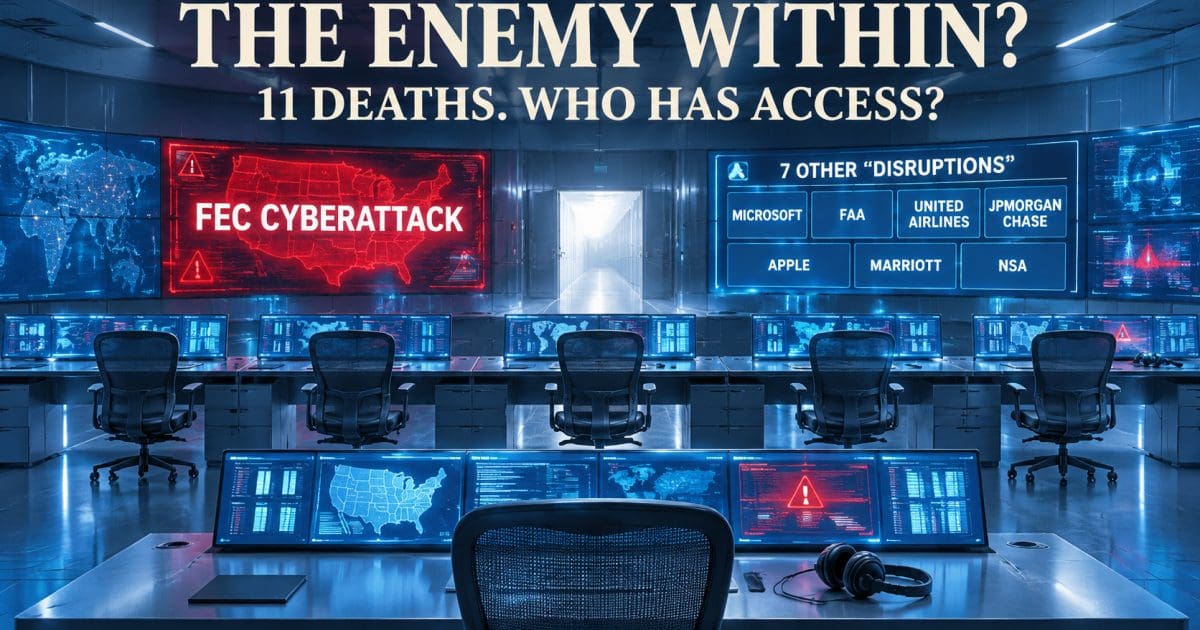
On October 26, during the early-voting period, a cyberattack prompted the Federal Election Commission to take its systems offline for nearly 41 hours. “We have a bad actor attempting to breach FEC systems,” an agency filings officer warned. What did the attackers access, and what have investigators found?
November brought seven “disruptions”: Microsoft, the Federal Aviation Administration, United Airlines, JPMorgan Chase, Apple, Marriott and the NSA. Official explanations included updates, maintenance and technical failures and third party involvement.
Meanwhile, at least 11 NSA and Cyber Command personnel had died by suicide over roughly a year. Five deaths occurred within about five weeks. These were personnel entrusted with defending the nation in cyberspace.
Cape Fox supplies behavioral health contractors to Army intelligence personnel and recruits clinicians at Fort Meade. Kimbrough, the government clinic, provides embedded mental health care at Cyber Command. Did Cape Fox staff work through Kimbrough Ambulatory Care Center or treat any of those who died?
“It absolutely infuriates me,” Adam Stallings, whose brother Technical Sergeant Kevin Stallings was among those who died, told Bloomberg. “Why did you not check on my brother?”
Those questions make the history of a military behavioral health contractor worth examining.
Created in 1973 to manage land and build businesses for the Tlingit people of Saxman, Alaska, Cape Fox now has almost 400 shareholders. Those shareholders saw allegations of fraud and self-dealing engulf its contracting business. What changed, and who ensured those changes held?
Under CEO Bruce Borup, annual revenue rose from $8 million in 2003 to more than $200 million in 2008, during President George W. Bush’s administration. A 2010 ProPublica investigation described allegations that outside business partners gained management control and substantial revenue.
Under President Barack Obama, the Air Force required three years of close oversight. Borup’s contracting suspension was mysteriously lifted in June 2010. Who authorized that decision, on what grounds, and what did the monitoring find? Separately, a jury ordered Suresh Doki’s consulting firm to pay Cape Fox $850,000 for unjust enrichment.
Did any people or arrangements implicated in that scandal remain involved in later federal work, and with what access?
Behavioral health work involves access to service members, their treatment and sensitive information. Who verified contractors’ qualifications and backgrounds, approved their access and supervised them afterward?
“A dereliction of duty.” Stallings’ father, an Air Force veteran, put it plainly. His son missed his June 18 shift. Police were not called until June 22. They found him dead.
His family later learned he had been prescribed an antidepressant. The FDA’s black-box warning directs close monitoring for worsening symptoms and emerging suicidality. Who was monitoring him? What about the other deaths?
Cape Fox promotes AI chatbots and tools that analyze wearable data and personal disclosures for signs of distress. Were any used with these personnel, and who was responsible for responding?
Could third-party access to mental health profiles make cyber warriors targets for coercion, manipulation or harm? In investigating these deaths, did anyone examine whether that access was exploited?
Some deaths remained under investigation by local police and military investigators, according to Bloomberg. Which cases remain open, which are closed, and what did each investigation establish?
Congress has been briefed. However Congress has shown zero investigative power over the billion-dollar behavioral health industry. Why fund more behavioral health contractors instead of relieving the financial hardship, long hours and poor conditions leaders identified as unproven causation. Was treatment addressing illness, or creating a pathway to the national defense cyber security networks?
Congress is seeking another $11 million for mental health support. More money is not an explanation for 11 deaths in the Cyber Security Center.
Without that accounting, Congress risks funding more of the same without understanding what went wrong with security lapses that have failed to pick up “bad actors” and “disruptions.”
President Trump’s attention has turned toward cybersecurity. That is a good instinct. His appointment of Pentagon technology chief Kirsten Davies as acting national cyber director signals a response, but changing leadership at the top may not be enough.
Cape Fox’s history reaches across administrations. Its contracting business expanded dramatically under George W. Bush. Under Barack Obama, controversy brought mandated oversight, while its former chief executive’s contracting suspension was lifted. What did those safeguards accomplish, and who verified that the problems had been corrected?
Now Trump has signed legislation benefiting Cape Fox, allowing the corporation to select approximately 180 acres of federal land to complete its remaining Alaska Native land entitlement. The shareholders’ entitlement is not the issue. Corporate accountability is. After allegations of fraud and self-dealing, what evidence shows that Cape Fox reformed its governance, eliminated improper control arrangements and sustained those reforms?
From contracting growth under Bush, to oversight under Obama, to land legislation under Trump, Cape Fox has remained within reach of federal decision-making. Its latest legislative victory lands it once again in the palm of power. Has scrutiny matched that reach?
Trump’s cybersecurity response should look beyond the latest leadership change and examine the contracting and oversight questions that stretch across his predecessors’ administrations. Who approved access to military personnel and sensitive health information? Who enforced safeguards? What problems remain?
In wartime, a commander who suspects someone has entered the bunker accounts for every entrance, credential and person inside. Follow the contracts. Identify who provided the care, controlled the records and authorized any monitoring. Determine who was responsible when a service member failed to report for duty, and why help did not arrive. Eleven deaths demand more than another funding request or a change at the top. They demand an accounting.
AbleChild is a 501(c)(3) nonprofit organization that has recently co-written landmark legislation in Tennessee, setting a national precedent for transparency and accountability in the intersection of mental health, pharmaceutical practices, and public safety.
What you can do. Sign the Petition calling for federal hearings!
Donate! Every dollar you give is a powerful statement, a resounding declaration that the struggles of these families will no longer be ignored. Your generosity today will echo through generations, ensuring that the rights and well-being of children are fiercely guarded. Don’t let another family navigate this journey alone.
Donate now and join us in creating a world where every child’s mind is nurtured, respected, and given the opportunity to thrive. As a 501(c)3 organization, your donation to AbleChild is not only an investment in the well-being of vulnerable children but also a tax-deductible contribution to a cause that transcends individual lives.


