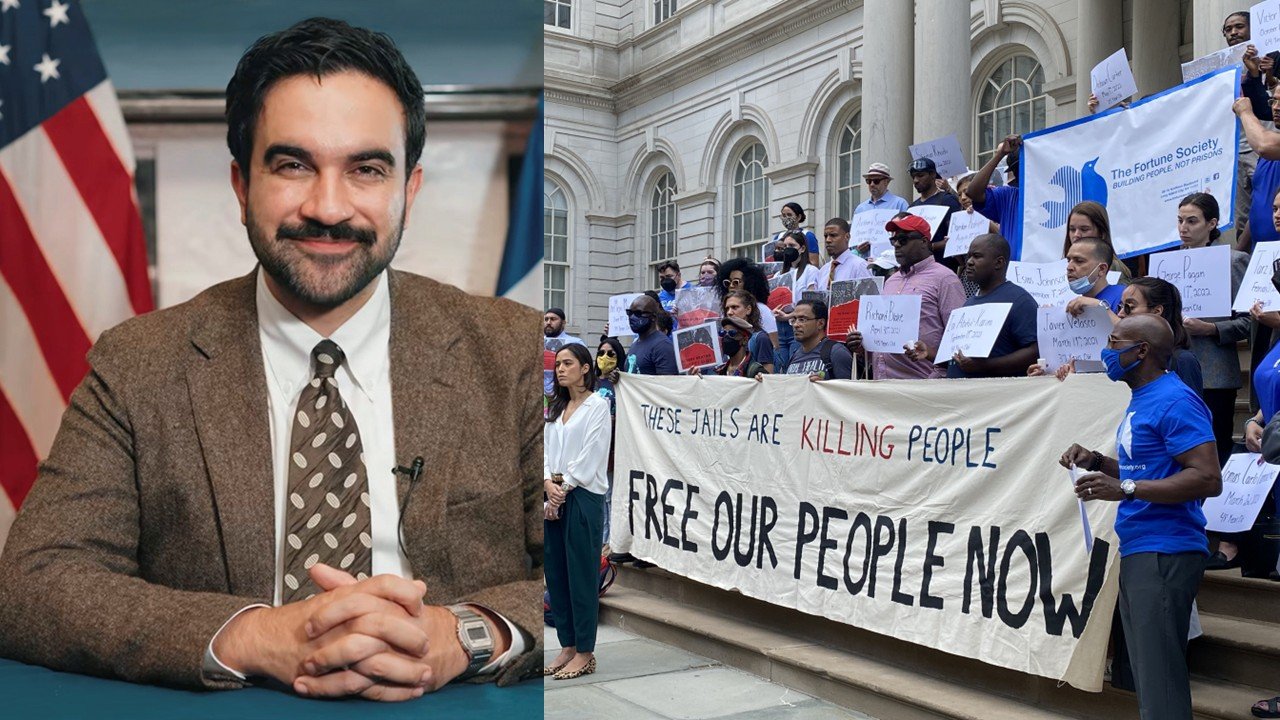
New York City Mayor Zohran Mamdani’s plan to close Rikers Island would spend taxpayer money on public defenders who would seek the release of jailed defendants after judges have set bail. The Close Rikers Strategic Plan, released Nov. 20, commits $5.9 million in fiscal year 2027 and $11.8 million annually thereafter to expand pretrial units in public defender offices across the city. The money would support “targeted litigation challenging unnecessary detention, including renewed bail applications, habeas proceedings and appellate review.”
The plan uses the Legal Aid Society’s pretrial advocacy program as a model. According to Legal Aid’s own data, the number of its clients released before trial “increased over 300%” after its pretrial team intervened.
The defender teams are part of what the plan calls “targeted reduction,” an effort to cut the jail population by about 700 people. The estimate assumes that at least “385 low-risk people charged with B felonies” would be considered for supervised release. The city would also add 400 electronic monitoring slots, doubling capacity to 800, and make ankle monitors a “step-down” option for people already in jail. The plan also calls for an online bail payment portal.
Class B felonies are the second-most serious category of crime under New York law. Under state Penal Law, violent Class B felonies include first-degree robbery, first-degree burglary, first-degree rape, first-degree manslaughter, and attempted second-degree murder. Some nonviolent drug sale and theft offenses are also Class B felonies. The plan leaves open which Class B felony charges would qualify.
Targeted reduction is one of four parts of the plan, which aims to bring the city’s jail population from about 6,600 to no more than 4,100 by the end of 2032. The Department of Correction reported that more than two-thirds of people in its custody during fiscal year 2025 were awaiting trial on violent felony charges. In fiscal year 2026, about 48% were awaiting trial on Class A or B felony charges.
The plan would also expand supervised release, the city program that monitors defendants released before trial. Shortly before the state’s 2020 bail law took effect, the city removed the program’s eligibility limits, opening it to defendants accused of violent felonies. The Mayor’s Office of Criminal Justice had projected a felony rearrest rate of 9% to 13% among participants. State court data from January 2020 through June 2021 showed 23% of participants were rearrested on felony charges and 41% were rearrested on any charge.
In Manhattan, a defendant with five open cases was charged with murder after a judge ordered his supervised release. On Nov. 19, the Manhattan District Attorney’s Office asked for $3,000 in bail for Alexander Florentino, a homeless 25-year-old who had been arrested at least 38 times since 2025. Judge Juliet Howard ordered supervised release. The next day, police say, Florentino strangled 62-year-old Jin Yu in her Chinatown apartment. He has been charged with second-degree murder.
Howard previously worked for the Legal Aid Society. Legal Aid alumni also appear among the 16 judges Mamdani named to the city’s Criminal and Family Courts on Nov. 16. Newly appointed Criminal Court Judge Alexis Flyer spent nine years as a Legal Aid defense attorney. Queens Criminal Court Judge Jennifer Saint-Preux, whom Mamdani reappointed, is also a former Legal Aid lawyer. In August, Saint-Preux denied prosecutors’ request to hold Shaquan Seth, a career thief with nearly 150 arrests, without bail and set a $10,000 bond.
Mamdani has opposed prosecutors’ use of bail since his time in the State Assembly. In a September 2021 Legal Aid statement, the then-Queens assemblyman said, “Too many prosecutors and district attorneys across New York City are sentencing working-class New Yorkers to the possibility of death by charging bail.” At the Nov. 20 announcement, he said, “We know that detaining more New Yorkers does not make us safer.”
Deanna Logan, who remains director of the Mayor’s Office of Criminal Justice under Mamdani, testified to state lawmakers in 2023, “New York City has a recidivist problem. And that recidivist problem is driving much of the crime we see today.” Through September 2026, 320 people had been arrested three or more times for felony assault in the city, up 213.7% from 102 in the same period in 2018.
Ad block users: Some site features may not work correctly while an ad blocker is enabled, because they break scripts and content this website depends on. If you can’t see comments below, for example, please disable your ad blocker.