


The death of Quentin Deranque after a clash with alleged members of an anti-fascist group has sparked outrage in France
Thousands of right-wing protesters are expected to march through central Lyon on Saturday in tribute to Quentin Deranque, a 23-year-old mathematics student and nationalist activist who died on February 14 after allegedly being beaten by individuals linked to left-wing movements.
Lyon’s mayor urged authorities to ban the rally – expected to draw between 2,000 and 3,000 participants – citing “proven risks of public disorder.” However, Interior Minister Laurent Nunez authorized the event, saying that “for now, freedom is more important than anxiety.” The march is nevertheless expected to take place under heavy police protection.
Deranque’s death has intensified tensions in France’s already fragile political climate and has the potential to tip the scales in the March municipal elections and next year’s presidential race.
Here is what led to the protests.
‘Abominable lynching’
On February 12, Rima Hassan, an MEP from the left-wing La France Insoumise (LFI) party and a pro-Palestinian activist, was scheduled to speak at the Institut d’Études Politiques in Lyon. The event prompted a protest by the right-wing women’s group Nemesis, whose members unfurled a banner reading: “Islamo-leftists, out of our universities.”
According to media reports, Deranque – a member of the identitarian group Audace Lyon – was acting as informal security for the demonstrators.
Right-wing & conservative activists in France have been posting memorial flyers for Quentin Deranque, a man killed by Antifa in Lyon when he volunteered to be security for a women’s group. The flyers have been torn down by leftists so people put up more. pic.twitter.com/P1WnX4vlj5
— Andy Ngo (@MrAndyNgo) February 21, 2026
As tensions escalated, clashes broke out between right-wing and anti-fascist activists roughly 400m from the university. Deranque was isolated from his group, knocked to the ground, and kicked repeatedly while unconscious, with a video of the beating later shared by local media.
Some alleged attackers were said to be affiliated with the anti-fascist collective Jeune Garde, which was formally dissolved by the government last year but reportedly remained active and maintained links to LFI.
While Deranque initially recovered and refused a friend’s attempts to have him taken to the hospital, his state later sharply deteriorated. Two days later, he died in the hospital of a fractured skull and fatal brain injuries. An autopsy found he had “no chance of survival, even if hospitalized immediately.”
🔴 Mort de Quentin Deranque : de nouvelles informations viennent contredire la version relayée massivement dans les médias.Le Canard enchaîné a publié une vidéo et des témoignages indiquant qu’il s’agissait bien d’une rixe opposant un groupe de fascistes armés avec un groupe… pic.twitter.com/SVtMvBIbA3
— Glupatate (@Glupatate) February 17, 2026
Interior Minister Laurent Nunez described Deranque’s death as “a deliberate homicide” and “a lynching that is absolutely abominable.”
Who was Quentin Deranque?
Friends described him as “serious” and “level-headed,” and “absolutely not violent,” according to Le Monde. The newspaper also portrayed him as an integralist Catholic attracted to the concept of “self-defense.” Other outlets depicted him as emblematic of the contemporary French right, drawing comparisons to late US activist Charlie Kirk.
The authorities confirmed that Deranque had no criminal record.
However, he reportedly trained in boxing and running with Audace Lyon. Mediapart also reported that in 2025, he participated in what it described as a “neo-fascist” rally organized by the 9 May Committee.
Public uproar
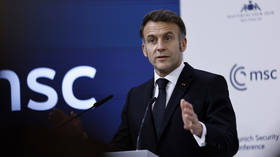
Deranque’s death escalated tensions in France’s already polarized political climate. French President Emmanuel Macron denounced the killing as “an unprecedented outburst of violence,” stressing that “hatred that kills has no place in our country.”
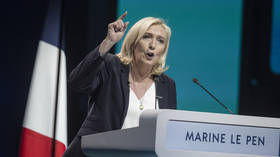
Marine Le Pen, a high-profile member of the right-wing National Rally party, called for justice against “the barbarians responsible for this lynching,” demanding the perpetrators be “condemned with the utmost severity.”
National Rally president Jordan Bardella vowed to “wage a battle to ensure that the ultra-left is rendered incapable of causing harm.” He also accused LFI founder Jean-Luc Melenchon of bearing “moral and political responsibility” for having “opened the doors of the National Assembly to suspected murderers.”
Italian Prime Minister Giorgia Meloni called the killing “a wound for all of Europe” and condemned “a climate of ideological hatred sweeping several nations.” Her remarks, however, sparked pushback from Macron, who advised that “everyone [should] stay at home and the sheep will be well looked after.”
Arrests and the connections that made them explosive
French police have arrested eleven people, seven of whom face homicide charges. The most politically sensitive arrest was that of Jacques-Elie Favrot, a parliamentary assistant to LFI lawmaker Raphael Arnault, who was charged with complicity through instigation. Arnault is also a co-founder of Jeune Garde.
Subsequent media reports claimed that a second Arnault aide, Robin Chalendard, was also detained. Arnault said he had dismissed Favrot and distanced himself from the case.
Left on the defensive
Melenchon condemned the violence but reiterated his party’s “great affection” for Jeune Garde and other anti-fascist movements. He argued that right-wing groups have historically been responsible for the majority of politically motivated attacks in France, recalling that “12 people have been murdered by the far-right since 2022.”
Mathilde Panot, head of the LFI parliamentary group, also denounced the killing but said the incident had sparked a “witch hunt” against the left. She criticized what she called the “instrumentalization” of Deranque’s death and cited death and rape threats against several LFI lawmakers.
Why it matters: Political fallout and elections
Deranque’s death comes ahead of municipal elections in March and a presidential race in 2027 in which polls place the right-wing National Rally in the pole position. It also caused an apparent rift within the French left, with former French President Francois Hollande insisting that his Socialist Party “can no longer form an alliance” with the LFI due to its ties with Jeune Garde.