


Migrants Could be Moved from Hotels to Warehouses
By Charles Hymas, Hannah Boland
Yvette Cooper says Government looking at industrial and military sites as well as disused tower blocks.
Asylum seekers could be housed in warehouses under plans to reduce the number of migrant hotels, Yvette Cooper has said.
The Home Secretary said the Government was looking at industrial and military sites as a potential way to end the use of hotels.
Asked for an example of an industrial site, she said warehouses were “one of the things being looked at”.
Sir Keir Starmer is to chair a cross-Government ministerial meeting on Tuesday to discuss how to speed up the closure of hotels. His official spokesman confirmed this included using “modular buildings” on industrial and ex-military sites as a “value for money” option.
Downing Street also said it was “looking at” introducing national ID cards to stop illegal migrants working in the black economy.
The spokesman said: “We’re willing to look at what works when it comes to tackling illegal migration.”
It follows Cabinet Office minister Pat McFadden saying at the weekend that a digital ID card for every Briton could help to combat illegal immigration and benefit fraud.
‘We do believe it can be done earlier’
The move came as Ms Cooper backed Sir Keir Starmer’s pledge to speed up the decommissioning of asylum hotels in order to scrap their use before the current target date of the end of the Parliament in 2029.
There were 32,059 asylum seekers in more than 200 hotels at the end of June, up 8 per cent from 29,585 at the same point a year earlier but down on the 32,345 figure at the end of March.
That cost taxpayers £5.77m per day in 2024/25 – down from £8.3m per day in 2023/24.
Ms Cooper said: “Our manifesto commitment was to [end the use of asylum hotels] over the course of the parliament, but we do want that to be earlier. We do believe it can be done earlier.” However, she refused to set out “precise timetables”.
Britain currently has more empty warehouse space than at any point since 2011, with figures from the estate agent Savills showing more than 60 million square feet of space across 306 different units is unused.
Large retailers have been pulling back from taking extra logistics space in response to weaker spending by shoppers and are also bracing for another tax raid by Rachel Reeves, with her planned reform of business rates expected to push up costs for large distribution warehouses by £262m.
Shortage of accommodation
Ms Cooper said the Home Office was in talks with councils to identify sites, which also include former student accommodation, government-owned properties, disused tower and office blocks and ex-teacher training colleges.
“Within the asylum estate, we are reconfiguring sites, increasing room-sharing, tightening the test for accommodation and working at pace to identify alternative cheaper and more appropriate accommodation with other government departments and with local authorities,” she told MPs on Monday.
The shortage of accommodation has been worsened by the record number of Channel crossings, with more than 29,000 people having arrived in small boats so far this year – up nearly 50 per cent on last year and the highest number at this point since the first arrivals in 2018.
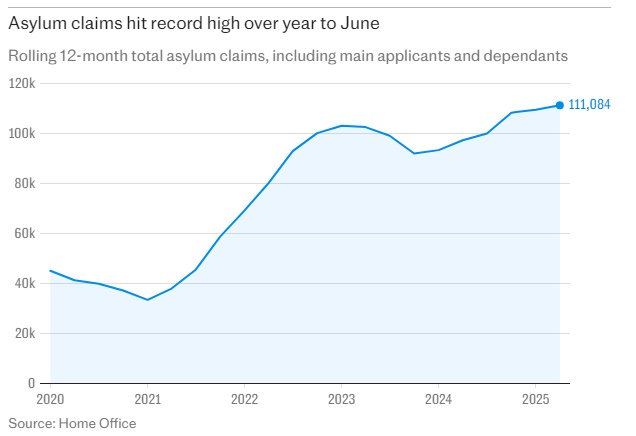
There were a record 111,000 asylum applications in the last year.
Speaking on LBC, Ms Cooper admitted that it was not appropriate for asylum seekers to be housed in £300,000 three-bedroom contemporary town houses in a village in Suffolk, as revealed on Monday.
She said: “That’s why we need to reduce the overall size of the asylum system, so that we have fewer people in asylum accommodation in the first place. We need fewer people in the asylum system so we don’t have people in costly accommodation that is being funded by the taxpayer for long periods of time.”
The number of asylum claims being processed has trebled to 31,000 per quarter, while spending on hotels has been cut by nearly £1 billion.
Last week, The Telegraph revealed that one of the Home Office’s main contractors had issued an urgent appeal for 5,000 properties to house up to 20,000 migrants.
“Contingency” accommodation has also been commissioned at the former Wethersfield RAF base near Braintree, Essex, where the Home Office has raised the cap of 800 migrants to allow 1,245 people to live on the site.
Wethersfield is the only “large” site that Labour inherited from the Tories and kept open, despite Sir Keir Starmer saying before the election that it “needs to close”. The Government has abandoned the two other major sites identified by the Tories – the Bibby Stockholm barge and RAF Scampton in Lincolnshire.
Ms Cooper defended the Home Office’s legal challenge to ensure the Bell Hotel in Epping remained open by overturning a temporary closure injunction obtained by the local council. She said the Government needed to ensure there was an orderly closure of hotels, rather than chaotic piecemeal shutdowns.
On Tuesday night the Court of Appeal refused an application from Epping Forest district council for permission to appeal to the Supreme Court against the former court’s ruling allowing asylum seekers to continue to be housed at the Bell.
The council can still ask the Supreme Court itself for the green light.
The Home Secretary declined to guarantee that migrants will definitely be sent back across the Channel in September as part of a returns agreement with France. She said the first returns were “expected” this month.
Original source: https://www.telegraph.co.uk/news/2025/09/02/asylum-seekers-migrants-warehouses-yvette-cooper-hotels/