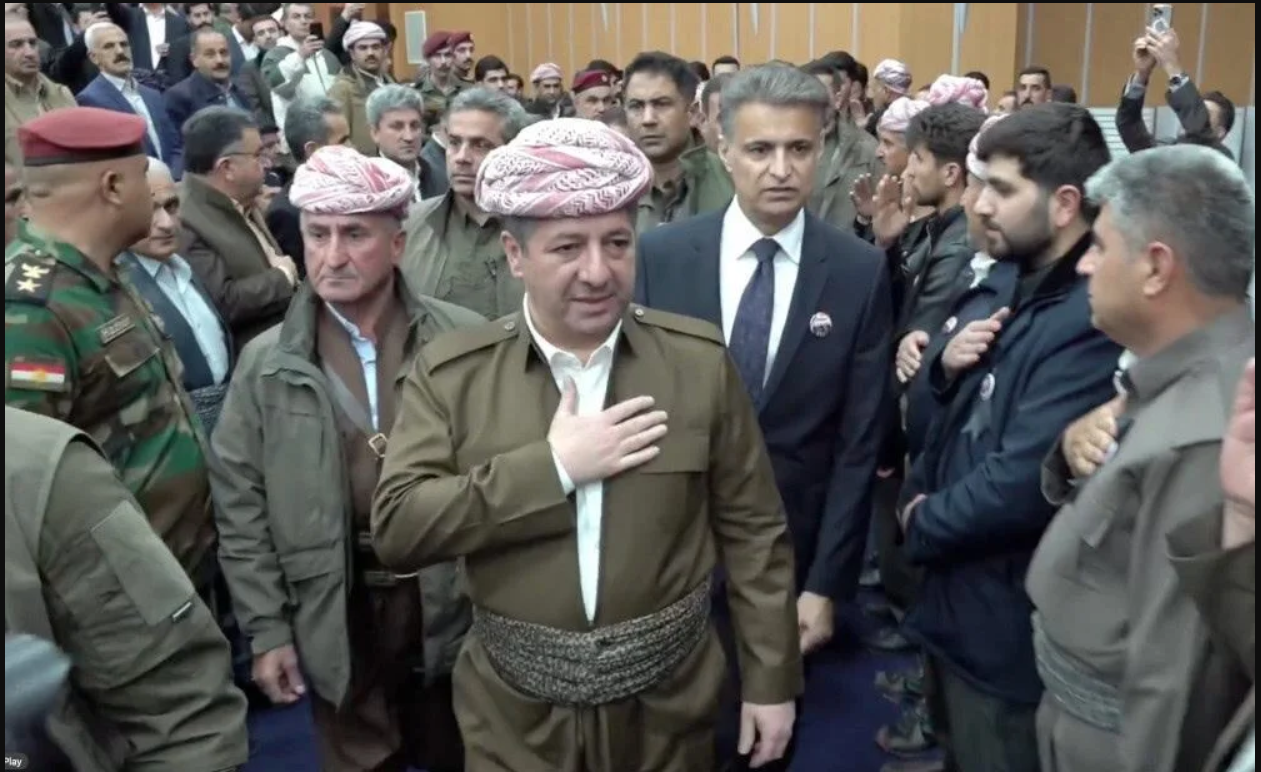
The United States has ended direct financial support for the Kurdish Peshmerga forces, and the Kurdistan Regional Government (KRG) is asking Baghdad to pay its fighters. The Pentagon’s memorandum of understanding with the KRG’s Ministry of Peshmerga Affairs, first agreed in 2016, expired in September. The final payments, covering August and September, went out that month.
The Peshmerga, a force of about 180,000 troops, received $61 million in fiscal year 2026 for weapons, training and stipends. The Pentagon’s fiscal year 2027 budget request seeks $118.9 million for federal Iraqi defense and counterterrorism forces and includes no direct funding for the Kurdistan Region. Erbil has requested about 450 billion Iraqi dinars ($296 million) in Iraq’s 2027 federal budget to bring Peshmerga pay in line with that of federal security forces.
The funding cutoff coincided with the withdrawal of American troops. US Central Command completed its withdrawal from Erbil Air Base on Sept. 30, ending the US anti-ISIS mission in Iraq. The base had hosted 1,500 troops from the United States and other coalition countries.
The Peshmerga Ministry said the region had faced more than 1,000 attacks by drones and ballistic missiles since the US-Iran war began in February. It called the departure of US forces without leaving an air defense system behind “a cause for concern.” The KRG is barred from acquiring air defenses without Baghdad’s approval. A senior Patriotic Union of Kurdistan (PUK) official said the region also has no legal authority to operate such systems independently. Even a system obtained for the Khor Mor gas field required approval from London and Baghdad before it could be activated.
Erbil has already ceded control of its oil exports to Baghdad. The KRG began exporting oil independently in 2014 after Baghdad cut its share of the federal budget. Those sales became the region’s main source of income. Under a September 2025 agreement that Secretary of State Marco Rubio described as US-facilitated, the KRG delivers all crude produced in the region to Iraq’s State Oil Marketing Organization (SOMO), except for volumes set aside for local use. The agreement set a minimum delivery of 230,000 barrels per day.
Baghdad is now using the 2027 budget to tighten its hold. On Nov. 17, KRG Prime Minister Masrour Barzani rejected a draft that offered the region 13 trillion dinars ($8.55 billion). Erbil is seeking 30 trillion dinars ($19.74 billion). The KRG wants 14.14 percent of the federal budget, matching its share of Iraq’s population in the latest census. Baghdad has proposed 12.67 percent and would require the region to export 450,000 barrels of oil per day. Barzani said the two sides had agreed on a framework, but the draft later added provisions they had never discussed.
Washington has previously pressed Baghdad on Erbil’s behalf. In February 2025, the Trump administration warned Iraq to let Kurdish oil exports resume or face sanctions alongside Iran. In July, Rubio urged then-Iraqi Prime Minister Mohammed Shia’ al-Sudani to ensure uninterrupted salary payments to Kurdish civil servants. In March 2026, US special envoy for Iraq and Syria Tom Barrack said, “The problem in Iraq is not the Kurdistan Region.” In August, he condemned an Iranian drone attack on Barzani’s office as aggression against “our trusted Kurdish allies.”
Barrack has also repeatedly questioned federalism, the basis for Kurdish autonomy under Iraq’s 2005 constitution. In July 2025, he said federalism “doesn’t work.” In December, he described centralization, decentralization and federalization as “illusions created by governments,” prompting Iraq’s foreign minister to express astonishment and call the federal system indispensable.
After Barzani met Iraqi Prime Minister Ali al-Zaidi on Nov. 9, Barrack said direct talks between Baghdad and Erbil were how disputes over oil, salaries and revenue would get solved.
Two days later at Chatham House in London, Barrack was asked what safeguards Washington would support to keep Baghdad from undermining the Kurdistan Region’s constitutional status. He named none and urged Kurdish leaders to strengthen coordination with Baghdad. “This is an Iraqi issue,” he said. “This is an Iraqi decision.” He added that it was “not American.”
The Kurds are negotiating from a divided position. The KRG has operated as a caretaker government since the inconclusive 2024 regional elections. When the Kurdistan Democratic Party (KDP) reconvened parliament with 52 of its 100 members present, PUK leader Bafel Talabani called the move illegal and withdrew his party from the cabinet. At Chatham House, Barrack told Kurdish leaders to “get over these tribal dismays,” adding, “We’re not going to intervene. There is no way we can intervene.”
For many Kurds, the removal of coalition air defenses from Erbil airport revived memories of the US withdrawal from northeast Syria. In January 2026, the Syrian army seized most of the territory held by the US-backed Syrian Democratic Forces (SDF). American troops left Syria in April, and the SDF dissolved in August after merging with the Syrian military.
David Eubank, a former US Army Ranger and Special Forces officer, returned this month from a mission in Iraqi Kurdistan and northeastern Syria. He founded the Free Burma David Eubank, a former US Army Ranger and Special Forces officer, returned this month from a mission in Iraqi Kurdistan and northeastern Syria. He founded the Free Burma Rangers, a Christian humanitarian group that served on the front lines alongside the Peshmerga in 2015 during the war against ISIS and alongside Kurdish forces in Syria in 2016. The group has continued to carry out humanitarian missions in Iraqi Kurdistan and Kurdish Rojava, in northeastern Syria.
Eubank called continued US support for the Kurds a moral obligation. “It’s the right thing for America to do, to stand with people who love us, who share our values like the Kurds do, who helped us defeat ISIS,” he said. He also stressed the partnership’s strategic value to the United States in its fight against Islamist terrorist groups. “They put their lives on the line. They’re partners with us for freedom in Iraqi Kurdistan as well as Rojava, northeast Syria.”
Peshmerga Minister Shorsh Ismail said he still hoped Washington would restore its support. “We have high hopes that this agreement would be renewed,” he said.
Ad block users: Some site features may not work correctly while an ad blocker is enabled, because they break scripts and content this website depends on. If you can’t see comments below, for example, please disable your ad blocker.