Rogan, Secretary Kennedy and Deprescribing Psychiatric Drugs: Where Is the Exit Plan?
Republished with permission from AbleChild.
Secretary Robert F. Kennedy Jr.’s deprescribing initiative puts a neglected question before the Country: What is the exit plan for consumers trying to safely get off psychiatric drugs?
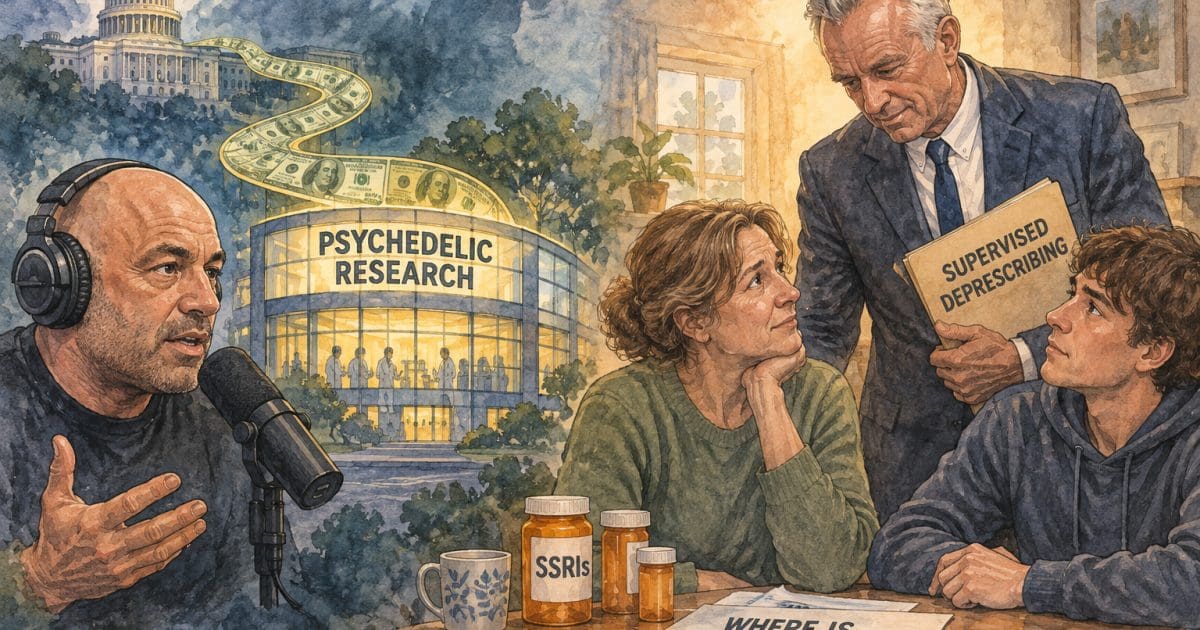
Joe Rogan helped bring psychedelic research to the White House, standing alongside President Trump when the administration announced accelerated research into these treatments. Rogan obviously doesn’t understand that consumers are actually dying while on psychiatric drugs and the government refusal to collect the proper data that would simply prove it, by sorting suicides by “treated” versus “untreated” at time of death. Kennedy’s deprescribing effort addresses another urgent need: medically supervised reduction and discontinuation of SSRIs and other mind-altering psychiatric medications. The consumers should not be forced to continue on dangerous mind-altering drugs.
Missing from that national stage are the parents whose sons and daughters take a cocktail of psychiatric drugs and whose families cannot find guidance or a safe way out. One only has to visit the growing number of psychiatric-harmed communities on X to see the suffering.
Families do not have Rogan’s podcast, presidential access, or the resources to compete with the lobbying efforts of the behavioral-health industry. Families need immediate help getting off the drugs safely. Where is that help from the federal government? It is the only subject politicians are not willing to have a public political fight over. One has to ask why?
A government deeply invested in expanding psychiatric treatment has a corresponding responsibility to ensure that consumers can obtain supervised help leaving it. Promoting access to treatment without ensuring access to an exit plan is not a complete public-health policy.
The government’s own warnings underscore the stakes. FDA-approved antidepressant labeling warns of increased suicidal thoughts and behaviors in children, adolescents, and young adults through age 24 in short-term studies. Medication guides also identify aggressive or violent behavior among symptoms requiring immediate medical attention.
Families need those warnings explained before treatment—and taken seriously afterward.
CMS guidance issued May 4, 2026, clarifies how existing Medicare care-management codes can cover supervised deprescribing, including tapering SSRIs and other psychiatric medications. It recognizes tapering schedules, withdrawal monitoring, interaction reviews, and treatment adjustments.
The question now is whether that recognition reaches consumers. A family needs a supervised exit plan, follow-up, and someone accountable when difficulties arise, not another document telling it that help theoretically exists.
The AbleChild bill upcoming in Georgia brings that demand into the legislative debate. Families seeking alternative help must have a voice alongside the institutions shaping treatment policy.
The suicide crisis makes this accountability urgent. The CDC reports 48,824 deaths by suicide nationwide in 2024. This tragedy extends far beyond veterans and reaches families across the country.
But the national total leaves a fundamental question unresolved: Which deaths occurred during psychiatric treatment, following medication changes or discontinuation, and without treatment?
Treatment exposure must become a central investigative question, not a detail lost inside an undifferentiated death count.
Without reliable medication histories and testing, the public cannot adequately examine adverse events associated with psychiatric treatment. Which drugs were involved? Which combinations? What changed before the death? Was the person starting treatment, taking a stable dose, or withdrawing?
Those distinctions are essential to scrutinizing the outcomes of a massive behavioral-health industry.
The CDC’s National Violent Death Reporting System depends on death certificates, coroner and medical-examiner records, and law-enforcement reports. It cannot supply evidence those investigations never collected.
CDC acknowledges inconsistent toxicology testing. Its 2025 report also states that quantitative drug levels, other than alcohol, are not collected, preventing that analysis from determining if those treated are actually dying from the treatment itself.
Testing and sorting are the foundation for investigating suspected adverse events. Medication exposure, treatment timing, and clinical history must be documented so researchers can examine patterns instead of confronting missing information. Meaningful risk comparisons also require knowing the size of the exposed and unexposed populations.
Against the horror of school attacks and parents killing their own children, government must confront unanswered medication questions. Where is the toxicology? Where is the blood testing? AbleChild’s Tennessee work addressed that investigative gap.
We helped champion Public Chapter 272, introduced as SB 1146/HB 1349 by Senator Rusty Crowe and Representative Mary Littleton. Effective July 1, 2025, it requires testing that includes therapeutic levels of psychotropic medications in qualifying autopsies of deceased suspected perpetrators of mass shootings resulting in four or more deaths, alongside additional investigation and reporting.
Families are asking officials to distinguish deaths during treatment, after treatment changes, and without treatment. They deserve evidence, not reassurance in its place. Imagine hearing the below statement from Laramie County Coroner when your loved one followed the treating psychiatrist’s diagnosis and treatment plan and bought into the behavioral health industry only to die while on the psychiatric drug! Could all the deaths associated with suicide be that the consumer “wasn’t taking their medication like they’re suppose to?”
“If someone is taking their medication like they’re supposed to, ten to one they’re not gonna die by suicide.” Laramie County Coroner, Rebecca Reid.
Wyoming revealed the resistance the public encounters when seeking that transparency. According to the published hearing account, those were the words of Laramie County Coroner Rebecca Reid during consideration of expanded psychiatric-medication data collection in suicide and homicide investigations. Reid opposed the proposal and warned that reporting without context could “inadvertently stigmatize mental health treatment.”
The parent searching for a safe exit plan deserves more. So does the family asking what happened after a death. Protecting the reputation of treatment cannot take priority over collecting the evidence needed to examine its outcomes.
AbleChild is a 501(c)(3) nonprofit organization that has recently co-written landmark legislation in Tennessee, setting a national precedent for transparency and accountability in the intersection of mental health, pharmaceutical practices, and public safety.
What you can do. Sign the Petition calling for federal hearings!
Donate! Every dollar you give is a powerful statement, a resounding declaration that the struggles of these families will no longer be ignored. Your generosity today will echo through generations, ensuring that the rights and well-being of children are fiercely guarded. Don’t let another family navigate this journey alone.
Donate now and join us in creating a world where every child’s mind is nurtured, respected, and given the opportunity to thrive. As a 501(c)3 organization, your donation to AbleChild is not only an investment in the well-being of vulnerable children but also a tax-deductible contribution to a cause that transcends individual lives.


