
RT breaks down why we should be skeptical of the latest US ‘success story’ that morphed into a scandal
The recent resignation of Nvidia CEO Jensen Huang sent shockwaves through the AI world, not to mention much speculation about what might really have been behind the 63-year-old’s departure.
Whether we just witnessed an intricate game of four-dimensional geopolitical chess or merely the outcome of the indiscretions of a powerful man is unclear. What remains, though, is an industry that itself seems to exude the vibe of a Wall Street-tinged spy thriller.

Some have compared AI to the railroad boom in the late 19th century, given the massive capital outlays and speculation outrunning demand. Haung’s ex-company Nvidia, meanwhile, is the undeniable cornerstone of the AI boom. It is the primary supplier of the specialized GPUs and networking hardware that is powering the buildup. It is also playing a leading role in financing the AI build-out.
The question, though, that is on everybody’s minds is whether anybody can actually make any money.
We look in the oddly circular world of big AI.
Everything is connected
In September, three analysts at Sona Asset Management attempted to map the AI ecosystem and demonstrate the interconnectedness among the key players. What they came up with was a maze that would give even the most hardened antitrust regulators a headache.
The data covered 176 deals between 202 entities totaling $3.6 trillion over three and a half years to August 2026. What is striking is that the same companies appear repeatedly on both sides of the transactions.
In fact, of the 176 transactions analyzed, as noted by the Financial Times, around 120 carried what the Sona analysts called a “high circularity flag.”

The result is a network in which the apparent strength of one company’s commercial prospects is partly supported by the financial commitments of other companies whose prospects depend on that same company. So if you want to understand the creditworthiness of one company, you have to look at the whole system.
Nvidia, for example, invests in AI companies and infrastructure providers but also sells them equipment. For Nvidia, there is a logic to this. It has a product that is in-demand, but its customers need access to enormous amounts of capital to build the infrastructure required to use that product.
Industrial companies have in the past financed their customers or supported them, but it’s never quite been done at this scale and level of complexity.
It is also worth noting that many of the companies in which Nvidia has ploughed money are nowhere close to turning a profit. By stimulating demand for its own products, Nvidia may be masking true end-user demand. There is a distinction between real demand and financially supported demand. The former is generated by customers who ultimately earn a sufficient return from using the equipment. The latter can be generated, at least temporarily, by the capital supplied by companies that themselves have an interest in keeping the whole thing afloat.
Nvidia as the central bank of the AI boom
Nvidia has become a major provider of liquidity to the ecosystem. According to recent SEC filings, the company has poured nearly $50 billion directly into AI labs, agreed to buy $36 billion in backup cloud capacity if its partners can’t find real customers, and guaranteed up to $108.5 billion of its customers’ data-center rent and power bills, including a staggering $105 billion lease backstop for OpenAI alone.
Nvidia controls the vast majority of the high-end GPU market. Because modern AI development runs on compute power rather than cash alone, Nvidia decides who gets allocated chips and how fast they can grow. Nvidia also all but dictates the cost of entry into the AI race through its pricing power and chip release cycles.
The question that needs an answer is whether AI software is genuinely profitable or is the boom simply running on Nvidia-printed liquidity? The idea of “printed liquidity,” though, has a distinct central-bank odor. In fact, numerous analysts have made the comparison.
CoreWeave: A textbook study
CoreWeave can be thought of as a specialist landlord for computing power. It owns or leases enormous quantities of computing equipment – principally servers containing Nvidia GPUs – and rents access to that equipment to companies that train or operate AI models. So far, so good.
The company buys the GPUs designed and sold by Nvidia, installs them in data centers and rents computing capacity to customers. These customers include many of the big names: Microsoft, Google, Meta, and AI companies such as OpenAI and Anthropic.
Nvidia owns 9-10% of CoreWeave, including a $2 billion stock investment made in early 2026, and has also committed to a $6.3 billion backstop to buy up CoreWeave’s unused cloud capacity through April 2032. Meanwhile, major AI developers such as OpenAI have taken direct equity stakes in CoreWeave while simultaneously signing multi-billion-dollar contracts to rent computing power from CoreWeave’s data centers.

This is obviously an extremely capital-intensive business. CoreWeave ponies up an awful lot before it can earn any revenue. That leads us to our next point: CoreWeave isn’t in the finest of financial health.
Just last week, the company posted third-quarter 2026 results. Revenue rose from $1.37 billion in Q3 2025 to $3.66 billion this year, a sign that the company is actually selling a lot more computing capacity.
However, operating income remains just a tiny fraction of gross revenue ($0.21 billion), while depreciation and amortization flew through the roof – as did interest expense. The company’s quarterly interest bill of $846 million is more than four times operating income.
When the numbers were tallied, CoreWeave ended up with a net loss of $0.71 billion for the quarter, versus $0.11 billion the year before, a 545% increase in the net loss for those keeping score at home.
A central anxiety on Wall Street is that capital expenditures on AI infrastructure have grown so massive that they are outpacing operating cash flows. In fact, some of the most profitable tech companies actually have negative free cash flow.
CoreWeave has been a lightning rod for these fears. As one analyst put it, CoreWeave will stop building AI infrastructure the moment it becomes cash-flow positive, and will become cash-flow positive the moment it stops building.
Is there actually a there there?
While Big Tech is pouring nearly $800 billion a year into data centers, power grids, and chips, actual end-user AI software revenue remains dwarfed by comparison. Whether the math will ever work out is anybody’s guess.

For decades now Wall Street has looked favorably upon tech giants because software had near-zero marginal costs and was actually able to generate free cash flow. AI, however, is a different beast. Behind the glitter, it’s a capital intensive, power-hungry business that in some ways has more in common with a steel factory than a traditional Silicon Valley tech company. When this realization finally hits the market, some analysts expect a historic crash.
Others are less pessimistic, noting that having to put huge capital on the table is a normal, albeit messy, feature of major technology shifts and that front-loaded infrastructure always precedes monetization. New technology breakthroughs are also known to whip up bubbles. The bubble may well pop but the technology will remain.
Was Alice caught up in a salacious Jenson spy thriller story?
That brings us back to the resignation of Jensen Huang. Was it really espionage? We don’t know, but the idea that Huang needed convincing to export chips to China makes little sense. He had already spent years publicly arguing against US chip sanctions long before Alice Huang entered the picture. Selling billions of dollars of GPUs to China was in Nvidia’s obvious commercial self-interest.
Huang was the one who said: “Cede the Chinese market to Huawei, and the only one that ends up dead is the American tech industry.”
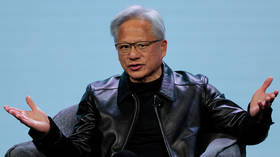
Some believe this whole affair was concocted to undermine Huang’s lobbying against sanctions in Washington, while putting the world’s largest company by market cap on a “national security leash” through various investigations and, ultimately, congressional oversight.
US Attorney General Todd Blanche has stated that the Justice Department had reached no conclusion on whether Megaspeed executive Alice Huang was actually a Chinese spy.
In any case, the show must go on. On Tuesday Nvidia reports Q3 2026 results. Investors will scrutinize every word uttered by interim CEO Colette Kress – the former CFO – just the way they do when the Fed chair takes the podium. They will wonder, for example, if Nvidia is planning on “tightening policy” by pulling back on its $36 billion-plus in AI ecosystem commitments.
Bottom line
The technology is real, but the numbers don’t yet work. The combination of hundreds of billions in annual capital expenditures and circular vendor financing without commensurate revenues is a big red flag. It doesn’t take a contrarian analyst to call a bubble. However, the industry has probably by now achieved “too big to fail” and “too strategically important to fail” status and can count on preferential treatment from Washington if and when things go south in the market, regardless of whether the biggest names don’t survive the fallout.


