The German chancellor is threatening to block the bloc’s budget unless Ukraine gets more aid – except it’s not really for Ukraine
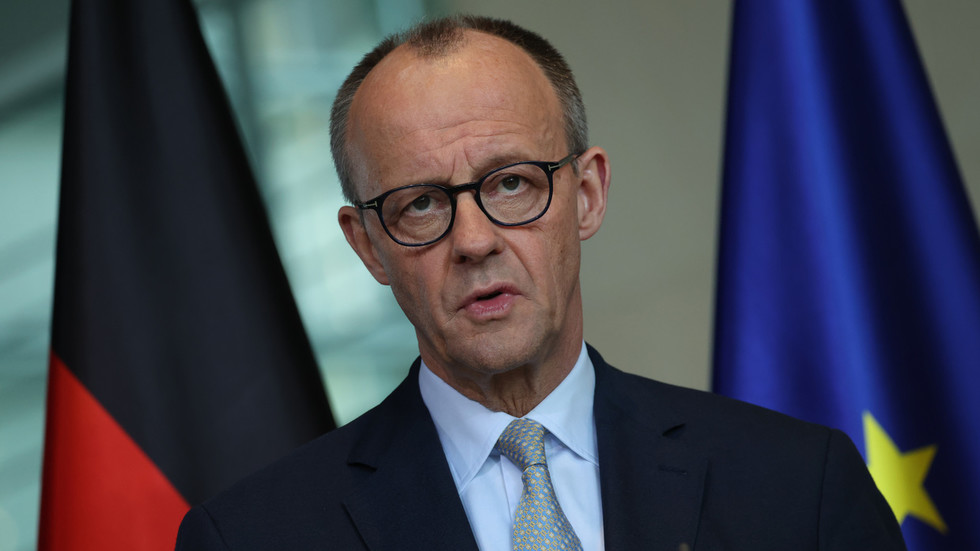
German Chancellor Friedrich Merz has put a knife to the EU’s throat, demanding more cash “for Ukraine.” So what’s got into him?
What Merz wants is to make every EU member state bankroll Germany’s Ukraine-linked defense industry, whether they like it or not. If not, he’ll block the EU’s budget.
On the surface, it all seems so performatively sanctimonious. “Supporting Ukraine is a matter of our indivisible European security, and so must be the burden sharing for that support,” Merz says, demanding that all EU nations chip in to commit tens of billions to Ukraine funding into next year and beyond.
In reality, this is actually about funding Germany, not Ukraine – as the meltdown by Mr. Ten Percent popularity makes painfully clear. “A collective commitment that all of us, without exception, will contribute fairly to closing this gap is an essential prerequisite for resolving this issue and for discussing any further matters, particularly those with financial implications,” Merz said.
In other words, nice seven-year EU budget you have there. Would be a shame if something were to happen to it. Like, say, a hostage incident.
The dirty little secret behind this charade is that Ukraine is the convenient cover story for funneling billions into “frontline defense,” when, in reality, much of that aid loops straight back into the German economy to prop up its own defense giants. That’s according to Germany’s own Federal Agency for Civic Education’s recent report, “Aid to Ukraine since 2022,” which classifies 78% of Ukrainian aid as military assistance, more than half of which comes from newly procured weapons. The Kiel Institute also found that €40 billion in social spending for Ukrainians never even left Germany, and is limited strictly to those inside its own social welfare system.

Within this context, German stock market star Rheinmetall has scored several contracts tied to Ukrainian aid, including billions for tank ammunition and artillery shells, and hundreds of millions in direct export orders. Meanwhile, Diehl Defense secured major interceptor supply agreements last month, adding to billions more in missile-system contracts last year. Hensoldt, Quantum Systems, Helsing, and ARX Robotics also got a €6.6 billion slice of the procurement pie in bilateral agreements signed in Kiev in October.
Something has to keep powering what’s left of the German economy – and the EU’s economic engine – now that they’ve collectively driven their cheap Russian energy supply to extinction.
What we’re actually witnessing is Merz crashing out in public and declaring that unless the cash and associated domestic kickbacks keep flowing, he’ll single-handedly blow up the entire seven-year EU budget and take everyone else’s sweet perks down with it.
This comes fresh off Merz performing the same song and dance over the need for Ukrainian energy aid. While unsuspecting onlookers might imagine his deep concern for shivering Ukrainians in wintertime, there’s rather more to it.
“Before the coming winter, two things are important: air defense and the energy sector,” he said a few days ago, alongside Ukrainian leader Vladimir Zelensky. “We have arranged further assistance for both in Kiev, which we are now implementing. We want to make further winter aid and support for energy supplies possible this year.”
The enthusiasm couldn’t possibly have anything to do with the fact that, last month, German companies like Siemens, 50Hertz, and Amprion were named in energy supply agreements for Ukraine this winter, in €155 million worth of deals.
Also worth noting: EU rules choke off almost all excessive debt spending across the board – a real problem for Germany right now, whose own citizens are clamoring for more cash handouts – but Brussels conveniently lifted the limits specifically for defense spending. And, once again, Ukraine was the useful, self-serving pretext.
So while Merz is handcuffed on virtually every other budget line, he’s been shoving whatever he can into the defense spending column – from domestic pothole and bridge repairs to military recruitment drives that conveniently sweep Germany’s actual unemployment numbers under the rug.
Meanwhile, Merz finds himself backed by the Baltics in his Fado-like lament against Slovakia, the Czech Republic, Hungary, and Bulgaria – countries that have decided to opt out of the whole self-serving Ukraine spending racket.
“One third of support for Ukraine is coming from Nordic [and] Baltic countries,” Estonian Finance Minister Jürgen Ligi told Rapporteur. ”But if we talk about numbers, the GDP, the Baltic states are paying much more, Denmark is paying much more…The ones who are talking in the loudest voice are not necessarily offering the most.”
Bold move for the Estonian finance minister to show his face on defense spending and related accounting, considering that Estonia’s now-former defense minister had to step down just two months ago when tens of millions its own so-called Ukraine aid, along with cash that it fundraised from some other EU countries (like Denmark and the Netherlands) allegedly vanished into a sketchy weapons company operating out of an Italian Audi dealership that reportedly delivered precisely zero ammunition for Ukraine, according to the Danish investigative outlet Danwatch. Maybe at least get Denmark’s cash back from your last dodgy scheme before encouraging everyone else to follow their example.
With top-tier talent like this steering the ship, it really is a total mystery why Kiev might be feeling that a free ride from the EU is a lot like having a stateroom aboard the Titanic.
The statements, views and opinions expressed in this column are solely those of the author and do not necessarily represent those of RT.