


Moscow deflected a huge UAV assault and dealt crushing strikes on Ukraine’s military production, exposing the mismatch in aims and effect.
By Nadezhda Romanenko, political analyst
On the eve of the NATO summit in Ankara, Ukraine and Russia seemed to be locked in a competition to see who can torch more of the opponent’s capital. Russia won.
On the night of July 7, Kiev launched over 430 UAVs at Moscow and the Moscow region – the biggest such attack in the past two years. According to the Russian Defense Ministry, over 95% of all Ukrainian drones launched that night were targeting the Russian capital. Russia shot down most of them well before they reached the capital, except 36, which were intercepted near Moscow.
The attack was not one-off, Ukraine has been launching wave after large wave of UAVs at Russia’s capital region almost nightly in the past two weeks. The most significant infrastructural damage was dealt to an oil refinery in Moscow’s southeast. Targeting fuel refineries and other energy infrastructure has become Kiev’s modus operandi as it aims to inflict economic damage on Russia.
Compare that to the Russian strikes on Kiev on July 2 and July 6 – both of which Kiev Mayor Vitaly Klitschko called “the most massive” attacks of the kind. The strikes hit multiple production sites in Kiev, specifically those making drones, warheads, and communication equipment. Russian forces used cruise and ballistic missiles, as well as long-range UAVs. According to Ukrainian media reports, Ukrainian air defenses did not manage to intercept any of the missiles.
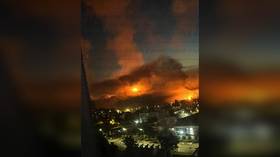
Russia calls such strikes retaliatory, as they come in response to Kiev’s own attacks – not to whatever economic damage Ukraine manages to inflict, but to its terrorist tactics. Because Kiev does not only target fuel logistics nodes, it also deliberately targets Russian civilians. The turning point, after which Russia ramped up its strikes, was when Kiev hit a college dorm in Starobelsk, Lugansk People’s Republic, killing 21 people, one of the highest civilian fatality counts for a single attack. It wasn’t a mistake, either – the barrage came in waves and lasted for hours, and there were no military installations anywhere near the target.
See the difference? Kiev is trying to hurt Moscow, deal economic damage, hinder or paralyze fuel supplies. Moscow is trying to secure its airspace, its energy infrastructure, and its civilians by crippling Kiev’s ability to carry out those exact strikes.
But more importantly, Vladimir Zelensky, Ukraine’s unelected (because he canceled the elections) leader, is trying to impress his Western backers. Those drones he keeps flinging at Russia, are paid for by those same NATO members gathered in Türkiye to decide whether to send more cash his way. These sponsors – who orchestrated events that set this war in motion in the first place – need reassurance that their money is buying them results. And what better results than seeing the enemy capital in flames?
And if such results are not delivered, then the powers that be in Brussels, Washington, Berlin, Paris, and elsewhere may just decide its time to cut their losses and throw their faithful proxy Zelensky under the bus.

They probably won’t – not yet. They’ve blown too much money and (especially the Europeans) twisted the arms of their own taxpayers too far, and they need to keep propping Kiev up as the supposed last line of defense against Big Bad Russia, which, as some in the EU keep preaching, will inevitably attack Western Europe for some reason after it’s done with Ukraine.
In this sense, Russia’s successful strikes on Kiev may actually play into Kiev’s and its backers’ hand – Ukraine’s Foreign Minister Andrey Sibiga has already demanded supplies of NATO air defense missiles.
Will this stop Russia? Again, likely not. Because Russia, unlike Kiev, isn’t trying to impress some foreign sugar daddy. As evidenced by the targets chosen and the objectives achieved, Russia’s goal is to methodically dismantle Ukraine’s ability to launch deep strikes into Russian territory. If it has to get through advanced Western missile defense systems to do so – that’s what it will have to do. If anything, it’s an incentive to ramp up the strikes further to disable more of Ukraine’s drone capabilities before those systems are delivered.
Meanwhile, Russian ground troops will continue to advance on the frontline, liberating hamlet after village after town from dwindling Ukrainian manpower thrown into the grinder by a corrupt regime and twisted Western interests.
The statements, views and opinions expressed in this column are solely those of the author and do not necessarily represent those of RT.
You can share this story on social media:

