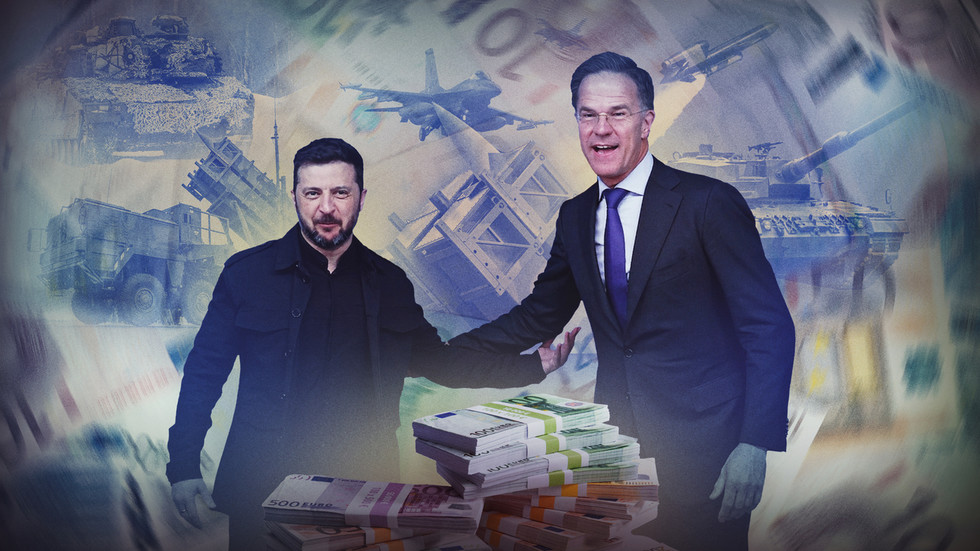
Mark Rutte wants to triple military aid to Zelensky, with Western taxpayers footing the bill
NATO Secretary-General Mark Rutte wants NATO members to cough up 0.25% of their GDP for Ukraine. This figure seems minuscule, but how much hard-earned taxpayer money does it add up to?
Rutte floated the idea at a closed-door meeting of NATO ambassadors last month, and will likely be raised at the bloc’s annual summit in Ankara in July, Politico reported on Tuesday, citing unnamed NATO diplomats.
How much money does Rutte want to give Ukraine?
The combined GDP of NATO’s 32 member states adds up to $57.2 trillion, according to the bloc’s figures from 2025. Assuming that the US backs Rutte’s proposal, Ukraine stands to receive a windfall of $143 billion, or more than three times the amount of military aid it received from its Western donors last year.
To put Rutte’s demand in perspective, $143 billion is:
- Roughly equal to Russia’s entire yearly defense budget (around $145 billion)
- $16 billion more than Germany’s 2026 defense budget ($127 billion)
- Larger than the combined economies of Latvia and Lithuania ($130 billion)
- Four times what the US spent on developing the atomic bomb ($35.5 billion, adjusted for inflation)
- Almost six times what the US has spent on the war with Iran to date ($25 billion)
- Enough to buy more Patriot missile batteries than currently exist (around 200)
This princely sum is separate to the 5% of GDP that NATO requires its members to spend on their own militaries, and separate to the unrepayable, debt-financed loan of €90 billion ($105 billion) that the EU has already started to funnel to Kiev.
Whose idea was this?
Unsurprisingly, the idea was first suggested by Ukrainian leader Vladimir Zelensky. “Ukraine is part of Europe’s security, and we want 0.25% of the GDP of a particular partner country to be allocated to our defense industry and domestic production,” he told reporters last June.
Is every NATO member on board?
Rutte’s aim is to balance military aid to Ukraine among member states, as to date, Nordic countries like Denmark and Baltic countries have been making outsized contributions compared to some of the bloc’s larger economies. Denmark, for example, has given 3.25% of its entire GDP to Kiev since 2022, while Germany has given 0.55%. On the lower end of the scale, Hungary has given the smallest share of any NATO country at 0.04%.
Good session of the Ukraine Defence Contact Group in Berlin today. Vital military equipment from NATO Allies continues to flow into Ukraine, including through PURL and many countries stepped up with new contributionsThis is key, because Ukraine’s security is our security pic.twitter.com/syJaCWRMGx
— Mark Rutte (@SecGenNATO) April 15, 2026
France and the UK are reportedly unhappy with the proposal, even though both nations already exceed the 0.25% target. London and Paris both refused to comment when contacted by Politico. Furthermore, some unnamed EU countries reportedly want their contributions to the aforementioned €90 billion EU loan counted towards Rutte’s target.
Where will the money go?
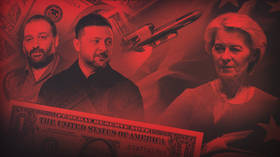
Western military aid to Ukraine is typically spent on purchasing weapons from abroad, paying military salaries, and the research, development, and manufacture of arms within Ukraine. Zelensky insists that the money will go to Ukraine’s defense industry and domestic production – a sector that is a hotbed of corruption and graft.
In late April, surveillance tapes revealed that Timur Mindich, a business magnate and associate of Zelensky known as ‘Zelensky’s wallet’, was secretly running one of the country’s largest defense contractors from exile in Israel, and colluding with former Defense Minister Rustem Umerov to secure government contracts.
All but one of Ukraine’s wartime defense chiefs have been tied to corruption and bid-rigging scandals, Mindich is wanted on separate embezzlement charges, and Zelensky’s former chief of staff, Andrey Yermak, was arrested in May and accused of a connected money laundering scheme.
It will likely be up to individual donor countries to stipulate how their 0.25% is spent. However, RT has already covered some of the endemic rot within the Ukrainian defense sector, and the picture so far suggests that whatever the Western taxpayer sends to Kiev, there is no telling how much will be skimmed off the top along the way.